




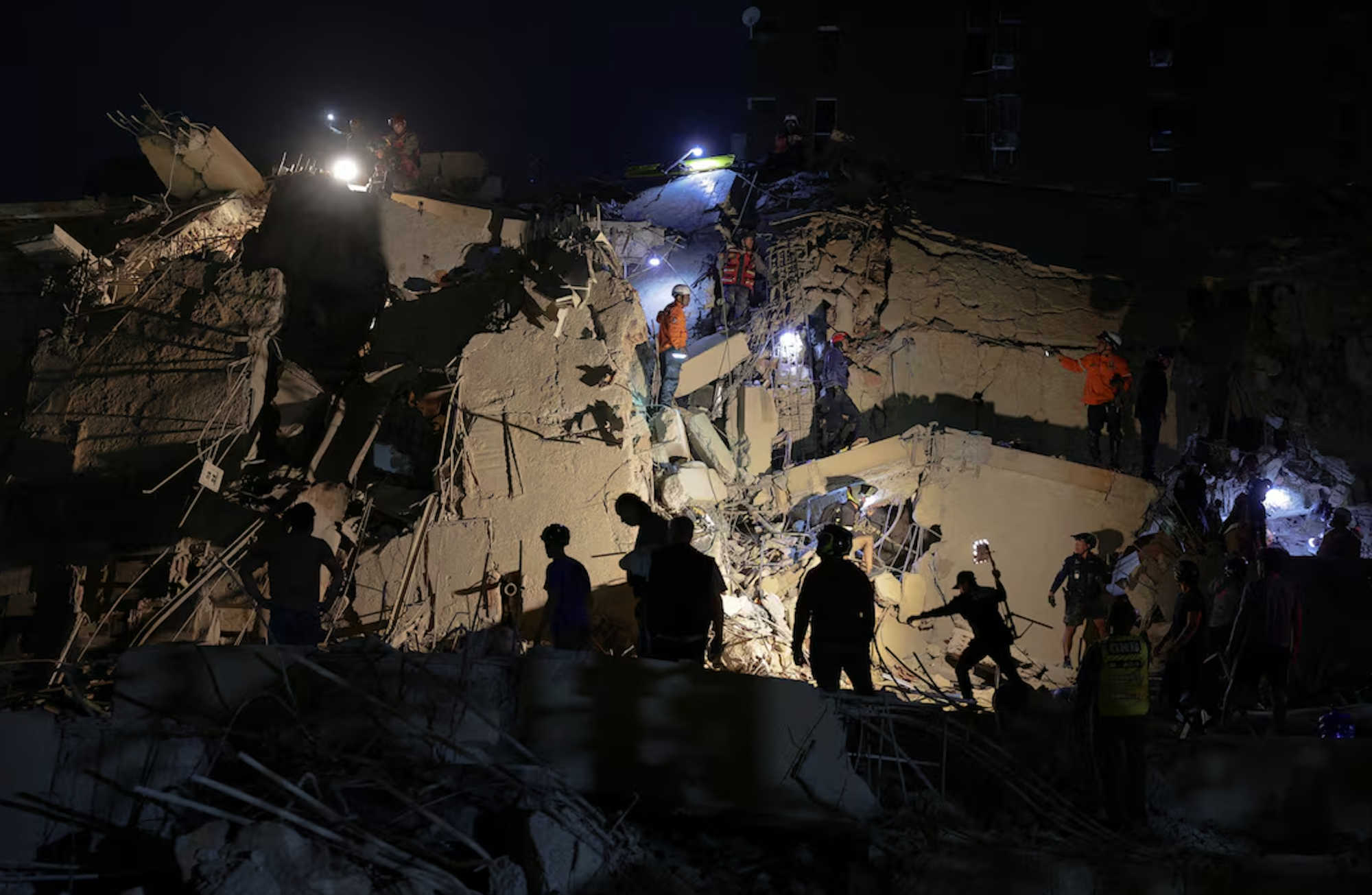
Two major earthquakes struck northern Venezuela Wednesday evening, collapsing buildings in and around Caracas, damaging critical infrastructure, and prompting rescue operations as officials reported at least 32 deaths and hundreds of injuries.
The U.S. Geological Survey listed the back-to-back earthquakes at magnitudes 7.2 and 7.5. The first quake struck shortly after 6 p.m. AST, followed less than a minute later by the stronger 7.5 event near Venezuela’s Caribbean coast. The second earthquake was listed near the coast of Venezuela, with a depth of 10 kilometers, or about 6 miles.
The damage was reported across several states, with Caracas and nearby La Guaira among the areas drawing immediate concern. Buildings collapsed, residents fled into the streets, and emergency crews searched through debris for people believed to be trapped. Parts of the capital also experienced power and cellphone disruptions, while debris and toppled utility poles blocked some streets.
Acting President Delcy Rodríguez declared a state of emergency and said damage had been reported in several states. She also said Simón Bolívar International Airport, the country’s main airport, was damaged severely enough to close, and that classes would be canceled for several days. Some schools were expected to be used as shelters and donation centers.

“We urge our population to remain calm,” Rodríguez said. “We urge unity.”
In the coastal state of Falcón, Gov. Víctor Clark said 32 people had been hospitalized, while 15 people were still trapped more than four hours after the earthquakes. Authorities also called on health care professionals to report to hospitals to assist the injured.
The U.S. Geological Survey’s impact modeling warned that the death toll could rise significantly as rescue teams reached damaged areas and searched collapsed buildings. Early casualty figures did not include some of the hardest-hit areas, according to initial reports.
The earthquakes were felt well beyond Venezuela, including in Colombia and parts of Brazil. In Caracas, residents remained outside for hours after the shaking stopped, with authorities warning that aftershocks could further weaken damaged structures.
The quakes also triggered a brief tsunami advisory for Puerto Rico, the U.S. Virgin Islands and the British Virgin Islands. The advisory warned of possible sea-level fluctuations and strong ocean currents that could affect beaches, harbors, marinas, bays, inlets and coastal waters. In the U.S. Virgin Islands, the earliest estimated arrival time for hazardous sea-level fluctuations and strong currents was listed at approximately 7:19 p.m. AST Wednesday.
Residents in or near the ocean were urged to move out of the water, stay off beaches, and avoid harbors, marinas, bays and inlets while the advisory was in effect. The public was also warned not to go to the shoreline to observe possible tsunami activity.
The advisory was canceled a short time later. In its final tsunami threat message, the Pacific Tsunami Warning Center said the tsunami threat from the earthquake had passed and that there was no further threat. The center said minor sea-level fluctuations could still occur in coastal areas near the earthquake over the next few hours, but no further action was required beyond normal caution near the sea.
As of the latest federal update, there was no tsunami warning, advisory, watch or threat in effect for the region.
The earthquakes struck along a seismically active area where the Caribbean and South American plates meet. While Venezuela has experienced damaging earthquakes before, strong events of this magnitude are uncommon and have raised concern that the death toll and damage assessments could change as emergency crews reach more areas.
International offers of assistance began emerging shortly after the quakes. U.S. officials said they were in contact with Venezuelan authorities and mobilizing assistance, while other governments across the region also expressed support.

For the U.S. Virgin Islands, the local impact remained limited to the short-lived tsunami advisory. The main emergency remained in Venezuela, where officials were still assessing damage, treating the injured, searching collapsed buildings, and urging residents to stay clear of weakened structures as aftershocks remained possible.