

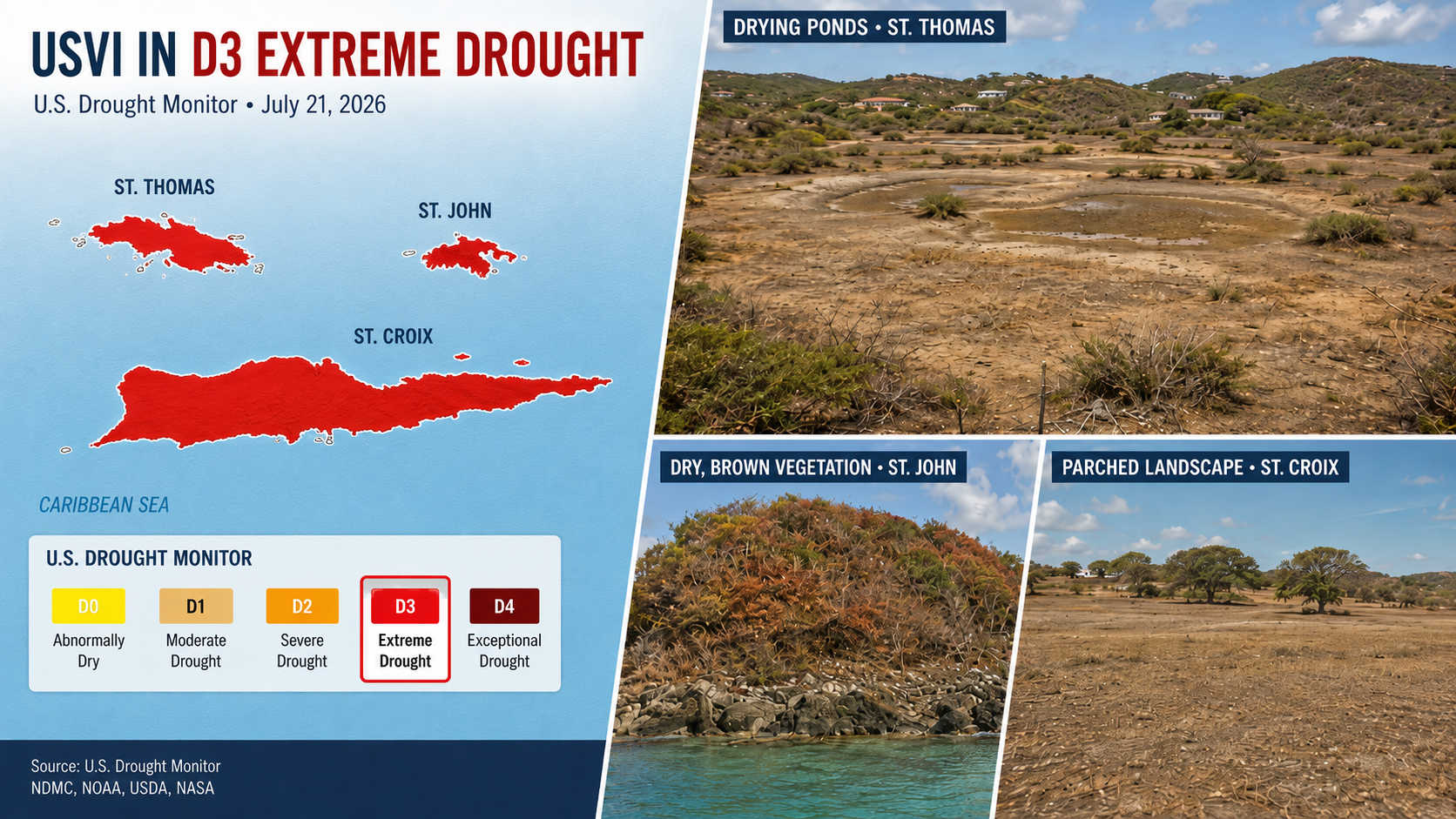
Governor Albert Bryan Jr. announced Monday that he has formally requested a federal disaster declaration for St. Croix, St. Thomas and St. John as extreme drought conditions strain farmers, livestock and the territory’s water supply, prompting WAPA to restrict water-hauling hours and emergency officials to call for immediate conservation.

Bryan said the request was submitted to U.S. Secretary of Agriculture Brooke Rollins. With neighboring Puerto Rico experiencing similar conditions, the governor said he expects a prompt response from federal authorities.
Speaking during a Government House press briefing, Bryan said the prolonged dry spell is placing increasing pressure on agricultural and livestock operations as available water resources become more limited.
The Department of Agriculture has begun preparations to obtain animal feed and additional water for livestock farmers.

Territory at D3 Extreme Drought
V.I. Territorial Emergency Management Agency Director Daryl Jaschen said a recent Drought Information Statement from the National Weather Service in Puerto Rico confirmed that the Virgin Islands has been experiencing “Extreme Drought” conditions since July 14.
The territory’s D3 classification is one level below D4, the most severe drought category.
Jaschen said farmers across all three islands are experiencing “severe drought conditions, moisture shortages, declining pasture conditions, and reduced crop yields.”
He encouraged farmers to photograph and document drought-related losses so federal assistance programs can be activated, including emergency grazing assistance, forage support and other drought-relief resources.
Water Production Nearly Equal to Consumption
The drought has also driven water demand high enough that the territory has little margin between the amount being produced and the amount being consumed.
“We’re currently…generating 3.1 million gallons of water per day for each district” through reverse osmosis, Jaschen said.
“However, we’re also consuming at 3 million gallons per day. So right about now we’re just about even with what we’re generating, what we’re consuming…this is not a good news story.”
The high consumption has contributed to extremely low levels of stored water.
Jaschen said St. John has just over two days of water available in storage tanks, roughly in line with its position at this time last year. St. Thomas and St. Croix, however, have significantly less stored water than they did during the comparable period last year.
Demand from private water haulers has also risen sharply.
“This year, between May and June, St. Croix and St. Thomas water haulers have doubled their draws, and on St. John they’ve tripled their hauls. That tells you what’s happening right now in our territory with the consumption.”
WAPA Restricts Water-Hauling Hours
The V.I. Water and Power Authority has responded by limiting access to its water-hauling standpipes.
Rather than allowing haulers to draw water around the clock, WAPA will make the standpipes available between 9 a.m. and 3 p.m.
The change is intended to prevent heavy hauling demand from negatively affecting water pressure for other customers.
Residents Urged to Conserve Immediately
Jaschen called on Virgin Islanders to begin reducing water use immediately.
Residents are encouraged to keep showers under five minutes and turn off faucets while brushing their teeth or shaving.
Dishwashers and washing machines should only be operated with full loads. Rather than washing dishes beneath continuously running water, residents should use tubs or basins.
Households should also inspect plumbing for leaks and repair them promptly.
“Even small water drips, it all adds up to hundreds of gallons of water,” Jaschen emphasized.
Outdoor conservation measures include reducing how often lawns are watered or suspending lawn watering altogether.
Residents are also being encouraged to wash vehicles less frequently and to use buckets instead of hoses when washing is necessary.
Household wastewater from laundry can be reused for watering plants where appropriate, while patios and other outdoor areas should be swept instead of washed down with a hose.

Jaschen also urged residents to maintain supplies of potable water, capture rainwater whenever it becomes available and keep emergency water supplies for pets and livestock.