


 77°F
77°F


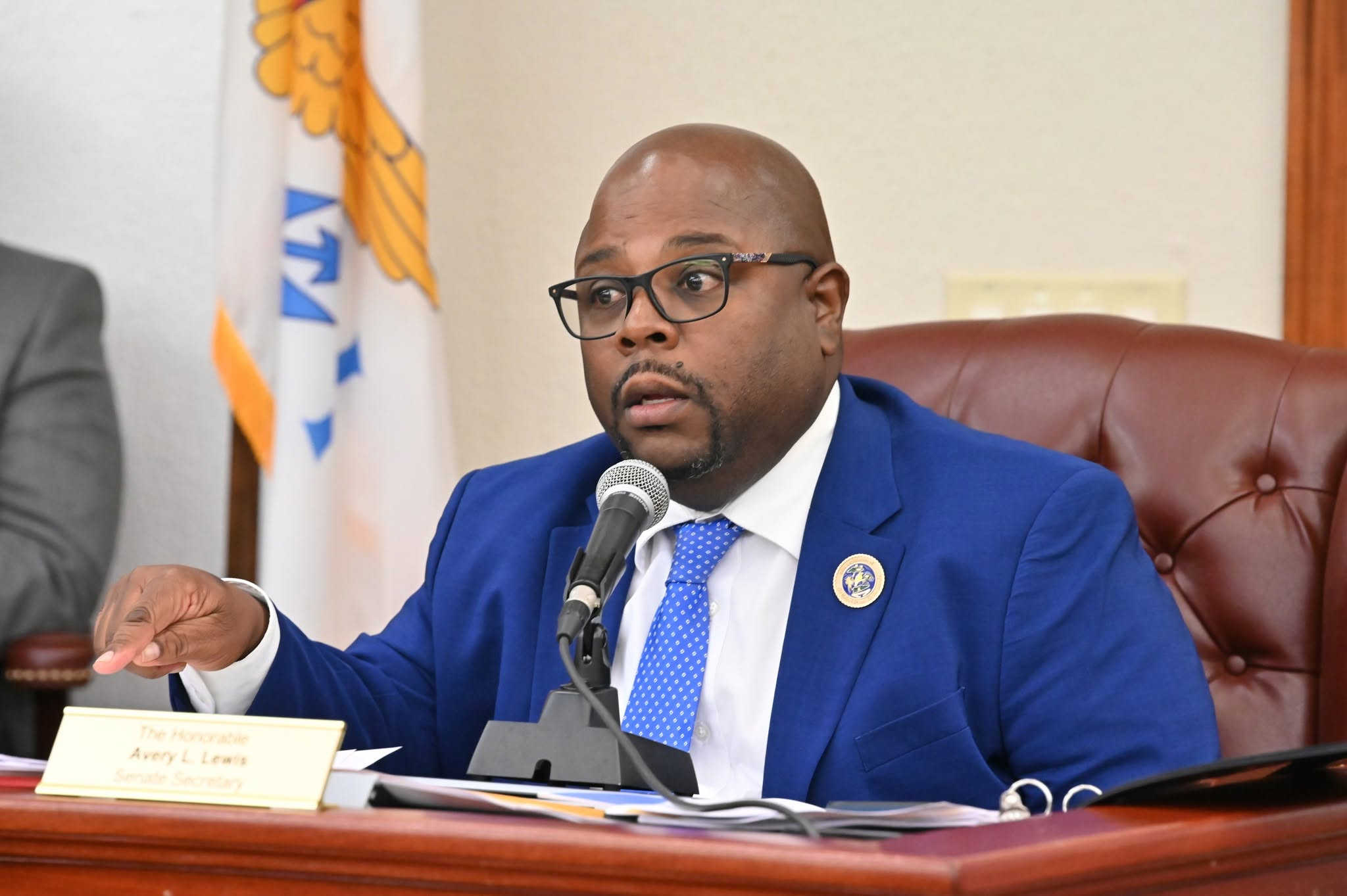
Senator Avery Lewis. Photo Credit: V.I. LEGISLATURE.
Senator Avery Lewis used Wednesday night’s V.I. Consortium Election Cycle interview to make the case that his first term has produced meaningful legislative wins, pointing first to a newly enacted paid-leave law for parents of children with disabilities and a measure tied to the future of the Government Employees’ Retirement System.

At the same time, the interview exposed several unresolved policy areas that remain central to voter concerns, including WAPA, crime, hospital accountability, immediate cost-of-living relief and the nearer-term financial gap facing GERS.
Lewis, who represents the St. Thomas-St. John District, currently serves as secretary of the 36th Legislature, chair of the Committee on Government Operations, Veterans Affairs and Consumer Protection, and vice chair of the Committee on Education and Workforce Development. Asked to name his three strongest accomplishments, and to explain whether they had passed, become law and been implemented, Lewis began with legislation allowing parents of children with disabilities to take paid leave to attend medical appointments.
The law, he said, allows eligible parents in both the public and private sectors to receive up to four hours of paid leave to take a child with a disability to a medical appointment. Lewis said the measure applies to businesses with more than 10 employees and includes notice requirements, with exceptions for urgent appointments. Employees must provide documentation that the appointment occurred, but do not have to disclose the nature of the medical visit.
Lewis described the measure as one of his proudest accomplishments, saying it was shaped by the reality that parents of children with disabilities can spend significant time navigating medical appointments and should not have to choose between work and their child’s care.
He then cited his work on legislation tied to the Westin resort and GERS. Lewis said he pushed for the property, or proceeds from its future sale, to benefit the retirement system once the bonds tied to the deal are paid off.
Under his explanation, after the 30-year bond period ends, the hotel would ultimately benefit GERS rather than revert simply to the central government. If the hotel is sold, Lewis said 75 percent of the proceeds would go to GERS and 25 percent would go to hospitals and healthcare facilities. He also said he intends to bring a future amendment to clarify that if the hotel is not sold, the full asset would revert to GERS.
Lewis framed the measure as an important long-range safeguard for retirees and the wider economy, warning that a collapse of the retirement system would have severe consequences across the Virgin Islands. He acknowledged, however, that the Westin-related provision does not solve the nearer-term GERS funding gap, which he described as a work in progress.
The Consortium previously reported that GERS has received $112.2 million less than expected from rum cover-over revenues pledged under the Indenture of Trust, after receiving more than $90 million less than anticipated in 2023 and 2024, followed by another $21.7 million shortfall this year. Although Congress approved a permanent increase in the rum cover-over rate to $13.25 per proof gallon beginning at the end of this year, the increase was not made retroactive, leaving the system without the revenue it had expected from prior years.
GERS Administrator Angel Dawson has warned that the system is now counting down toward temporary insolvency between 2033 and 2039. Earlier this year, he told lawmakers that if insolvency arrives, the central government could be forced to inject at least $82 million annually from General Fund revenues to pay full benefits.
The system had attempted to increase the employer contribution rate from 23.5 percent to 26.5 percent, but the Legislature preempted that move by attaching language to the appropriations bill preventing GERS from increasing employee or employer contribution rates without legislative approval.
That context made Lewis’s Westin measure both significant and incomplete. It offers a potential long-term asset strategy for the pension system, but it does not by itself address the nearer-term revenue gap that Dawson has warned could bring the system to temporary insolvency well before the Westin benefit materializes.
Asked whether he had a concrete plan for that more immediate risk, Lewis said he has been communicating with GERS and reviewing issues such as unfunded mandates and alternative retirement structures, but did not present a completed solution. He said he would not sit by and allow the system to fail, but the exchange underscored that his strongest GERS accomplishment is long-term in nature, while the system’s shorter-term pressures remain unresolved.
Lewis also pointed to streetlighting legislation for St. Thomas, saying he pushed funds to address dark areas from the University of the Virgin Islands to Raphune Hill. He said the measure was signed into law but has not yet been fully implemented, and that he has met with WAPA Executive Director Karl Knight about moving it forward. The project, he said, includes money for materials, labor and equipment.
Beyond completed laws, Lewis highlighted several pending or developing initiatives. He said he has legislation before the Budget, Appropriations and Finance Committee to exempt prescription drugs from gross receipts and excise taxes, a measure he argued could help residents who face difficult choices between medication, rent and food. He also cited proposals dealing with elder abuse, financial fraud involving seniors, notaries who encounter suspicious activity, and the possible adoption of private roads that serve multiple households with senior residents and are also heavily used by the public.
Lewis also discussed his proposal for a technical college in the Virgin Islands, which was held in committee for further work. He said the measure remains important because not every student will pursue a traditional four-year college path, and the territory needs stronger training pipelines for plumbers, electricians, nurses, HVAC workers, tradespeople and future entrepreneurs. The bill was held, he said, partly because colleagues wanted stronger language protecting employees during the transition into a new technical-college structure.
Those responses gave Lewis several clear points of strength: he could identify completed laws, explain some pending measures, and connect his legislative agenda to families, retirees, seniors, students and workforce needs.
But the interview also tested whether those accomplishments have translated into measurable relief on the territory’s most difficult problems.
WAPA remained the most persistent pressure point. Lewis defended his campaign position against privatizing the utility, saying local workers inside WAPA deserve the chance to fix the authority. He pointed to hearings, meetings, solar projects, composite poles, prudent replacement work, St. John transmission funding and streetlighting appropriations as signs that progress is being made. But he also acknowledged that the utility remains a major burden, particularly after repeated outages in St. Thomas and St. John.
Pressed on whether residents should receive some of the savings from cheaper energy sources rather than seeing all savings directed to WAPA debt service, Lewis initially said he would need to review the full facts. After additional discussion, he said some relief should reach ratepayers and that he would support legislative action if necessary.
On St. John, where repeated outages have led to public anger over spoiled food, spoiled medicine and poor communication, Lewis said he has been looking for a way to provide relief but has not yet identified a funding source. He said he has spoken with OMB and other officials, and has urged WAPA not to disconnect customers until the authority can prove it is providing stable, efficient power.
The interview also turned to crime, following a surge in homicides across the territory. Lewis said he called the governor’s chief of staff to ask what the administration planned to do and raised the possibility of a stronger coordinated law enforcement response involving federal resources. But when pressed on the long-discussed need for cameras across the territory, he said a proposal to add $6 million in cameras did not move forward because the funding source was insufficient and lawmakers were facing competing demands from hospitals.
On healthcare, Lewis defended the Senate’s decision to provide funding to the hospitals, saying lawmakers cannot simply criticize without also helping the institutions remain open. He acknowledged problems with billing, pension remittances and accountability, but argued that years of accumulated problems cannot be fixed only through pressure. He said hospitals have taken steps to pay down obligations and improve systems, while also admitting that collections and internal accountability must improve.
The result was a mixed but defined picture of Lewis’s first term. He was strongest when discussing laws and proposals that were personal, specific and connected to identifiable groups: parents of children with disabilities, retirees, seniors, students and residents who need lower prescription costs. He was less definitive when pressed on the territory’s hardest operational problems — WAPA, crime technology, hospital performance and immediate GERS solvency.

Lewis presented himself as an active first-term senator still building out his legislative agenda. The interview showed that he has accomplishments to point to, but also that some of the territory’s most urgent issues remain beyond the reach of the laws he has passed so far.