


 77°F
77°F


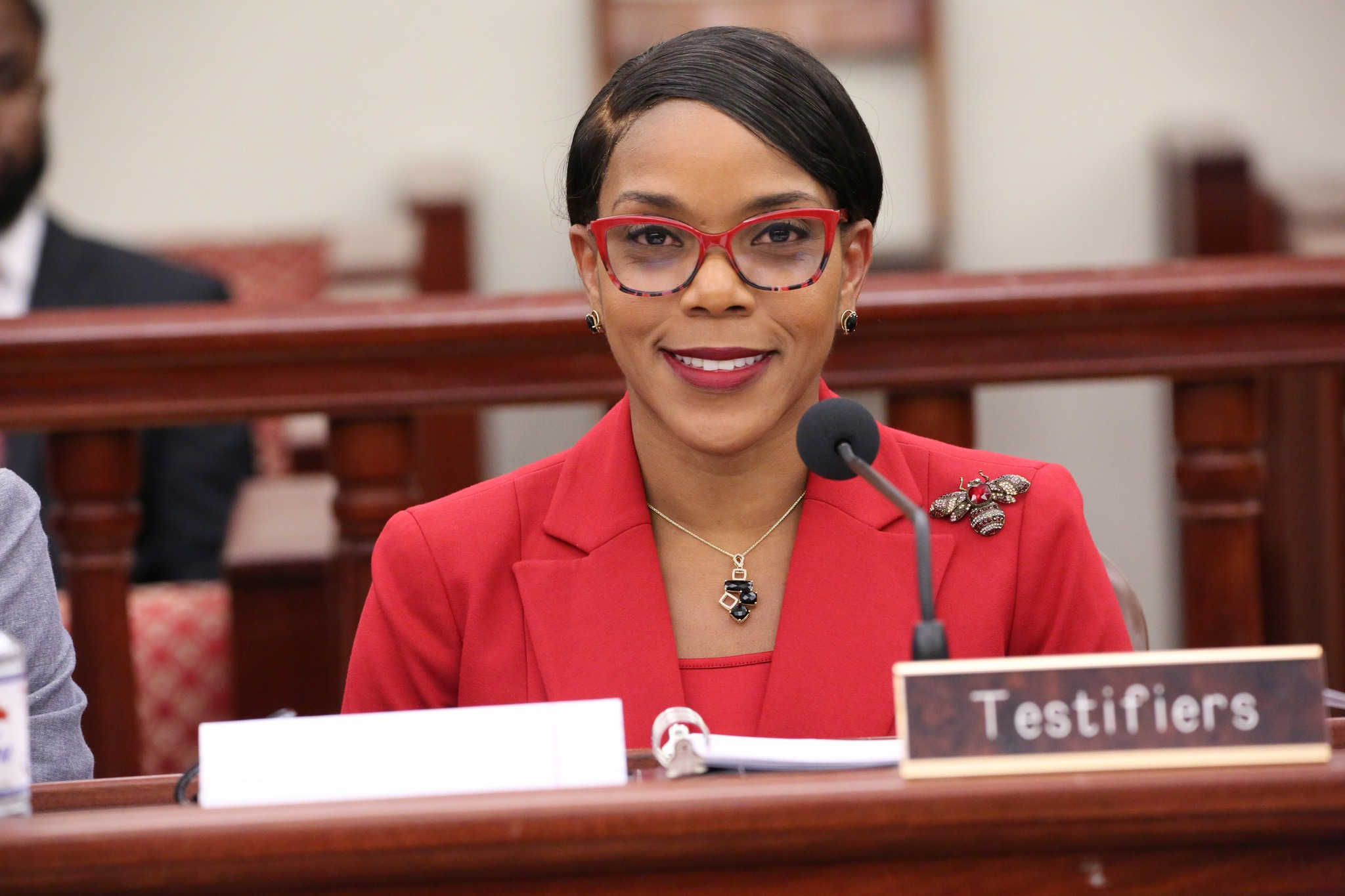
Dayna Clendinen, VIHFA’s chief operating and disaster recovery officer, to whom HUD addressed its suspension notice as lawmakers demanded disclosures and a full Senate review. Photo Credit: V.I. LEGISLATURE.
ST. THOMAS — Legislative scrutiny of the V.I. Housing Finance Authority intensified late Monday as Senator Marvin Blyden demanded a project-by-project accounting of affected federal grants within five business days, while Senators Marise James and Clifford A. Joseph Sr. asked Senate President Milton Potter to convene a Committee of the Whole hearing on HUD’s immediate suspension of the authority.

Mr. Blyden, chairman of the Committee on Housing, Transportation and Telecommunications, said VIHFA should exercise its right to appeal the federal action but must use the 30-day response period to correct the long-standing financial, auditing, procurement and project-delivery failures identified by the U.S. Department of Housing and Urban Development.
Ms. James and Mr. Joseph separately called for an immediate public hearing to establish the scope of the suspension, examine its potential impact on housing and disaster-recovery programs and determine what corrective action is needed to protect federal funding.
The three lawmakers’ actions followed a July 20 notice from HUD Deputy Secretary Andrew Hughes suspending VIHFA from future participation in federal procurement and nonprocurement transactions pending an investigation. The notice was sent to VIHFA Chief Operating and Disaster Recovery Officer Dayna Clendinen.
Mr. Blyden said the tone of HUD’s 13-page letter was unnecessarily accusatory and, at times, bordered on disrespectful. He nevertheless warned that objections to the department’s language could not become a substitute for confronting its findings.
“But we cannot allow our objection to the tone of the letter to blind us to the substance,” Blyden said. “We cannot pretend that these problems are not real, or that the people of the Virgin Islands have not suffered for years because of inaction, weak internal controls and, in some cases, malfeasance.”
HUD’s notice cited legislative oversight hearings chaired by Mr. Blyden during which senators questioned VIHFA officials about inadequate financial controls, insufficient internal auditing, slow spending of federal funds and the failure to complete critical housing and recovery projects.
“These are not new concerns, and they did not originate in Washington,” Blyden said. “We have been raising them right here at home for years.”
Mr. Blyden said VIHFA must do more than file a legal challenge. He urged the authority to make institutional changes during the 30-day appeal period that demonstrate it can protect federal money and deliver projects.
“To put it politely, VIHFA needs to put its sugar in one bag,” he said. “It must strengthen its financial safeguards, improve internal auditing, establish real accountability and finally put federal and local funds to work for the people they were intended to serve.”
In a separate letter to Ms. Clendinen, Mr. Blyden said the Legislature and the public need a detailed explanation of what HUD’s action does and does not affect.
He noted that the suspension appears to prohibit VIHFA from taking part in future covered federal transactions but does not clearly state that every existing grant, previously obligated award or executed subrecipient agreement has been suspended. He said general descriptions would therefore be insufficient.
Mr. Blyden requested a complete inventory of every active federal grant, cooperative agreement and other award administered by VIHFA. For each, he asked for the federal agency, program and grant number; the original award; the amounts obligated and expended; the undisbursed balance; and the period of performance.
The authority must also state whether it continues to have access to federal payment and drawdown systems and whether HUD or another agency has imposed a payment hold, stop-work order, special condition, termination notice or other restriction.
Mr. Blyden requested a list of every government entity, nonprofit organization, contractor and subrecipient currently receiving or scheduled to receive money through VIHFA. The requested information includes the recipient’s name, the program and activity being funded, the total award, expenditures, remaining balance, agreement status and expiration date, and whether continued work or reimbursement has been affected.
VIHFA was also asked to identify every project approved before July 20 for which a grant agreement, subrecipient agreement, contract, obligation or notice to proceed had not been fully executed.
The authority must separately identify projects that will require an amendment, additional obligation, funding increase, new contract, renewal, extension or other future transaction while the suspension is in effect. Impact on Housing and Recovery Programs Sought
Mr. Blyden asked VIHFA to explain specifically how the suspension could affect homeowners, renters, first-time homebuyers, low-income families, seniors, veterans, people with disabilities and people experiencing or at risk of homelessness.
He also requested a program-by-program assessment covering Community Development Block Grant Disaster Recovery and mitigation funding, electrical-grid recovery, HOME, CDBG, Emergency Solutions Grants, HOME-ARP, Continuum of Care and other federally supported programs administered or coordinated by the authority.
VIHFA must provide copies of communications from HUD or other federal agencies interpreting the scope, implementation or practical consequences of the suspension.
Mr. Blyden also asked the authority to describe any exceptions, waivers, administrative agreements or other measures it plans to pursue so critical existing and pending projects can continue while its appeal is considered.
The final portion of the request seeks a detailed corrective-action schedule covering financial safeguards, internal auditing, procurement, fraud prevention, subrecipient monitoring, expenditure rates and project delivery.
The information is due electronically within five business days of VIHFA’s receipt of the letter. Mr. Blyden said the committee may call a public briefing or oversight hearing after reviewing the response because the matter affects critical services and approximately $2 billion in federal resources.
Mr. Blyden said that although parts of HUD’s notice were written in unusually strong terms, VIHFA must focus on the substantive findings and alleged deficiencies.
He said concerns about weak controls, inadequate auditing, slow expenditures and the failure to deliver urgently needed housing had repeatedly surfaced during local oversight hearings.
The authority’s appeal, he said, must be supported by more than legal arguments and should include credible evidence that immediate changes are being made to safeguard federal funds and produce results.
Mr. Blyden pointed to approximately $4 million in locally appropriated funding for the First-Time Homebuyer Program that VIHFA failed to spend. The governor and Legislature subsequently agreed to redirect the money to the V.I. Economic Development Authority for other homeownership initiatives.
He also highlighted HUD’s finding that programs intended to produce 329 single-family and multifamily housing units had not completed a single home, even as a substantial portion of available administrative funding had been spent.
“That is simply unacceptable,” Blyden said. “Families cannot live in plans, reports or administrative budgets. They need homes.”
Mr. Blyden said he was prepared to work with Gov. Albert Bryan Jr., VIHFA and federal officials to restore access to funding serving homeowners, renters, low-income families, seniors, veterans and people experiencing or facing homelessness.
“But objecting to the tone in Washington and fighting for restoration of federal funding cannot mean ignoring what is wrong here at home,” he said. “The VIHFA Board and executive leadership must take drastic and immediate steps to fix the Housing Finance Authority. We must demand accountability from HUD, but we must first demand it from ourselves.”
Mr. Blyden said he would continue holding oversight hearings with VIHFA before the conclusion of the Legislature’s budget hearings so senators can consider appropriate fiscal and structural reforms.
His information request was copied to Mr. Bryan; VIHFA Board Chairman J.P. Oriol; Interim Executive Director Valdez Shelford; all senators; and the media.
James and Joseph Seek Committee of the Whole
Ms. James and Mr. Joseph formally requested that Mr. Potter convene a Committee of the Whole hearing as soon as possible to examine HUD’s action and provide the Legislature and the public with a complete account of the circumstances surrounding the suspension.
They said the potential interruption of federal housing assistance required immediate legislative attention, even as additional information was still being gathered.
HUD’s action is based on allegations of years of financial mismanagement, audit findings and the conviction of a former VIHFA executive in a disaster-recovery contracting scheme. The senators said that, if accurate, the allegations raise broader questions about the territory’s ability to administer federal housing and recovery programs responsibly.
Ms. James chairs the Committee on Disaster Recovery, Infrastructure and Planning and is a member of the Committee on Housing, Transportation and Telecommunications. Her office said the issue extends beyond one agency because it concerns federal confidence in the territory’s management of public money and the possible consequences for thousands of residents who depend on federally funded housing and recovery programs.
“The Virgin Islands has received billions of dollars in federal disaster recovery funding following Hurricanes Irma and Maria. These funds were entrusted to rebuild our homes, restore our communities, strengthen our infrastructure, and improve the quality of life for our residents. Any action that jeopardizes our ability to receive or administer those funds demands the highest level of attention by the Legislature,” said Senator Joseph.
The senators said a Committee of the Whole hearing would allow lawmakers to establish the facts, determine whether corrective action is necessary and demonstrate to federal officials and the public that the territory is committed to responsible stewardship of taxpayer resources.
They urged their colleagues to support the hearing, arguing that resources intended to rebuild the territory should not be placed at risk because of failures in governance or oversight.