

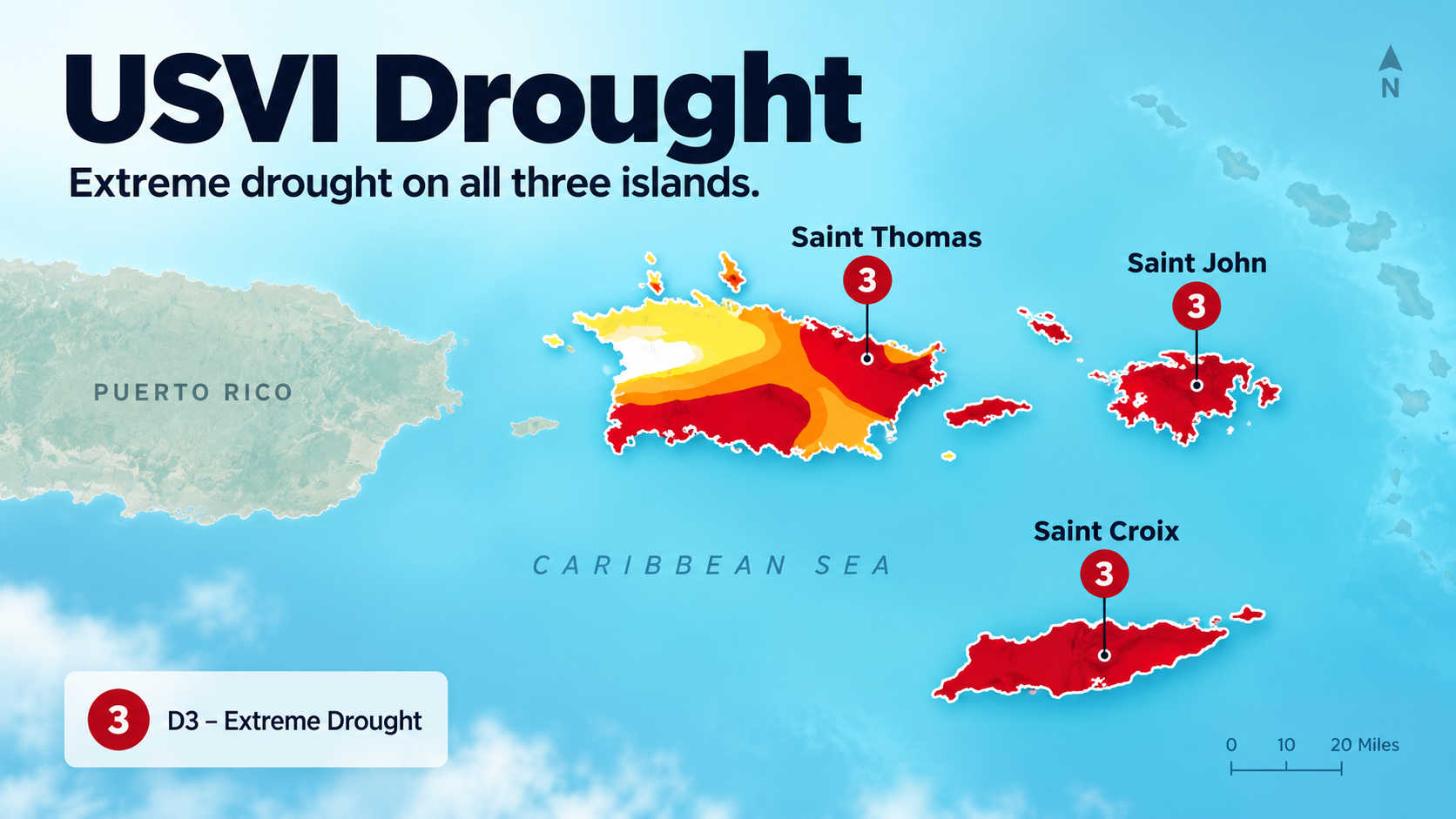
Extreme drought gripping St. Croix, St. Thomas and St. John is now more likely to persist than substantially improve through the end of the year, according to a new federal seasonal outlook that says September’s increase in rainfall has not been enough to pull the territory out of its months-long drought.

The National Oceanic and Atmospheric Administration’s Climate Prediction Center, in its Seasonal Drought Outlook released Thursday, said all three Virgin Islands have been “mired in extreme drought” for several months. Although rainfall has increased somewhat during September, forecasters said the amounts have been insufficient to break the D3 classification. D3 is one level below D4, the most severe category on the U.S. Drought Monitor scale.
The outlook extends through the end of December and identifies continued low tropical activity in the Atlantic Basin as a key obstacle to meaningful relief. With the relatively quiet season expected to continue, NOAA said there is a reduced chance of a tropical system delivering the kind of widespread, sustained rainfall capable of significantly changing drought conditions across the territory.
“As a result, drought persistence seems more likely than improvement,” the Climate Prediction Center said, while emphasizing that forecast confidence for the Virgin Islands remains low.

That qualification is important: NOAA is not saying significant rain cannot occur between now and December. Rather, based on current conditions and seasonal signals, forecasters see continued drought as the more probable outcome. The Seasonal Drought Outlook used U.S. Drought Monitor conditions valid September 15 as its starting point and incorporates short-, medium- and seasonal-range precipitation forecasts.
The Virgin Islands stands out in NOAA’s broader year-end outlook. Across large portions of the mainland United States, drought improvement or removal is expected as fall progresses, aided in some regions by heavier September rainfall and in others by precipitation patterns associated with El Niño. Puerto Rico and the Virgin Islands are among the areas where NOAA instead expects drought to persist or potentially worsen because unusually low Atlantic tropical activity is forecast to continue.
The new forecast comes just two weeks after rainfall associated with the remnants of former Tropical Storm Dolly delivered some of the most significant short-term relief St. Croix had received during the current drought. The Consortium reported September 4 that community gauges around St. Croix measured roughly 1.30 to 1.96 inches during that period, while St. Thomas and portions of St. John received considerably less rain.
But even on St. Croix, where the rainfall was most substantial, federal monitors found that groundwater remained severely depleted. At the Adventure 28 monitoring well, groundwater on September 1 stood 24.64 feet below land surface, compared with 18.38 feet below land surface on the same date a year earlier. The deeper measurement indicated that the water table remained considerably lower despite the recent rainfall.
Thursday’s seasonal assessment confirms that the subsequent increase in September rainfall has still not been sufficient to change the territory’s drought classification. NOAA said drought has been “steadily intensifying” across the Virgin Islands over the past several months, with St. Croix, St. Thomas and St. John remaining at D3.
The prolonged conditions have already produced consequences beyond the federal drought maps. The Consortium reported in July that all three islands had reached Extreme Drought following unusually dry conditions that depleted ponds, stressed vegetation and left some households struggling to maintain cistern supplies. Both Cyril E. King Airport on St. Thomas and Henry E. Rohlsen Airport on St. Croix recorded their driest June on record.
By August, the impacts had become serious enough for Governor Albert Bryan Jr. to request a federal agricultural disaster declaration covering all three islands. At the time, territorial officials reported moisture shortages, deteriorating pasture conditions and reduced crop yields, while the Department of Agriculture began preparing to secure additional animal feed and water for livestock farmers.
The drought has also placed unusual pressure on the territory’s potable-water infrastructure. During the August emergency briefing, officials said WAPA was producing about 3.1 million gallons of potable water per day in each district while consumption was running at approximately 3 million gallons daily, leaving little margin for rebuilding stored supplies. Private water-hauling demand had doubled on St. Croix and St. Thomas and tripled on St. John between May and June, according to VITEMA Director Daryl Jaschen.
Conditions have since improved somewhat on St. Croix’s public water system, although problems remain. The Consortium reported Monday that islandwide potable-water inventory had climbed from approximately 31 percent to 38 percent after WAPA increased production, but some customers in higher-elevation West End communities continued to experience low pressure or intermittent service. WAPA has attributed the system problems to a combination of drought-related production challenges and leaks in the distribution network.
The authority’s boil-water advisory also remained in place as of Monday while WAPA rebuilt storage, worked to stabilize system pressure and continued water-quality testing. Residents were still being asked to conserve water and postpone nonessential uses such as washing vehicles, pressure washing and watering lawns.
The latest NOAA assessment suggests that those pressures cannot yet be viewed as the final stages of the drought. While individual rainfall events can provide temporary relief, ending a prolonged drought generally requires enough sustained precipitation to restore soil moisture, recharge groundwater, replenish cisterns and improve agricultural conditions — changes that have not followed the territory’s September rainfall so far.
The National Weather Service in San Juan similarly reported earlier this month that Extreme Drought continued across the Virgin Islands even after some improvement from recent rainfall.

NOAA’s next Seasonal Drought Outlook is scheduled for October 15.