




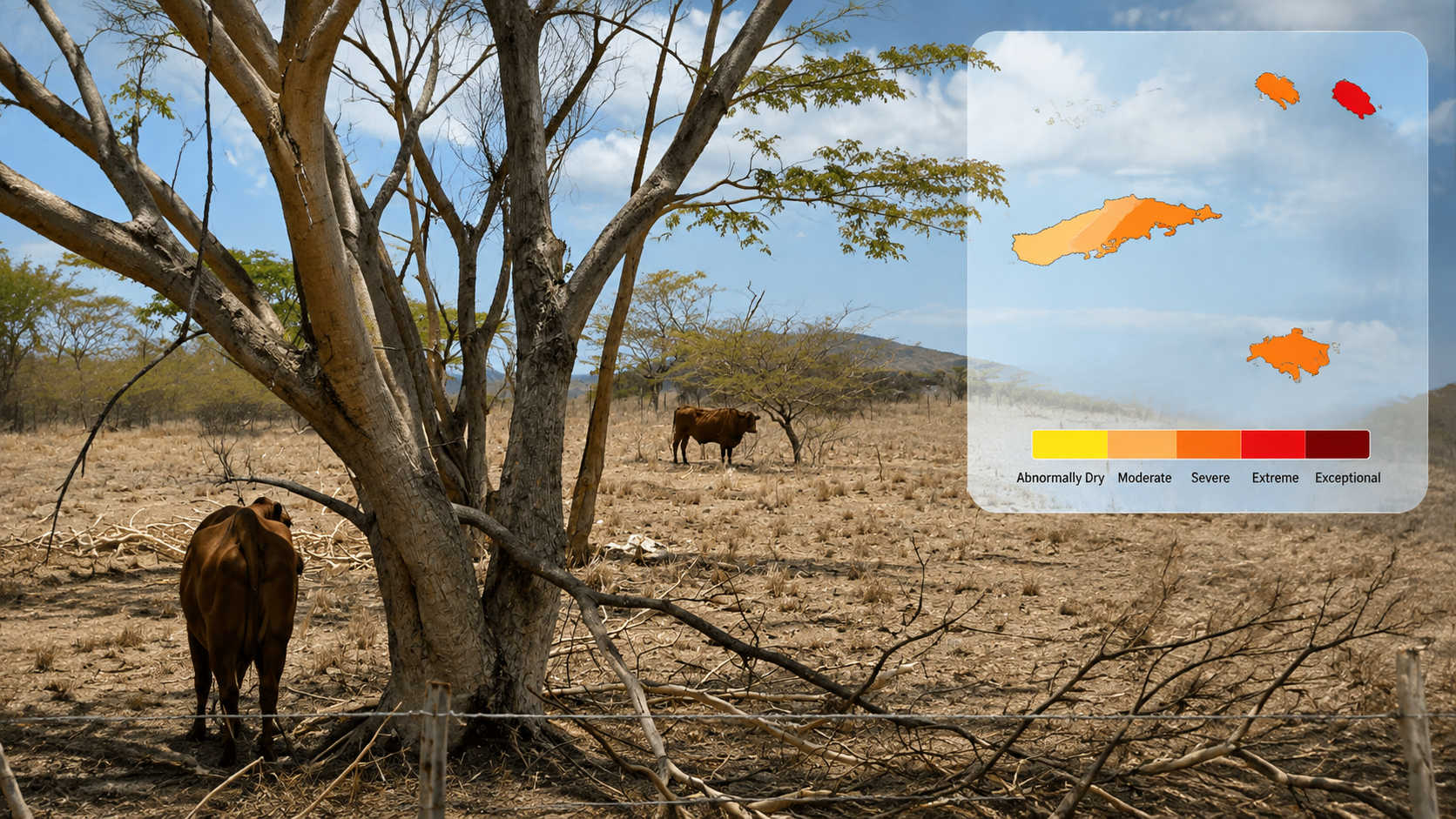
Rain from the remnants of former Tropical Storm Dolly delivered the most substantial precipitation St. Croix has seen during the latest stretch of the territory's drought, but federal monitors say the rainfall has done little so far to replenish severely depleted groundwater supplies, leaving St. Croix, St. Thomas and St. John in Extreme Drought.

The latest U.S. Drought Monitor, released Thursday and based on conditions through Sept. 1, found a stark difference in rainfall among the three islands. St. Croix received moderate and relatively widespread precipitation, while St. Thomas and portions of St. John remained largely dry. Despite the rain, groundwater on all three islands remains considerably lower than at the same point last year.
The National Weather Service in San Juan summarized the situation Thursday by saying Dolly's remnants brought “beneficial rainfall” to St. Croix, but St. Thomas and parts of St. John remained relatively dry. Extreme Drought, classified as D3 on the federal drought scale, continues across the U.S. Virgin Islands.
St. Croix Received the Most Rain, But Groundwater Remains Severely Depleted

St. Croix recorded by far the most widespread rainfall of the three islands during the monitoring period.
Federal observations showed totals ranging from 1.30 inches to 1.96 inches at community weather stations around the island. Frederiksted-area stations recorded 1.92 and 1.96 inches, while several Christiansted-area gauges measured between 1.30 and 1.61 inches. East Hill recorded 1.45 inches.
Those numbers represented meaningful short-term rainfall during a drought that has depleted private cisterns and sharply increased reliance on WAPA's potable-water network.
But underground, the picture remains significantly worse.
At the Adventure 28 monitoring well on St. Croix, groundwater stood 24.64 feet below land surface on Sept. 1, compared with 18.38 feet below the surface on the same date last year. Because a greater depth means the water table has fallen farther underground, the measurement indicates substantially less groundwater availability than a year ago.
The Drought Monitor therefore kept St. Croix in Extreme Drought despite the week's rainfall, finding that the recent precipitation has not yet produced a meaningful groundwater recovery.
St. Thomas Received Almost No Rain in Some Areas
Conditions were even drier on St. Thomas.
Cyril E. King Airport recorded only 0.01 inches of rainfall during the monitoring period. Other gauges around the island measured between 0.06 and 0.34 inches, indicating that the moisture associated with Dolly largely missed St. Thomas.
Groundwater conditions there also remain poor. The Grade School 3 Well reached 9.88 feet below land surface on Sept. 1, compared with 7.38 feet on Sept. 1, 2025. Federal monitors said groundwater depth at that location has been steadily increasing since April 20, meaning the water table has continued to retreat.
Those conditions were sufficient to keep St. Thomas classified in Extreme Drought.
St. John Also Missed Much of Dolly's Rain
Rainfall was similarly uneven on St. John.
A monitoring station at Windswept Beach recorded 0.48 inches, while another near Cruz Bay recorded only 0.03 inches, according to the Drought Monitor. Federal officials said there was no evidence of substantial, widespread rainfall across the island.
At the Susannaberg DPW 3 Well, groundwater was measured 18.50 feet below land surface on Sept. 1, compared with 12.67 feet on the same date in 2025.
The latest measurement was also deeper than the previous week's reading, indicating that St. John's groundwater situation continued to deteriorate despite the passing tropical moisture. The island remains in Extreme Drought.
Drought Has Already Placed Heavy Pressure on St. Croix's Water
The latest federal findings come as St. Croix continues dealing with water-system problems that WAPA has repeatedly linked in part to the prolonged drought.
WAPA said in late August that what would ordinarily be a wetter period during hurricane season had instead become an extended dry season. As household cisterns emptied, more residents turned to the public potable-water system, driving demand higher at the same time the Authority was attempting to move greater volumes of water through an aging distribution network.
The strain has contributed to low pressure, intermittent service and outages, particularly in western St. Croix. WAPA said Seven Seas Water Group increased reverse-osmosis production during the drought, but the central challenge has been getting enough water through the distribution network quickly enough to meet demand without producing additional pipe breaks and leaks.
That already difficult situation was compounded late last month when WAPA temporarily suspended water production at Richmond because a wastewater overflow affected the coastline near its seawater intake. Production has since resumed, but WAPA continues rebuilding stored water inventory and carefully controlling pressure to avoid additional breaks in the system.
As of Thursday, WAPA said water inventories were gradually improving, with small gains at several storage tanks, but the Authority was still asking customers to conserve. The St. Croix boil-water advisory also remained in effect.
Federal Disaster Designation Remains in Place for All Three Islands
The continued D3 classification also carries consequences beyond household water supplies.
The U.S. Department of Agriculture has designated St. Croix, St. Thomas and St. John as primary natural disaster areas because of the drought, opening access to federal emergency loans for eligible farmers and agricultural producers.
The designation was approved after Governor Albert Bryan requested federal assistance amid mounting impacts on the territory's agricultural sector, particularly livestock producers. USDA said all three islands met federal drought thresholds necessary for the designation.
Emergency loans can be used for recovery needs including replacement of livestock or equipment, reorganization of farming operations and refinancing certain debts. The application deadline is April 23, 2027.
The latest drought figures demonstrate why several days of tropical rainfall do not necessarily end a prolonged drought. While St. Croix received enough rain to provide visible short-term relief and potentially replenish some cistern supplies, groundwater accumulation occurs more slowly and reflects rainfall conditions over a much longer period.
For now, federal monitors say the territory has not reached that point. St. Croix's groundwater remains severely depleted despite its recent rainfall; St. Thomas saw little benefit from Dolly; and St. John's groundwater remains both well below last year's level and lower than it was just a week earlier.