
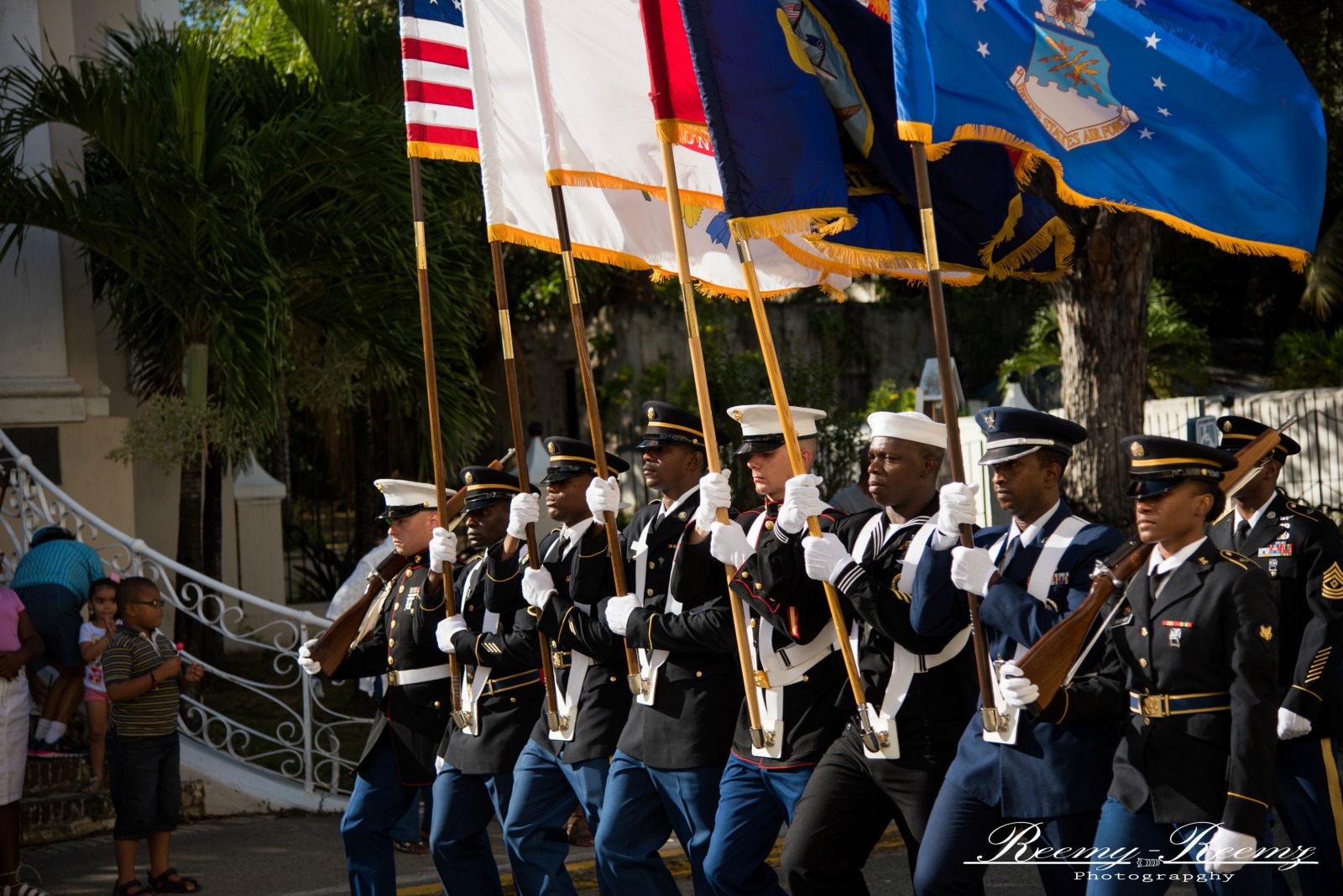
Transfer Day, recognized each year on March 31 and marks the day in 1917 that the sale of the Danish West Indies (U.S. Virgin Islands) to the United States was formalized, came with acknowledgements this year but no official ceremonies to commemorate the occasion.

The Danish West Indies islands were purchased from Denmark by the U.S. for $25 million in gold. The 1917 ceremony took place on the Charlotte Amalie Waterfront on the grounds of the Capitol Building. This year marked the 105th year of the transformative day, which forever changed the course of history for the territory and its people.
Governor Albert Bryan, who traveled out of the territory Thursday to support USVI basketball star Aliyah Boston, issued a statement. “As we go through this transformative time of rebuilding the U.S. Virgin Islands and head into a brighter future for all Virgin Islanders, I want to remind everyone of our history as a Territory and how far we as a people have come since Denmark sold our islands to the United States. Let us never forget our roots and resilience as we continue on this path of recovery and restoring our Territory toward the better standard of living all residents of the USVI deserve.”
A statement from the 34th Legislature reads, "Members of the 34th Legislature remind Virgin Islanders of the historical significance of Transfer Day as we celebrate 105 years under the American Flag. In January 1917, the United States agreed to purchase the Virgin Islands from a financially strapped Denmark for $25 million in gold coin, At 4:00 p.m. on March 31, 1917, Denmark formally ceded St. Croix, St. John and St. Thomas to the United States of America. The Danish Flag was lowered for the final time and the United States Flag was raised thereafter signaling the emergence of the Virgin Islands of the United States.

"As Virgin Islanders we must never forget our rich history, stated Senate President Donna A. Frett- Gregory. As we observe Transfer Day, let us be reminded of the opportunities that exist and seek to embrace them to ensure a better Virgin Islands for all."
While the Legislature held special programming on Channel 26 related to Transfer Day, the important occasion has been traditionally marked with in-person events with guest speakers.
One of the most significant Transfer Day events was in 2017, when the territory commemorated the centennial event, or 100 years of U.S. rule. Then-Danish Prime Minister Lars Løkke Rasmussen visited the USVI and provided remarks. Rasmussen delivered a speech that fully accepted responsibility for actions of his ancestors, making no excuses for the horrors so many faced. He also announced a five-year scholarship program to benefit the territory’s college students.
In announcing the scholarship program, Mr. Rasmussen said about the territory’s youth, “Ladies and gentlemen, this time around we will not hold them back, we will push them forward.”
He was sure during his address to highlight the bravery of legends like Moses “Buddhoe” Gottlieb, known as General Budhoe, the free black man who led the 1848 slave rebellion on St. Croix.
After acknowledging the 100th milestone of U.S. rule of the USVI, Mr. Rasmussen went straight to the core of his speech.
“The preceding years have not been forgotten — neither in Denmark, nor in the Virgin Islands,” he said. He mentioned the town names such as Christiansted and Frederiksted, as well as the design of the town buildings, stating that they served as reminders of how close the USVI and Denmark were nit. He also acknowledged the thousands of Danes who visit the territory annually, and said both he and the people of Denmark feel a special bond with Virgin Islanders.
“But although we share a common past, we have not always shared the same story about that past,” he said. Mr. Rasmussen said when he was a child, there was a popular Danish story about the Danish West Indies that spoke of the USVI as an exotic location with peaceful coexisting. He also mentioned a famous Danish King who had abolished slavery, but said Danish slavery of the USVI continued after it had been abolished, and living conditions only improved on paper.
“The true heroes were the men and women who stood up to the injustice,” Mr. Rasmussen said, later adding, “I suggest we also look somewhere else in our hearts and minds. I suggest we ask ourselves is there any justification for suppression? Any argument for treating people brutally? And we all know the answer; the answer is no. There’s no justification whatsoever for the exploitation of men, women and children that took place in these islands under Danish flags. There’s no justification for slavery. It is unforgivable. And it is a dark and disgraceful part of Danish history. So when I search my heart and my mind, there’s no doubt that the true heroes of the past are the men and women of the Virgin Islands who defied suppression. They were not given their freedom, they took it back.”
Mr. Rasmussen became emotional almost to the point of tears at various points of his address. He continued to praise the pioneers of the uprisings that ultimate led to freedom, including Queen Mary Thomas, Queen Mathilda Macbean and Axeline “Queen Agnes” Salomon, who led a movement that ended with the famous Fireburn.
“We must acknowledge what had happen in the past, and we must acknowledge that what happened in the past has affected where the island is today, because we can’t undo the past, what we can do is to improve the future,” Mr. Rasmussen said.

He said with Denmark now acknowledging the atrocities of the past, and with both sides deciding to embrace the future, “Today the people of Denmark and the people of the Virgin Islands share a common historic path, and today we share the same view of history, and today we share the same heroes. And hopefully we shall also share a bright future.”