

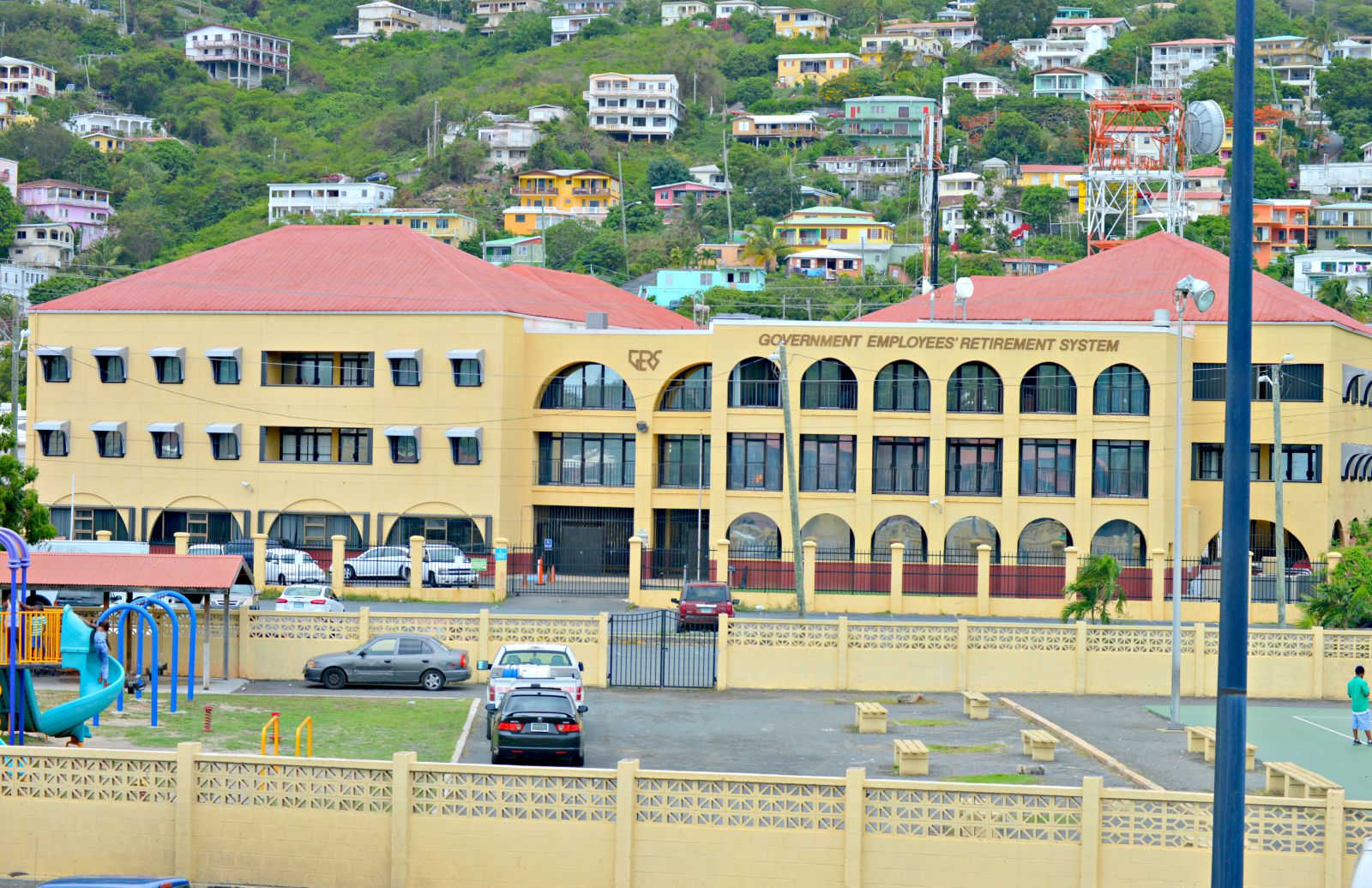
Despite securing a permanent increase in the rum cover-over rate from $10.50 to $13.25, the Government Employees’ Retirement System remains concerned about the possibility of temporary insolvency in the coming years.

GERS Administrator Angel Dawson appeared before the Committee on Budget, Appropriations, and Finance on Wednesday to provide an operational update. While the retirement system does not require legislative budget approval, it offers an annual overview as part of the budget preparation process.
Mr. Dawson described the system’s current status using a medical analogy, saying it has moved from “critical” to “serious” condition. He attributed this improvement “directly” to the historic $3.8 billion funding note spread over 30 years. However, he cautioned that cash flow is uneven because “annual contributions from the funding note are heavily backloaded, with half of the total contributions being funded in the last twelve years – mostly at the expense of the middle years,” between 2033 and 2038.
Bridging that funding gap, he said, will be critical. Without it, GERS could become “temporarily insolvent under two different scenarios.”

The recent increase in the rum cover-over rate could help, but Mr. Dawson noted that it takes effect only after December 31, 2025, and is not retroactive. Adding to his concern, “there is a risk that the actual funding note payouts will be lower than originally anticipated due to lower overall demand in rum consumption.” He said it is unclear how long such a decline could last.
Lawmakers are aware of the consumption issue. Senator Hubert Frederick commented that “tequila seems to be the beverage of choice” but expressed confidence after discussions with the territory’s rum producers that “they're making the adjustments clearly to ensure that they could maximize their sales.”
Senator Carla Joseph struck a more cautious tone, warning, “The main issue that I'm concerned about is that we are not selling” in sufficient quantities. She noted the extensive work that went into securing the cover-over rate increase, calling it a way to “bandage the leak that was happening with the Government Employees’ Retirement System.”
Senator Kurt Vialet expressed optimism that, based on how the cover-over is administered—using estimates that are later “trued up”—“the next set of monies that we receive will be at the $13.25 rate.” Mr. Dawson disagreed, believing that come October, the rate would still be calculated at $10.50 because “since the increase was not approved in the legislation whose name I shall not call, it wasn't approved retroactively,” he said, referring to President Donald Trump.
Taking a cautious approach, GERS has modeled the potential impact of low rum consumption and lower returns on the cover-over rate. Using an “average shortfall of $25 million per year in the original Funding Note payout schedule at the $13.25 rate,” two insolvency scenarios emerged.
In the first, based on the current 23.5% employer contribution rate and the $25 million shortfall, GERS would be “temporarily insolvent from 2033 to 2039” and require “at least $290 million from GVI Fund revenues to pay full benefits.”
In the second, with the planned increase in the employer contribution rate to 26.5% and the same shortfall, GERS would be temporarily insolvent from 2036 to 2038 and need “at least $82 million from GVI General Fund revenues to pay full benefits.”
“You pay us sooner, or you pay us later. You're going to pay us one way or the other. It's usually cheaper if you pay us sooner,” Mr. Dawson told lawmakers.
The 26.5% contribution rate is scheduled to take effect October 1, 2025, the start of the new fiscal year. However, entities such as the Water and Power Authority have already warned of potential difficulties meeting the higher rate and have sought legislative support. According to Mr. Dawson, WAPA owes GERS $23,422,910.74.

GERS projects an additional $13 million in employer contributions based on payroll size. That amount is nearly equal to what the Schneider Regional Medical Center owes the system—$13,955,286.61.