



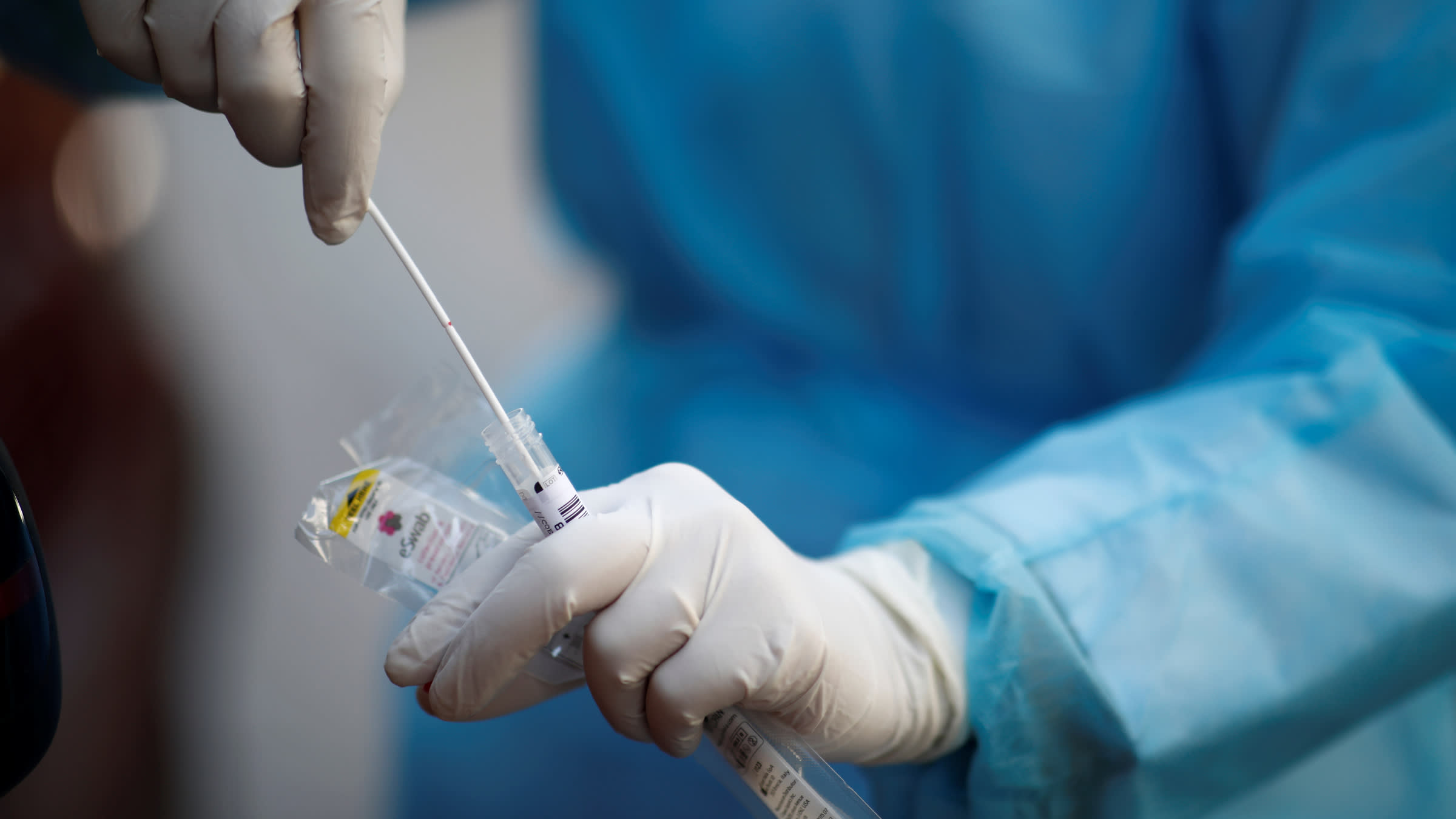
The V.I. Dept. of Health reported in its Wednesday data sheet that 38 people tested positive for Covid-19, bringing the territory's total as of Wednesday to 156.

The breakdown is as follows: 78 on St. Croix, 74 on St. Thomas and 4 on St. John. D.O.H. was investigating the cause of most of the new cases, according to the report. To date, 38,944 tests have been performed, with 2,218 testing positive and 36,641 testing negative.
A reason for the uptick in cases could be the department's push to test more; D.O.H. recently held free, territory-wide pop-up Covid-19 testing events.
The department recently issued a release stating that health officials and the administration were monitoring the new Covid-19 strains. Responding to questions last week from the Consortium relative to the administration's discussions surrounding the new Covid-19 strains, Governor Albert Bryan and Health Commissioner Justa and Encarnacion could only offer guidance.

"The same precautions you take for the current strain of Covid-19, or a variant of Covid-19 that we have right now, is the same precautions that we are going to be asking you to use for any variant that actually comes our way," the commissioner said.
Mr. Bryan said there were a lot of different strains of the virus, which is true. But none of the multiple variants over the course of the pandemic has captured the attention of scientists around the world as the strains first discovered in the United Kingdom in December, and the latest early this month emerging from South Africa — both of which have had far-reaching impacts. The U.K., for example, has gone into lockdown because of a surge in cases led by the new strain, and South Africa has taken similar steps.
The U.K. strain is said to be up to 70 percent more contagious than the more dominant strain, and the South African strain, while it matches the U.K. strain's viral strength, also contains a mutation that is believed to weaken the effectiveness of the current vaccines.
"There is no different tactic in dealing with the alternative variants," Mr. Bryan said. "You just protect yourself the same way and you'll be okay."
He added, "The thing I think that concerns me the most is the weariness of the public, especially our young people... people complaining about us shutting down the nightclubs. This is not a game; this is serious, people are going to die."
The new Covid-19 variant emerging from South Africa, named B.1.351, contains traits similar the strain first reported in the U.K., known as N501 — making the South African variant as viral as its British predecessor. But the South African strain contains another mutation, named E484K, that isn’t present in the U.K. variant.
According to the Wall Street Journal, researchers believe that the E484K mutation has changed the shape of Covid-19's spike protein, which the virus uses to attach to and infect human cells. The E484K mutation, researches believe, makes it harder for some antibodies to neutralize the virus. If the research holds, there could be consequences on how the new strain affects people who were previously infected by the virus and have built immune responses, or those who have taken the Covid-19 vaccines currently available.
Researchers studying the latest strain say E484K's unusually large number of mutations, especially in the spike protein, make the vaccines less effective against the strain, though the vaccines are not expected to be totally worthless. A vaccine that is weaker against the new variant means more vaccine recipients are likely to be infected with the virus a second time, in some cases mildly. And it also means more people will need to be vaccinated to help develop herd immunity and end the pandemic altogether.
The U.K. variant has since spread to many countries, including U.S. states Colorado, California, Florida and New York. Likewise, the South African strain has been reported in Japan, Finland, South Korea, Switzerland, the U.K. and Australia.
The South African variant was first reported amidst a wave of new infections and rising Covid-19 related deaths in the country. But the new strain isn't receiving all the blame for the latest deaths and surge in cases on the continent; thousands of South Africans have been crowding beaches, restaurants and bars, inevitably leading to more infections.

To that end, the government has mandated masks, banned social gatherings and has prohibited the sale of alcohol. Popular beaches and parks have also been closed.