

 77°F
77°F


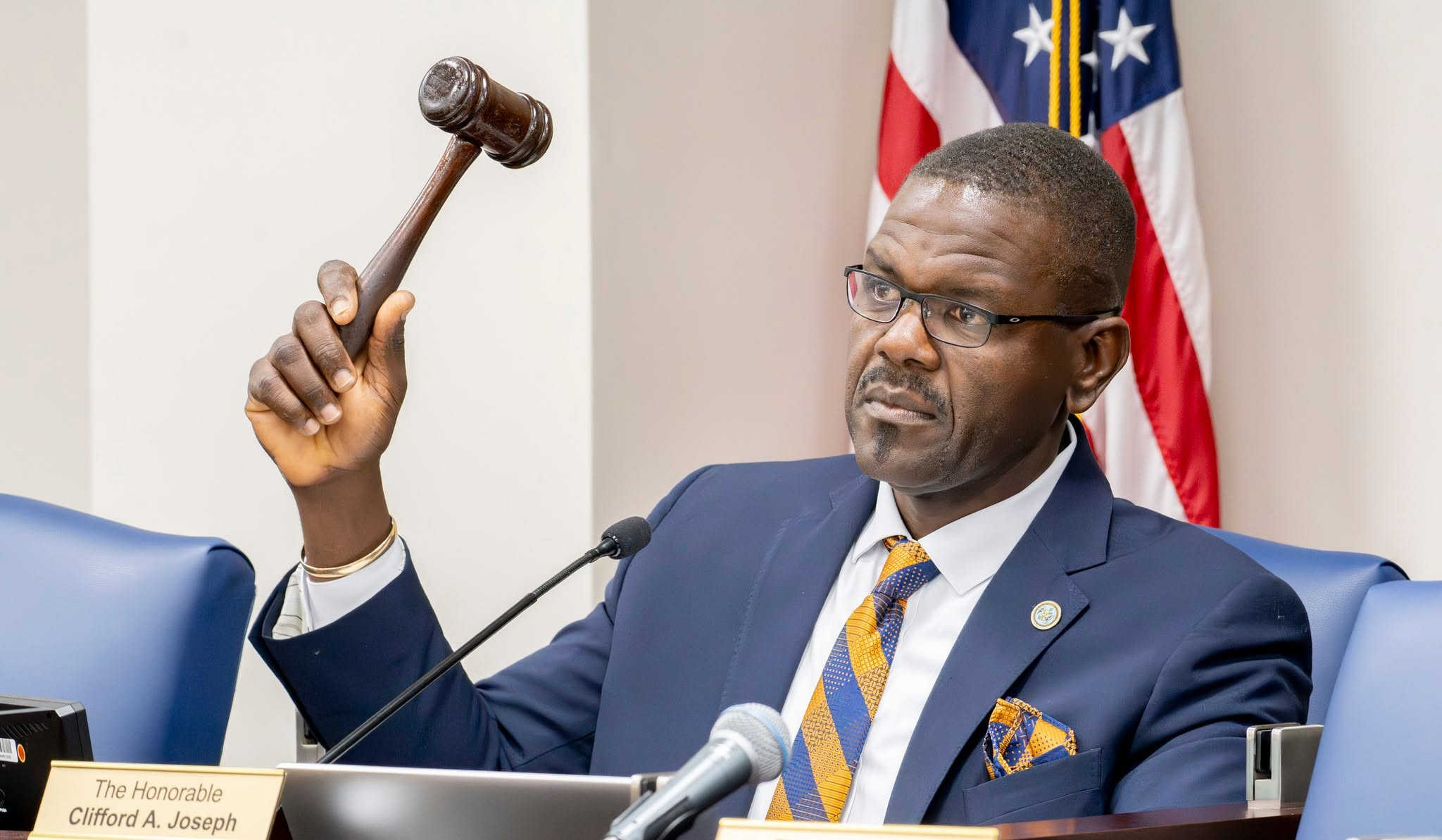
Senator Clifford A. Joseph. Photo Credit: V.I. LEGISLATURE.
Senator Clifford Joseph defended his controversial firearms bill during Monday night’s V.I. Consortium Election Cycle interview, saying the measure was designed in large part to address a licensing issue that had exposed the Government of the Virgin Islands to litigation, while also correcting what he described as inconsistencies in the territory’s gun laws.

The bill, now before Governor Albert Bryan Jr., has drawn sustained criticism from licensed gun owners and Second Amendment advocates, who have questioned whether the measure does more to burden lawful firearm holders than to address the illegal weapons driving much of the territory’s gun violence.
Asked in one sentence what problem the bill was designed to solve, Joseph said it was intended to address problems with the timely processing of firearms licenses that had led to a lawsuit against the government.
He later said the bill also deals with penalties for unlicensed firearms and clarifies restricted areas where weapons may not be carried. Joseph argued that if a person is stopped by police and presents a valid license, they are allowed to proceed, while a person without a license would fall under the bill’s provisions for unlicensed firearms.
The interview repeatedly returned to whether the measure’s restrictions fall too heavily on licensed gun owners, particularly when criminals carrying illegal firearms are already disregarding the law.
Joseph rejected the argument that the bill bans certain classes of firearms, saying the measure instead distinguishes between weapons that may be carried and weapons intended for home protection.
“There is no ban, no bans,” Joseph said. “That’s the clear point.”
He said some of the measure’s most contested provisions were shaped by conversations with law enforcement and licensed firearm holders. According to Joseph, the V.I. Police Department initially requested a 12-round limit, while the bill now before the governor includes a 15-round limit. He said the discussion centered partly on law enforcement concerns about being outmatched in a confrontation.
Joseph also said the bill includes changes that benefit licensed gun owners. He pointed to lower costs tied to firearm registration and renewal, and said police would no longer be coming to homes to inspect gun safes.
But pressed on whether there is data showing that licensed firearm holders in the Virgin Islands are committing crimes at a level that would justify new restrictions, Joseph did not provide a comprehensive figure. He cited one recent incident involving a licensed firearm holder, then argued that prevention remains part of the Legislature’s responsibility.
The debate sharpened when Joseph was asked why lawmakers would move to impose additional rules on lawful gun owners before solving the broader problem of illegal firearms entering the territory. Joseph said the bill addresses unlicensed firearms, but also acknowledged that the territory still needs to determine how illegal guns are coming in.
“We do not manufacture” firearms locally, he said, arguing that the territory should seek help from federal partners, including border-control agencies, to determine the source of illegal weapons.
Asked why not first pursue legislation focused on illegal firearms, ports of entry, enforcement technology and federal support before adding restrictions on licensed gun owners, Joseph said the Legislature had to respond to the lawsuit and correct inconsistencies in the law.
“Again, we had a suit, and we have to address the suit,” he said.
Joseph said the measure was also intended to avoid the possibility of another consent decree against the territory. He said the bill includes severability language, meaning that if a court later finds one portion unconstitutional, that provision could be separated while the rest of the law remains in place.
The senator acknowledged that amendments may continue even after the measure becomes law. Among the issues still under discussion is the magazine-capacity provision, which currently stands at 15 rounds. Joseph said he is considering a shift toward allowing the standard manufacturer capacity for each firearm, but noted that any change would require support from other senators.
Asked whether he is satisfied with the bill as it currently stands before the governor, Joseph answered, “right now. Yes.”
He also confirmed that if Governor Bryan signs the measure, its provisions would take effect.
“Everything takes effect, that’s the way law works,” Joseph said.
The interview made clear that Joseph views the firearms bill as one of his most consequential first-term measures, shaped by litigation, law enforcement concerns and months of debate with gun owners. But it also showed that the policy fight is not over. Even as Joseph defended the bill as ready for enactment, he left open the possibility of further amendments to address continuing concerns from residents and fellow lawmakers.