


 77°F
77°F


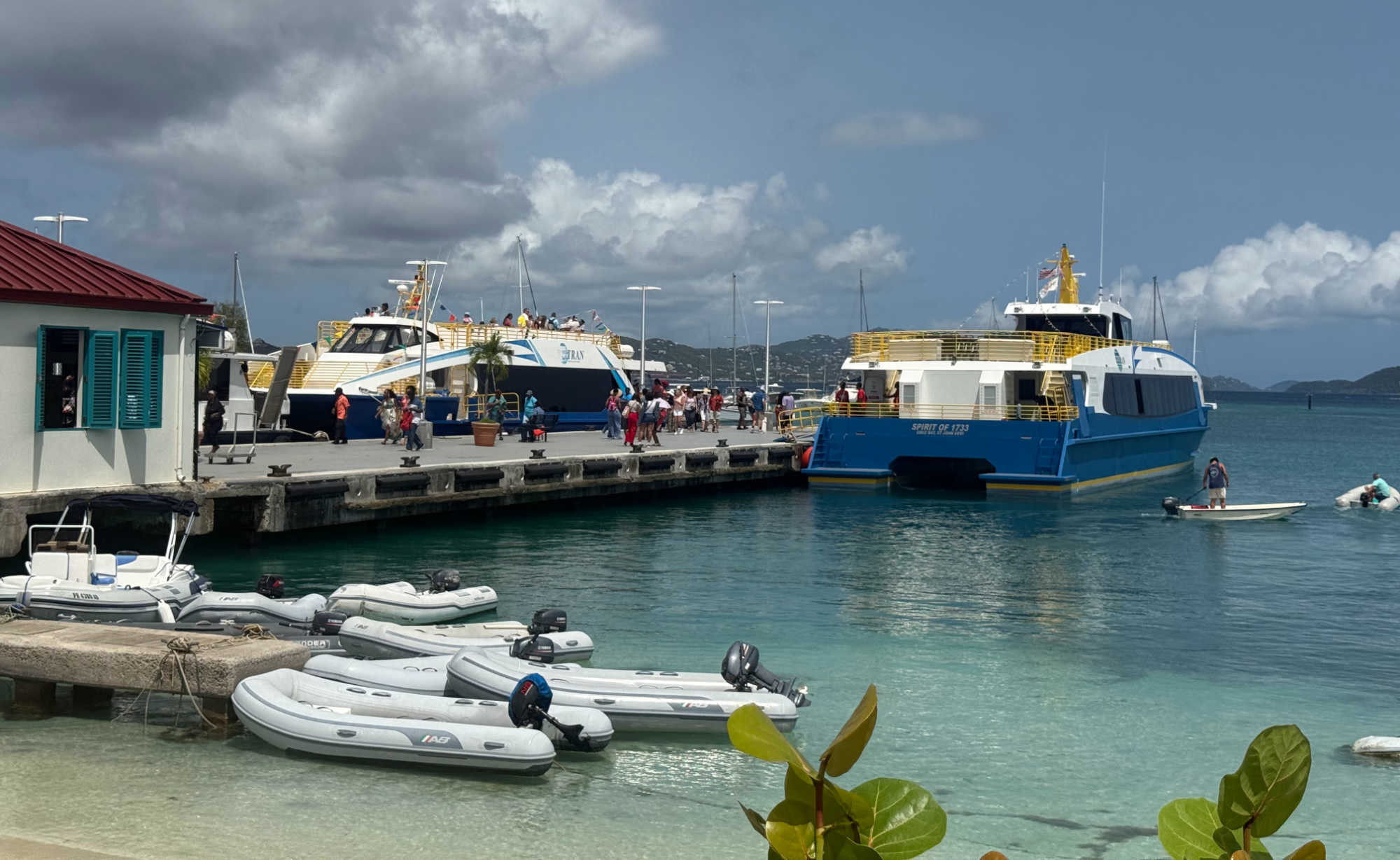
Ferries docked in Cruz Bay, St. John USVI. Photo Credit: V.I. CONSORTIUM.
The Public Services Commission has directed staff to sharpen the review of fuel and labor costs in the ongoing St. Thomas-St. John ferry rate case, while also instructing hearing examiner Jed JohnHope on how to complete his final report after ferry operators challenged nearly $190,000 in assessments tied to the investigation and alleged that some expenses were unreasonable.

Tuesday’s PSC meeting began with objections from attorney Maria Hodge, who represents Varlack Ventures and Transportation Services, the two companies responsible for ferry service between St. Thomas and St. John. Each company had recently been billed just over $26,000 for the ongoing rate investigation.
According to Ms. Hodge, the latest invoices bring the total value of the assessments to $190,000, which she said was “more than any hearing examiner’s fees in the history of the Public Services Commission.” She said the amount was even more striking because “there was no technical consultant hired by the Commission, so you have only one professional being paid.”
That professional is Mr. JohnHope, the hearing examiner in the rate case. Ms. Hodge accused him of inflating the bills beyond what could reasonably be justified.
As an example, she pointed to a recent public hearing on St. John, saying Mr. JohnHope, who is also running to become governor of the U.S. Virgin Islands, was the only official traveling from St. Thomas who stayed overnight on St. John, “at what must be the most expensive hotel in the Virgin Islands.” Ms. Hodge alleged that Mr. JohnHope’s suite cost $800 for the night, with additional costs tied to a rented car he brought across on the barge.
The hearing examiner “essentially made a mini-vacation out of attending this hearing,” Ms. Hodge complained.
She also argued that Mr. JohnHope’s billed hours appeared far beyond what would reasonably be expected for the amount of work performed. His bills, she said, “could not have been reviewed for reasonableness as required by law.”
The ferry companies are objecting to paying the assessed amounts without additional scrutiny.
Commissioners decided that Mr. JohnHope’s response would have to wait until the matter was handled at the staff level. Ms. Hodge confirmed that correspondence had already been sent documenting the companies’ objections, while PSC Executive Director Sandra Setorie confirmed that her team was reviewing the matter.
It was also confirmed during the meeting that the contract between the PSC and Mr. JohnHope allows recovery only for “reasonable costs and expenses.”
The meeting then shifted to the ferry companies’ request for a 75-cent emergency fuel surcharge, which they say is needed to offset rising fuel prices. The companies will have to wait until next month to learn whether they will be allowed to add the surcharge to tickets.
Ms. Hodge said the emergency petition was filed on April 17. She told commissioners that diesel costs have nearly doubled for Varlack Ventures, rising from $3.85 to $6.10 per gallon. Transportation Services is now paying $7.68 per gallon, up from $5.76. The sharp rise in fuel prices in the territory and on the U.S. mainland stems largely from the U.S.-Israel war against Iran, which began on February 28 and has shaken global energy markets. The conflict has pushed oil and gasoline prices higher, helped drive U.S. inflation to 3.8 percent, and added pressure across shipping, transportation, businesses, and household budgets.
She pointed to recent price increases affecting shipping services and the USVI-BVI ferry, arguing that the local ferry companies need relief under current economic conditions. The proposed surcharge would add 75 cents to each ticket during the territory’s fuel emergency.
“We believe this is reasonable and that the analysis justifies it. It is prudent and it is critical for the companies to continue to pay the cost of fuel,” Ms. Hodge said.
Ms. Hodge warned that failure to provide relief could place the ferry companies under severe financial pressure, drawing a comparison to Spirit Airlines’ collapse and arguing that the operators need the temporary surcharge “just to keep operating on a viable basis.”
Asked to explain why the two companies are paying different fuel prices, Ms. Hodge said Transportation Services operates the Spirit of 1776, “which is much larger and cannot be accommodated at the refueling location that the smaller vessels have.” She said special permission to refuel on the waterfront was denied by the Department of Public Works because the government “felt that their hands were tied by the terms of their federal contract.”
Commissioner David Hughes pushed back against the surcharge request, arguing that the ferry companies are already being overcompensated for their service. He said they are “being compensated for assets that you’re legally obligated under the base rate to provide that you are not providing.”
Mr. Hughes was referring to two government-purchased vessels that have been out of service for a significant period while undergoing extensive repairs.
Mr. JohnHope supported that observation, stating, “There are boats that have been outside of the territory for almost 10 years, that are being compensated for. There are boats that have been retired, they’re being compensated for.”
The PSC ultimately postponed a decision on the emergency fuel surcharge until its next meeting in June.
Before moving on to other business, commissioners provided Mr. JohnHope with guidance on how to complete his final report in the ferry boat rate investigation. PSC staff were ordered to design an audit of fuel and labor costs for the ferry companies to provide a stronger foundation for future rate analysis.
Commissioners also adopted Mr. JohnHope’s suggestion that the rate analysis “decouples” the downtown route from the Red Hook route.
In addition, Mr. JohnHope was instructed to treat the Red Hook route as fully serviced by the three boats provided to the ferry companies by the government. Because those vessels were not purchased by the companies themselves, they would not be eligible for cost recovery, a factor expected to affect future rate calculations.

With that guidance, commissioners said they expect Mr. JohnHope to complete the ferry rate investigation in a timely manner.