

 77°F
77°F


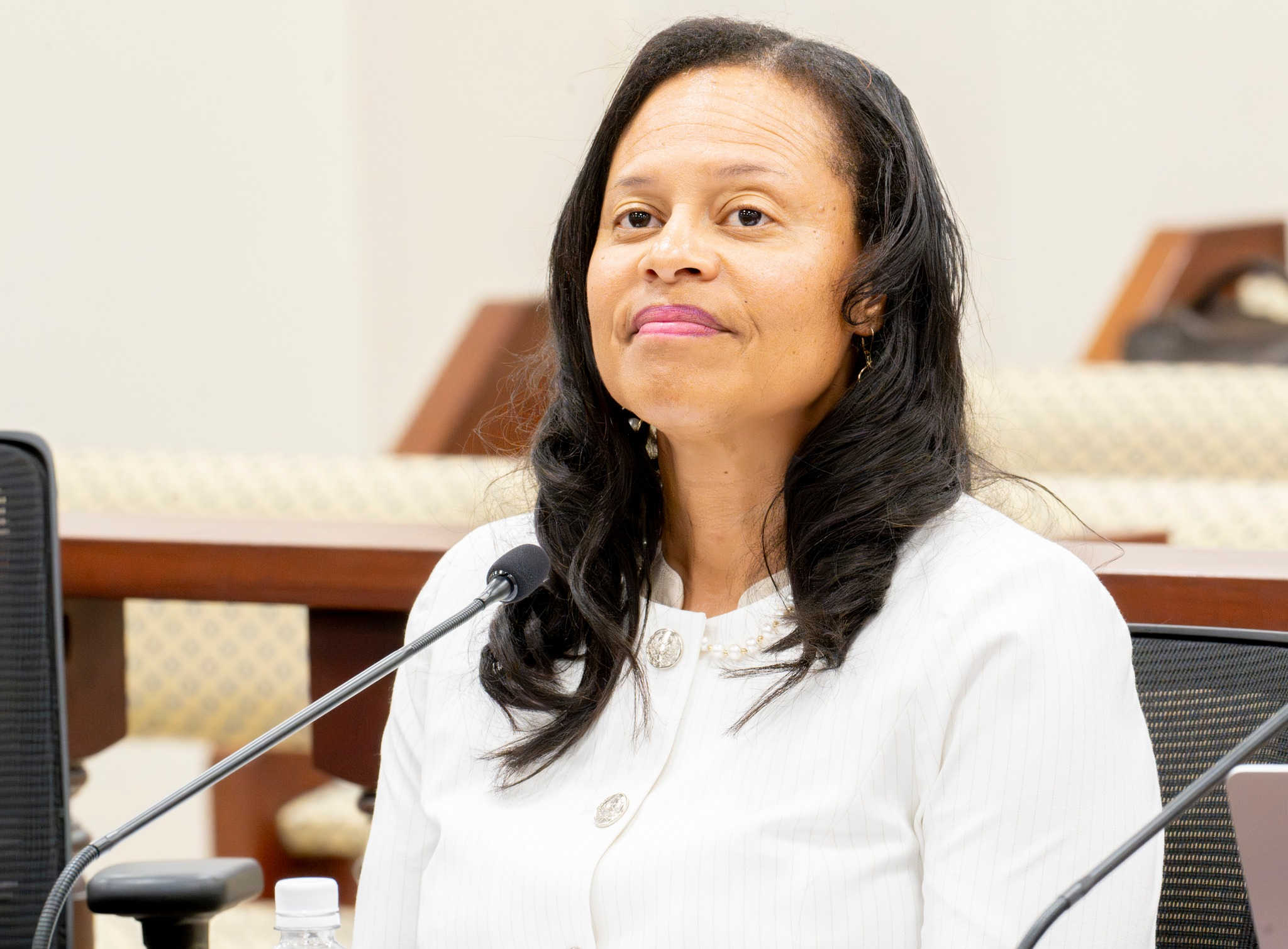
UVI President Dr. Safiya George. Photo Credit: V.I. LEGISLATURE.
Editor's Note: After publication, the University of the Virgin Islands advised that figures included in earlier legislative documents contained inaccuracies. This article has been updated to reflect the corrected figures provided by the university.

As the next budget cycle approaches and government and semi-autonomous agencies prepare to appear before the Committee on Budget, Appropriations, and Finance to defend their funding requests, the University of the Virgin Islands says delayed government allotments continue to create financial strain even as the institution maintains payroll, academic operations and student services.
UVI President Dr. Safiya George addressed the issue Wednesday during a meeting of the Committee on Education and Workforce Development, where updated testimony read into the record clarified the university’s current outstanding allotments and broader financial challenges.
According to the updated figures, UVI is currently owed $8.7 million in allotments. The outstanding amounts are for September 2025, March 2026 and April 2026, at $2.9 million each. The university has received its January and February allotments.
Though grateful for the government’s support, Dr. George explained that the “timing, consistency, and fulfillment of these allotments remain a significant concern.”
She told lawmakers that the delayed payments are “creating immediate and material operational challenges.” Despite the outstanding funds, UVI continues to incur expenses related to payroll, academic operations and student services. As the university awaits the release of funds, significant pressure is being placed on “institutional liquidity.”
Dr. George also pointed to rising employee health insurance expenses, “more than $3 million in WAPA costs,” and infrastructure-related expenses as part of the financial pressure facing the institution. She warned that the university’s funding needs are “not projections in isolation,” but reflect “current operational realities.”
The updated testimony also clarified that UVI requires approximately $3 million annually to support free tuition scholarship funding.
Without the release of funds and “a more predictable funding structure,” Dr. George said UVI will be “forced to make difficult decisions that directly impact student access, workforce development, and the territory’s broader economic stability.”
The delayed allotments have also affected the university’s ability to pay vendors.
“We have a significant number of vendors who are owed, in some cases, more than 90 days on their contracts,” she told Senator Kurt Vialet, the committee’s chair. “We still have 3.5 million outstanding to vendors,” she stated.
Dr. George said vendors that are crucial to UVI’s operations are prioritized when allotments are received.
With funding not flowing consistently to the university, Dr. George and her leadership team have implemented austerity measures, including major travel restrictions. Currently, the only travel permitted is “related to accreditation or to fulfill grant obligations,” she told Senator Avery Lewis.
UVI has also reduced procurement card limits, a move that has created challenges, particularly for researchers and deans. Card limits have been reduced to $3,000. “We've even reduced the cabinet-level member cards as well,” Dr. George noted.
The challenges caused by delayed allotments are compounded by the potential loss of federal funding, which supports research, student support and institutional development efforts. Funding for the Virgin Islands Small Business Development Center could be slashed, creating a “significant gap in support services for small businesses,” Dr. George said.
Aware of the financial challenges burdening operations, UVI is “advancing strategic fundraising efforts to strengthen its long-term sustainability,” Dr. George shared. The university has developed a “comprehensive case for support” to attract philanthropic investment in key priority areas.

Still, she urged lawmakers to support the timely release of the outstanding funds. It is a call being made by several other entities, as revenue shortfalls during specific parts of the fiscal year continue to create major fiscal constraints for key public-facing institutions.