


 77°F
77°F


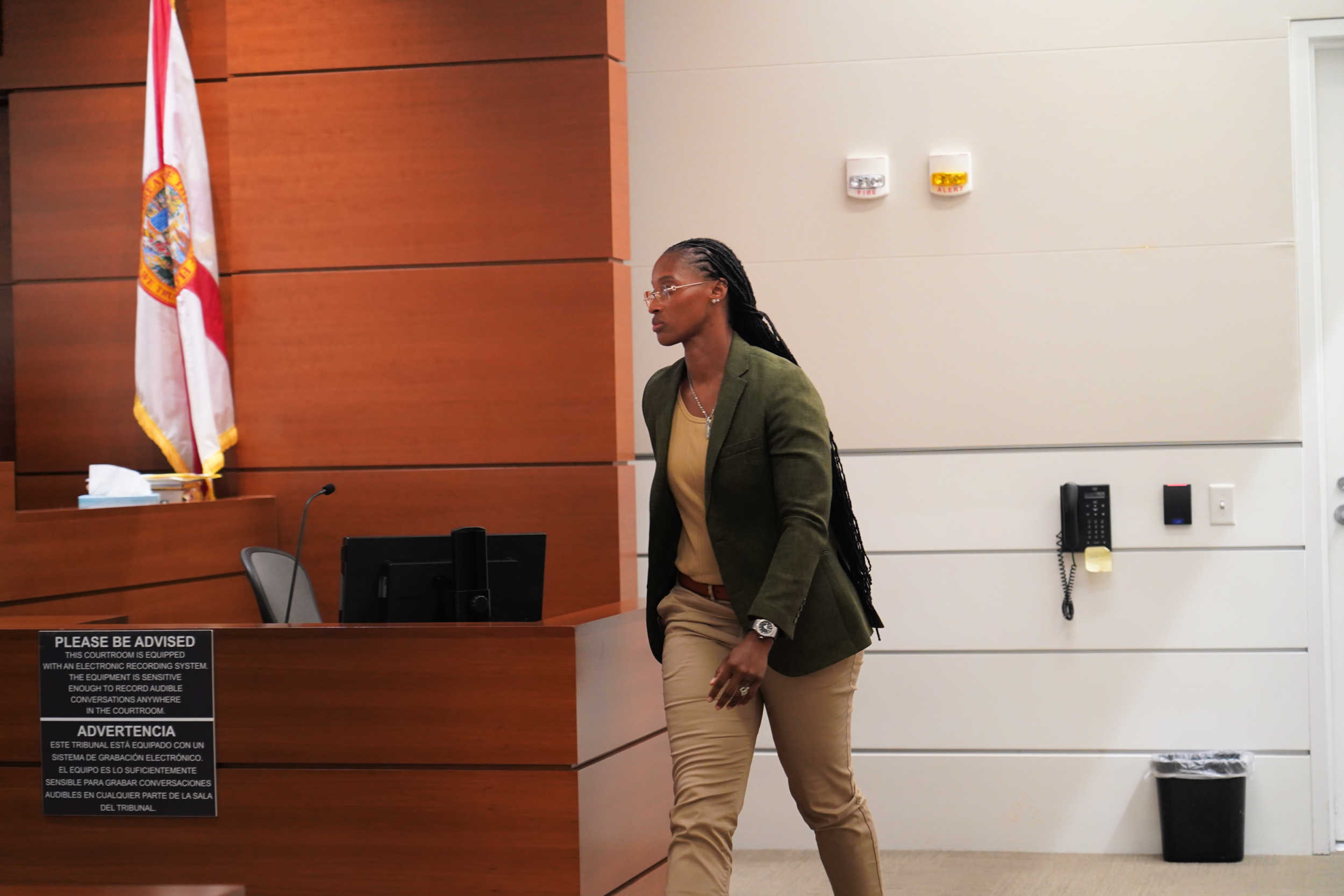
Janelle Sarauw steps away from the witness stand in a Broward County courtroom Friday after testifying in the final hearing on a domestic-violence injunction petition filed against her, which Judge Michael G. Kaplan later denied. Photo Credit: ERNICE GILBERT, V.I. CONSORTIUM.
FORT LAUDERDALE, Fla. — A Broward County judge on Friday denied a petition for a final injunction for protection against domestic violence filed against former Virgin Islands senator and current Delegate to Congress candidate Janelle K. Sarauw, ruling after a two-day bench trial that petitioner Zikeyraw Veretta Guishard had not met Florida’s legal standard for a final protective order.

The case was heard before Judge Michael G. Kaplan in the Circuit Court of the Seventeenth Judicial Circuit in and for Broward County, Florida.
Sarauw served in the Virgin Islands Legislature from July 2017 to January 2023 and is now running for the territory’s Delegate to Congress seat in the August 1 Democratic primary. She changed her voter registration to Democrat as she launched her campaign.
Friday’s ruling followed sharply conflicting testimony over two days about a relationship both sides described as toxic, cyclical and emotionally volatile. Guishard alleged that Sarauw repeatedly assaulted, intimidated and harassed her during and after the relationship. Sarauw denied being the aggressor and testified that Guishard was physically abusive, jealous, controlling and prone to escalating disputes over Sarauw’s communications with other women.
Judge Kaplan did not describe the relationship as peaceful. In announcing his ruling, he said there was “no doubt” the relationship had become dysfunctional and “characterized by intermittent acts of violence.” He also said he agreed there had been violence by both parties.
However, the judge said the question before the court was narrower than whether the relationship had been unhealthy or violent in the past. The issue was whether Guishard had proven either a recent act of domestic violence, measured from the February 5 filing date, or a reasonable basis to fear imminent violence.
The judge found that the last clearly “severe” act of violence occurred well before the petition was filed. He said there may have been some physical violence in December 2025, but found that it had not been proven to the same degree as earlier incidents. He also found that Sarauw had moved out, that there had been contact but no violence or threats of violence after that point, and that Sarauw was living primarily in the Virgin Islands.
The court described Sarauw’s February 5 email containing a nude video as “inappropriate and odd,” but not a threat of physical violence.
“For the reasons I’ve expressed, I’m going to deny the petition,” Judge Kaplan said.
The court also denied Guishard’s related request for an order to show cause based on alleged violations of the temporary injunction, finding that the evidence did not satisfy the burden necessary to prove a violation. Judge Kaplan then addressed both women directly, telling them the relationship was over and urging them to have no further contact. He told Sarauw in particular that, after everything presented in court, any future contact would be difficult to defend.
Under Florida law, a person may seek an injunction for protection against domestic violence if the person is a victim of domestic violence or has reasonable cause to believe he or she is in imminent danger of becoming a victim of domestic violence. Florida’s statute also lists conduct that may support such a petition, including prior abuse, threats, attempted harm, harm to pets, weapons, restraint, destruction of property and patterns of intimidating or controlling behavior.
Friday’s proceedings included Sarauw’s cross-examination, testimony from Sarauw’s cousin Rena Sarauw, brief rebuttal testimony from Guishard, and lengthy closing arguments from Rachel Kuhl, who represented Guishard, and Sashane McDonald, who represented Sarauw.
Friday began with Sarauw briefly reopening her direct testimony so the defense could introduce color photographs she said showed bite marks from an October 19, 2025 incident. Sarauw testified that the photographs showed marks from what she described as an attack by Guishard while Sarauw was holding her phone. Sarauw said Guishard bit her on the upper left part of her back and on her buttocks, leaving several bite marks, while trying to force Sarauw to release the phone.
During cross-examination, Kuhl questioned Sarauw closely about several incidents, including the May 19, 2024 episode that Guishard had described as a dog-leash attack.
Guishard testified Thursday that Sarauw took her dog downstairs during an argument and, when Guishard bent down to retrieve the dog, struck her across the face with a dog leash, blurring her vision. Guishard testified that Sarauw continued striking her across the arm, back and abdomen until she got away. Photographs admitted into evidence showed swelling and redness around Guishard’s left eye, a stripe-like mark on her left arm, redness and what appeared to be a cut near her ribs, and a whip-like mark extending toward her back.
Sarauw admitted during cross-examination that she hit Guishard with the leash, but insisted that she did so after Guishard had been hitting her for hours. Sarauw testified that Guishard had punched her, stabbed an air mattress with a knife, nicked Sarauw near the eyebrow, ripped her clothing and sprayed a Clorox product toward her eyes. Sarauw said she left for a lash appointment during the day and returned, only for the conflict to continue. She said that after Guishard left the apartment, Sarauw followed her and hit her with the leash because her “cup had overflowed.”
Kuhl challenged that account, pressing Sarauw on why she would follow someone she claimed had just assaulted her instead of remaining in the apartment or calling police. Sarauw initially said she responded in self-defense, but acknowledged that she went after Guishard after Guishard left the apartment. Kuhl also questioned why Sarauw went to a lash appointment in the middle of what she described as a lengthy assault, why she returned to the apartment afterward, and why the photographs of Sarauw’s injuries appeared far less severe than the photographs of Guishard’s injuries.
Sarauw maintained that she had endured repeated physical aggression from Guishard and that May 19 was the only time she physically fought back.
Kuhl also questioned Sarauw about her continued contact with Guishard after Sarauw testified she considered the relationship over in October 2025. Sarauw acknowledged communications in November, December and January, but said the relationship followed a repeated pattern of breaking up and reconciling.
The cross-examination focused heavily on January 1, 2026, when Guishard testified that Sarauw called the nursing station at Guishard’s workplace after Guishard had blocked Sarauw on her personal phone. Guishard testified Thursday that Sarauw told her to unblock her or Sarauw would continue calling the nursing station until Guishard lost her job.
On Friday, Kuhl pressed Sarauw on why she would call a hospital nursing station when she knew Guishard was working with patients. Sarauw said both women had called each other at work during the relationship and characterized the call as part of their pattern. She denied that her intent was to harass Guishard or provoke a reaction.
Kuhl also questioned Sarauw about a February 4 email in which Guishard told her not to contact her or her family and stated that any further attempt to reach out would be considered harassment. Sarauw acknowledged responding. Guishard had testified that Sarauw wrote that Guishard did not want to “play this dangerous game.” Guishard testified that hours later, around 3 a.m. on February 5, Sarauw emailed her a nude video, prompting her to go to the courthouse later that morning to file the petition.
Sarauw testified that she was going through her phone and “erasing” Guishard from it when she came across the short video. She said she had already deleted “our photos” from the phone, believed Guishard might want the clip because it involved Guishard and her dog, and sent it only to Guishard and no one else. Sarauw also testified that she currently had no pictures or videos of Guishard on her phone.
The defense then called Rena Sarauw, Janelle Sarauw’s cousin, who appeared by Zoom. Rena testified that she had known Janelle Sarauw her entire life and knew Guishard through the relationship.
Rena said she spoke with Guishard in 2024 after Janelle told her about an alleged assault. Rena said she told Guishard that her behavior was not acceptable and that she needed counseling. According to Rena, Guishard admitted she got upset, had a bad temper and needed help. Rena also testified that in 2025, when Guishard wanted to plan something for Janelle Sarauw’s birthday, Rena advised that the relationship should not continue in that manner and that Guishard should seek counseling before any possible couples counseling.
Rena Sarauw testified that she was concerned for Janelle Sarauw’s safety and told her she could not continue being a “punching bag.” She said she did not believe Guishard was being abused by Janelle Sarauw and described Guishard as the aggressor.
On cross-examination, Musca established that Rena Sarauw is Janelle Sarauw’s first cousin and that the two are close. Rena acknowledged that although she had spent time around the couple over the years, she never personally witnessed Guishard physically assault Janelle Sarauw. She also acknowledged that photographs she saw of alleged injuries to Janelle Sarauw had been sent to her by Janelle, and that Janelle told her what the photographs purportedly showed.
Guishard then returned briefly to the witness stand in rebuttal. She disputed Rena Sarauw’s characterization of their communications, saying the September 2025 exchange was about whether Janelle Sarauw would attend Guishard’s nurse-practitioner graduation, which fell on the same date as Sarauw’s birthday. Guishard testified that she told Rena she did not want Sarauw at the graduation but was willing to do something for Sarauw’s birthday, including possibly taking her on a trip. Guishard denied that the conversation involved an admission that she had assaulted Sarauw or had a temper problem.
Much of Guishard’s Thursday testimony focused on incidents she said formed the basis for the petition, including the May 2024 dog-leash episode, an October 2024 confrontation, a Carnival-related dispute in spring 2025, a Mother’s Day incident in Sarauw’s Jeep, and later disputes in December 2025 after Sarauw had moved out but remained on the lease.
Guishard testified that those incidents showed a pattern of physical aggression, intimidation and unwanted contact. She alleged that Sarauw struck her with a dog leash, forced her way into a bathroom during one dispute, moved a Jeep while Guishard was partly outside the vehicle, drove at a high rate of speed with Guishard and a minor witness inside, and later returned to the apartment despite being asked to stay away. Photographs, Ring-camera screenshots and testimony from the minor witness were among the evidence discussed during the hearing.
Sarauw disputed Guishard’s account of those incidents and testified that Guishard was the aggressor in the relationship. Sarauw said she hit Guishard with the leash only after Guishard had been physically attacking her for hours, denied that the December church incident became physical, and testified that she still had belongings at the apartment, remained on the lease and returned at times to collect personal items. She also disputed Guishard’s account of the Carnival-related vehicle incident, saying Guishard had a habit of trying to exit moving vehicles and that Sarauw was only reversing slowly on an incline.
The court also heard from a minor witness whose name and identifying details are being withheld. The witness testified that Sarauw had been part of the family’s life for several years and described seeing Sarauw grab Guishard, push her toward a bedroom door, slam doors and take the dog from the apartment.
Under cross-examination, McDonald emphasized that the minor witness and Sarauw continued to communicate after Sarauw moved out, including text messages about ordinary matters. McDonald also questioned the witness about a prior incident involving Sarauw for which the witness acknowledged apologizing. The witness said Sarauw had treated the witness well on some occasions and poorly on others.
Guishard also alleged that after the temporary injunction was issued, Sarauw attempted to pressure her indirectly through friends and family to drop the case or accept a mutual no-contact arrangement.
On Thursday, Deyonna Kerr, also referred to in court as Deyonna Jones, testified that Sarauw called her in April 2026 and asked her to ask Guishard to drop the restraining-order case. Kerr said Sarauw wanted the matter to “go away” and said the case could jeopardize Guishard’s nursing license. Kerr also testified that both women had talked to her about getting physical with one another during the relationship, and that Sarauw described at least one fight as self-defense.
Tabari Davis, Guishard’s cousin, testified by Zoom that Sarauw accused him of advising Guishard to pursue the restraining order and tried to get him to dissuade Guishard from continuing. Davis said Sarauw discussed possible negative consequences for Guishard, including her professional standing, and used a Caribbean idiom about digging “a grave for one” and “two,” which Davis interpreted as a warning of retribution. Under cross-examination, Davis denied that it was his idea to have the case dropped and said he did not remember telling Sarauw he would “dirty” her name.
Sarauw denied directing anyone to pressure Guishard or violate the temporary injunction. She testified that mutual friends and relatives were uncomfortable being placed in the middle of the dispute, and that she was willing to enter a mutual stay-away arrangement. Judge Kaplan ultimately found the evidence insufficient to prove a violation of the temporary injunction.
In closing, Musca argued that Guishard had proven she was a victim of domestic violence and that Sarauw’s testimony was not credible.
Kuhl focused heavily on the May 19, 2024 dog-leash incident, arguing that Sarauw admitted hitting Guishard multiple times with the leash. Kuhl argued that Sarauw’s self-defense explanation failed because Sarauw acknowledged Guishard had left the apartment and Sarauw followed her. Kuhl said Sarauw could have stayed inside, locked the door or called police, but instead chased Guishard, took control of the leash and struck her.
Kuhl argued that the photographs admitted into evidence showed Guishard’s injuries from the leash and other alleged incidents, while Sarauw’s photographs did not support the severity of Sarauw’s claims. She said Sarauw claimed Guishard punched her for hours, stabbed an air mattress with a knife, sprayed Clorox toward her eyes and repeatedly attacked her, but Sarauw’s documented injuries did not align with that description.
Kuhl also argued that Guishard’s continued contact, apology cards, affectionate messages and attempts to reconcile did not mean she was not a victim. She said such conduct is common in abusive relationships and that “love is not black and white.” Kuhl said Guishard testified that she apologized to calm Sarauw and preserve the relationship, not necessarily because she was the aggressor.
Kuhl said the alleged abuse did not stop in 2024, pointing to the December 2025 apartment incidents, the January 1 calls to Guishard’s workplace, the February 4 email warning Sarauw not to contact Guishard or her family, and the February 5 nude video or image sent hours later. Kuhl argued that the February 5 email was the immediate trigger that caused Guishard to go to court and file the petition.
Kuhl also urged the court to credit the minor witness’s testimony, saying the witness described multiple occasions when Sarauw was physical with Guishard. She further argued that testimony from Kerr and Davis supported the claim that Sarauw attempted to use third parties to push Guishard to drop the case.
McDonald, arguing for Sarauw, said the case turned on who the court believed was the “real victim.” She argued that Guishard had failed to prove either a recent act of domestic violence or imminent danger as of February 5.
McDonald said the crux of Guishard’s case was the May 19, 2024 dog-leash incident, which occurred far too long before the petition to support a final injunction. She argued that the more recent documented physical evidence came from October 2025, when Sarauw said Guishard bit her while trying to take her phone. McDonald said Sarauw, not Guishard, had photographs from 2025 showing injuries.
McDonald also argued that both women behaved illogically because the relationship was a “roller coaster.” She said Guishard could not use Sarauw’s continued contact and reconciliation efforts against her while asking the court to excuse Guishard’s own continued contact, cards, apologies and attempts to revive the relationship. McDonald pointed to messages from January 2026, about two weeks before the petition was filed, in which Guishard was still trying to discuss the relationship.
McDonald argued that Guishard’s jealousy over Sarauw’s communications with women, particularly Britney, repeatedly triggered conflict. She cited testimony that Guishard stabbed the air mattress, apologized for hitting Sarauw and described herself in messages as needing to handle emotions differently. McDonald argued that Sarauw’s size and strength did not mean she could not be abused.
McDonald also said the minor witness’s testimony did not establish that Sarauw was the aggressor. She argued that the witness described two adults yelling, tension in the car and door-slamming, and that the witness had heard Sarauw tell others that Guishard was aggressive, had anger issues and needed therapy.
On the February 5 video, McDonald argued that Sarauw was “deleting” Guishard from her phone and sent the clip only to Guishard. She said Sarauw had moved out, was living primarily in the Virgin Islands, had not been to Guishard’s home in 2026, and wanted to move on with her life and campaign.
After thanking both attorneys for their professionalism, Judge Kaplan said the relationship had been dysfunctional and involved intermittent violence by both sides. However, he said the court could not enter an injunction merely because the relationship had been unhealthy or violent in the past.
The judge said the evidence did not establish a recent act of domestic violence as of the February 5 petition date. He said the last severe incident was “quite some time ago,” and that while there may have been some physical violence in December, it had not been proven to the same degree as prior incidents. He also said Sarauw had moved out, the more recent events were minor in relation to earlier allegations, and there had been no violence or threats of violence since Sarauw moved out.
On the question of imminent danger, Judge Kaplan said the February 5 video was inappropriate and odd, but not a threat to commit violence. He said Sarauw had moved out and was living primarily in the Virgin Islands. The judge said that if the parties resumed contact or restarted the relationship, violence could happen again, but under the existing circumstances he did not find that violence was reasonably likely to happen immediately.
The petition was denied, as was the request for an order to show cause.

Judge Kaplan ended by telling both women that the relationship was over and that they should leave each other alone. He urged them to move on with their lives without each other in them. No final injunction was entered against Sarauw.