


 77°F
77°F


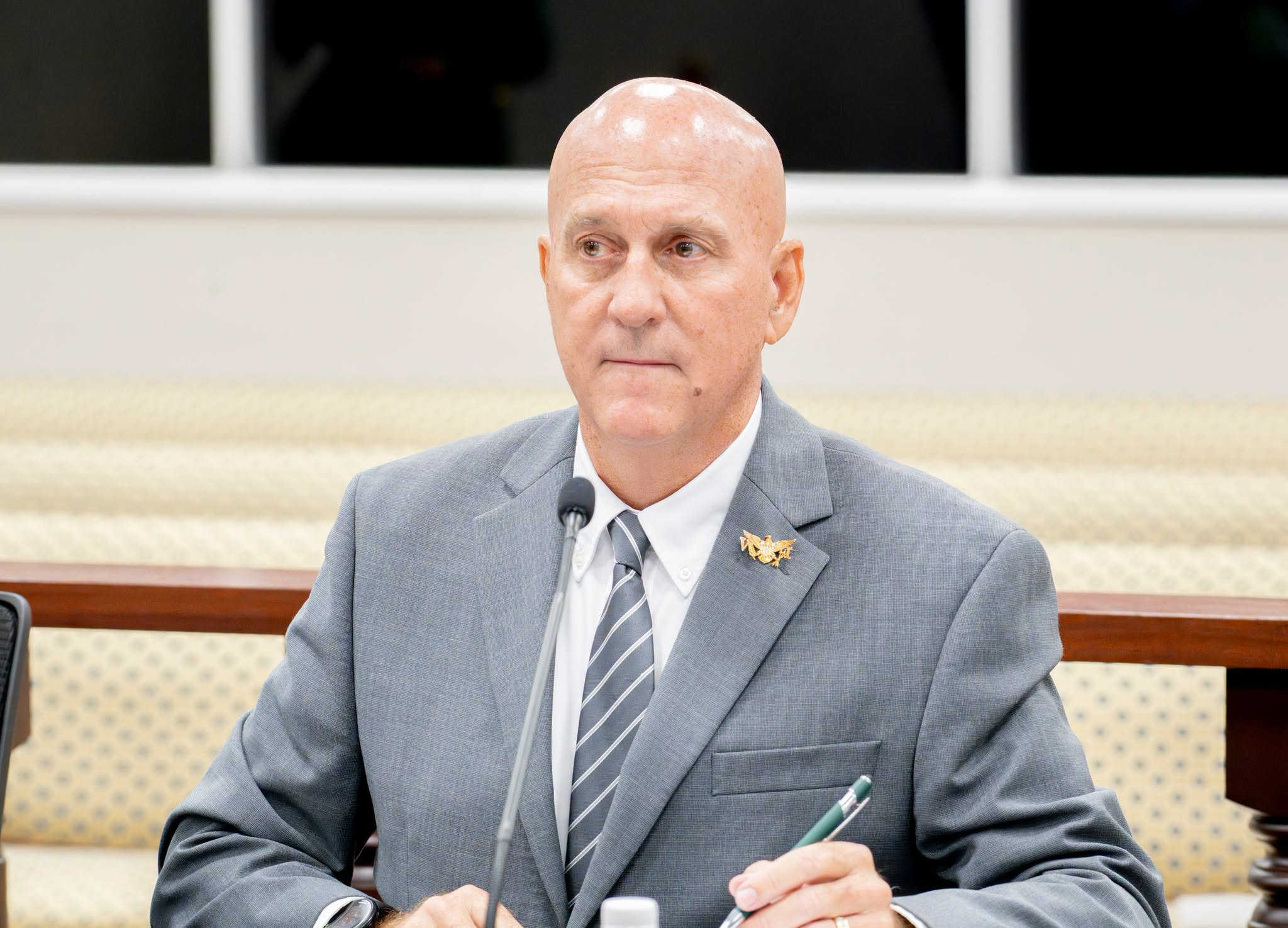
VITEMA Director Daryl Jaschen told lawmakers Tuesday that 9-1-1 staffing shortages continue to drive overtime costs, while the agency seeks $11.1 million for FY2027 and advances the long-delayed Hermon Hill Safe Room project. Photo Credit: V.I. LEGISLATURE.
The V.I. Territorial Emergency Management Agency is seeking $11,087,674 for fiscal year 2027 while continuing to manage high turnover, staffing shortages and overtime costs at its 9-1-1 call center.

The challenges were among several issues discussed Tuesday during VITEMA’s budget hearing before the Committee on Budget, Appropriations, and Finance. While the agency has made some progress in hiring and facility improvements, Director Daryl Jaschen said staffing at the Emergency Communications Center remains a central operational concern.
According to Mr. Jaschen, VITEMA’s FY2026 emphasis has included “addressing staffing shortages within the Emergency Communications Center (ECC-911), one of the agency’s most critical operational areas.” Five new hires have been processed so far, and four more employees are expected to join the team by August.
Still, overtime figures show the call center remains under pressure. Mr. Jaschen said overtime costs for call center operators totaled $372,048. As of May 2026, overtime had already reached $254,957.82, or $25,495 per month.
“Based on current trends, the overtime projection for FY2026 is $356,939,” Mr. Jaschen testified.
With $274,700 budgeted for overtime in FY2026, VITEMA is projected to exceed its overtime budget by $82,239. Mr. Jaschen said the agency intends to cover the excess using “unfilled budgeted staff positions.”
He also said the recent ratification of the collective bargaining agreement, which includes salary increases, “will go a long way in reducing our high overtime costs.”
Deputy Director Nadia Fearon described the 9-1-1 call center as a “revolving door.” She said salaries are among the main issues causing workers to leave. Childcare challenges have also been raised, “especially when we are on 12-hour shifts,” along with mental health constraints cited by staff.
Ms. Fearon said some individuals have expressed interest in part-time roles at the call center, but the Division of Personnel has advised that such an approach would require legislative action.
“They're going to have to do like a dual employee number in order to do it,” she explained.
Senator Novelle Francis, chair of the committee, asked about ways to “stop the bleeding” and urged VITEMA to “meet them halfway on those particular issues.”
“If you see that as a real barrier, we need to look at that as a possible area that we could fix,” he told VITEMA officials.
Mr. Jaschen said he is hopeful that legislative action could help allow part-time positions.
“If we can get that going, we can really solve the 9-1-1 [problem],” he said.
Despite the staffing challenges, Mr. Jaschen told lawmakers that operators “continue to demonstrate the highest level of professionalism, dedication, and commitment to duty.”
Earlier this year, VITEMA spent $209,618 to refurbish the St. Thomas call center.
The agency is also expecting about $736,762 from the Emergency Services Surcharge/Fund. By law, those funds can only be used to maintain and improve the 9-1-1 system.
That allocation is part of VITEMA’s FY2027 non-appropriated funds, which total $5,176,548. Along with a General Fund allocation of $5,911,126, the agency’s total FY2027 request is $11,087,674.
The request does not include funding for sand or sandbags. According to Mr. Jaschen’s testimony, there are “zero dollars budgeted for purchase of sand and sandbags.” The same is true for the current fiscal year, but Mr. Jaschen said Governor Albert Bryan Jr. has pledged to provide funding for that resource during the 2026 hurricane season.
VITEMA is also continuing work on its Safe Room Project at Hermon Hill on St. Croix, an initiative that has remained in the design phase for nine years.
The project is funded by FEMA at $22,509,692. Mr. Jaschen said architectural and engineering costs increased to $3,696,347, while construction costs decreased to $18,276,516 and contingency costs increased to $1,098,643.
As of April 30, 2026, the design package was 60% complete, and $2,600,126 had been spent on the architectural and engineering task order, according to Mr. Jaschen.
He told Senator Francis that he hopes the designs will be completed by October and forwarded to FEMA for review. Once completed, the facility will house St. Croix’s 9-1-1 call center office spaces and training spaces. A safe room in the building will be able to accommodate 200 people.
VITEMA has also felt the effects of federal spending cuts, similar to several other government entities. Mr. Jaschen said the “removal of CERT as priority under the Department of Homeland Security grant program creates direct risk for the program’s long-term sustainability.”
The CERT program was recently relaunched, but without federal support, territorial funding will have to fill the gap. Mr. Jaschen told lawmakers that if no federal funds are available, VITEMA will require $10,000 annually beginning in FY2029.
Tsunami preparedness has also “seen continued reductions at the federal level,” but VITEMA is working to ensure its grant strategy generates the funding needed.