


 77°F
77°F


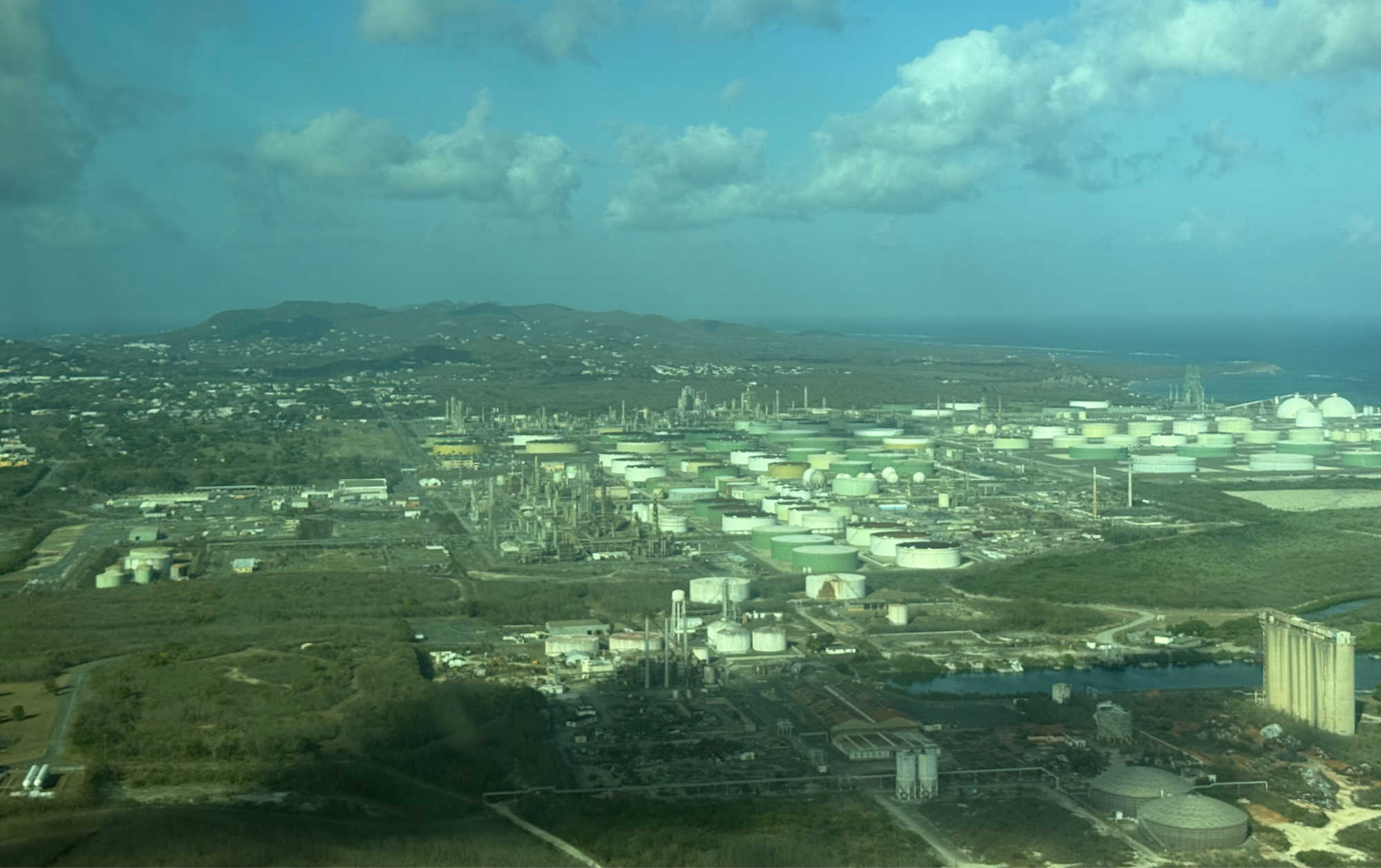
Aerial view of the oil refinery (idled) and storage terminal on the south shore of St. Croix. Photo Credit: ERNICE GILBERT, V.I. CONSORTIUM.
ST. CROIX — The White House has placed the idled St. Croix refinery among a limited group of facilities it wants returned to operation, referring prospective investors to federal agencies and consulting the Environmental Protection Agency on the requirements that would govern a potential restart.

Politico reported that White House officials have discussed reopening closed petroleum refineries from the Virgin Islands to California as the administration seeks additional domestic fuel-production capacity amid concern over elevated gasoline prices. Three industry executives familiar with the discussions said a range of potential investors had contacted the administration.
Officials with the National Energy Dominance Council confirmed that they had received inquiries and connected interested parties with the appropriate federal agencies to discuss how the government could help facilitate private investment.
The discussions have progressed to consultations between council officials and EPA regarding the regulatory requirements for restarting mothballed refineries.
One industry executive familiar with the White House talks said St. Croix “is one of the refineries on a short list of refineries … that the administration wants to keep running.”
The Hill separately reported that a White House official said the administration “would like to see refineries across the country reopen, especially the St. Croix refinery.” The official pointed to the facility’s strategic location and its original design for processing Venezuelan crude.
The renewed federal interest comes as the nationwide average price of regular gasoline reached $4.106 per gallon on July 31. That compared with $3.147 a year earlier and $3.847 one month earlier, according to AAA.
Potential Investors Approach White House
Politico reported that backers of the Freedom Fuel Network were among those who approached the White House about potentially investing in the St. Croix refinery. No agreement was announced.
Freedom Fuel is a recently launched, 25-location network of gas stations in the Philadelphia area that received public promotion from President Donald Trump and the White House for selling gasoline at $3.47 per gallon.
An Associated Press examination found that the network is operated by a collection of businessmen that includes an NFL kicking coach, a Republican fundraiser and two New Jersey entrepreneurs. The White House told AP that it had held discussions with individuals involved in establishing the network but had not funded or subsidized the company.
The refinery operated for decades under Hess and later HOVENSA before closing in 2012. A subsequent effort led by Limetree Bay invested heavily in restoring part of the complex, and refining resumed in early 2021 after nearly a decade offline.
That restart lasted only several months. EPA ordered Limetree Bay to pause operations in May 2021 following multiple air-emissions incidents, finding that continued operation posed an imminent and substantial danger to public health, public welfare or the environment.
Limetree later announced that the facility would shut indefinitely because of financial constraints and subsequently entered bankruptcy.
A federal bankruptcy judge approved the refinery’s sale for $62 million in December 2021 to West Indies Petroleum Limited and Port Hamilton Refining and Transportation, which indicated at the time that they intended to pursue a restart.
The refinery operation owned by Port Hamilton is separate from the adjoining bulk-storage and marine-terminal operation now doing business as Ocean Point Terminals.
Court Ruling Removed One Permitting Barrier
A major legal development came in July 2023, when the U.S. Court of Appeals for the Third Circuit vacated EPA’s determination that Port Hamilton had to secure a new Prevention of Significant Deterioration permit before restarting the refinery.
The court ruled that EPA exceeded its authority under the Clean Air Act when it treated the long-idled refinery as though it were a newly constructed facility under the agency’s Reactivation Policy.
EPA formally abandoned that nationwide policy in September 2025. The former approach presumed that a major industrial source left idle for two or more years had permanently closed and therefore had to undergo New Source Review before restarting.
Under the revised position, an idled facility does not require that type of permit merely because it resumes operation. A permit could still be triggered if physical or operational changes qualify as a major modification and result in the required level of increased emissions.
The court ruling and policy change removed one significant permitting obstacle, but they did not eliminate the refinery’s other obligations under federal and territorial environmental, operational and safety laws.
EPA’s official record states that the agency completed oversight of work removing ammonia, amines and liquefied petroleum gas from refinery equipment under a 2022 legal agreement.
EPA and Port Hamilton entered a second administrative order in August 2024 requiring the removal of additional materials from two LPG units and the implementation of enhanced safety measures. The order followed an inspection that identified possible risks involving materials not addressed in the earlier removal operation.
EPA also issued compliance orders requiring Port Hamilton, West Indies Petroleum and Ocean Point Terminals to seek coverage under territorial water-discharge permits and implement corrective measures for pollutant discharges into surrounding waters.

Those obligations remain separate from the question of whether the former Reactivation Policy can be used to require a new-air-source permit.