

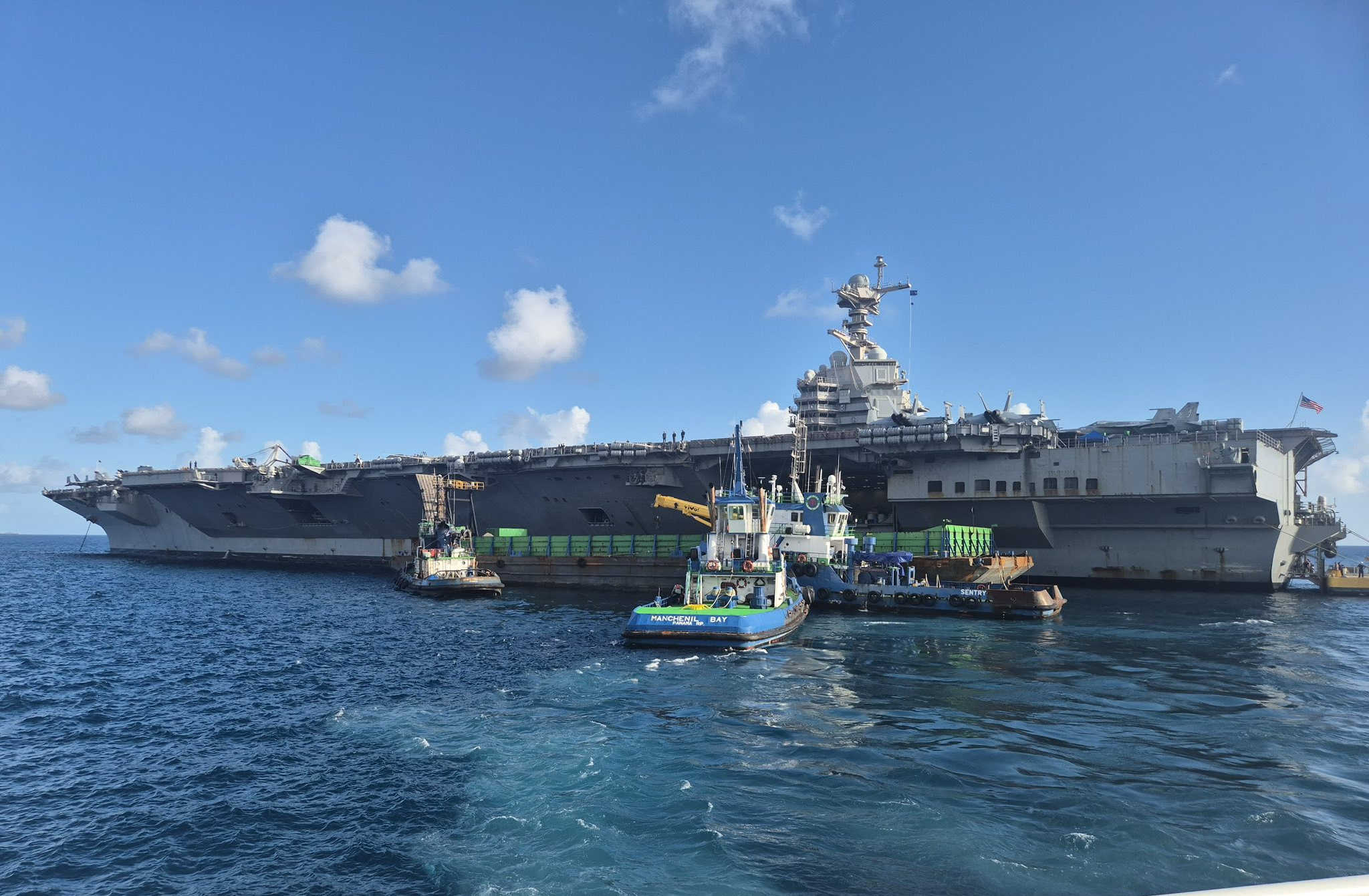
The USS Gerald R. Ford, one of the central U.S. warships in the campaign against Iran that has docked in both St. Thomas and St. Thomas, is set to temporarily dock at Souda Bay, Crete, after a significant onboard fire that injured sailors and damaged living spaces aboard the carrier. The fire broke out in the ship’s main laundry area, caused smoke-related injuries to about 200 sailors, forced one evacuation, and affected around 100 sleeping berths. The ship’s propulsion systems were not damaged and that the carrier remains operational, but the incident added a new layer of strain to a deployment that has already stretched beyond nine months.

The timing is significant because the Ford remains part of the U.S. military posture in a war that has already killed more than 2,000 people across Iran, Lebanon, Israel, Iraq and the Gulf. Israel’s foreign minister said on Tuesday that Israel had “won” the war in broad terms, even though the campaign was still continuing and its goals were not yet fully met. The conflict began on February 28 with joint U.S.-Israeli strikes on Iran and has since expanded into a wider regional confrontation.
Iran’s latest retaliation underscored that the war remains far from over. Reuters reported that Iran struck Tel Aviv with cluster warheads after the killing of senior Iranian security figure Ali Larijani. That strike killed two people near key Israeli military facilities. Reuters separately reported that Gholamreza Soleimani, commander of Iran’s paramilitary Basij force, was also killed in attacks carried out by the United States and Israel. Together, those killings formed part of the latest cycle of escalation that Tehran said it was answering with renewed missile fire.
The war’s maritime fallout remains just as important as the battlefield exchange. Iran has effectively blocked almost all maritime traffic through the Strait of Hormuz, the route for roughly 20% of global oil and natural gas shipments. Iran’s own oil exports have continued at a near-normal pace despite the disruption, with 1.1 million to 1.5 million barrels per day still leaving the country, mainly for China.

That selective flow matters well beyond energy prices. In June 2025 about 90% of Iran’s oil exports were going to China, with the country remaining Tehran's to buyer. AP reported this week that Iran has selectively allowed some vessels through Hormuz while keeping the passage effectively closed to Western and allied traffic. The broader implication is plain enough: if a larger share of crisis-era oil trade keeps shifting toward China-centered channels outside the traditional Western system, that would raise fresh questions about long-term pressure on the U.S. dollar’s central role in energy trade.
Elsewhere in the region’s political fallout, Cuba restored power after a 29-hour nationwide blackout, but the episode was the worst since the United States intensified its fuel blockade against the island. Power returned by 6:11 p.m. Tuesday and Cuba’s largest oil-fired power plant was reactivated, but officials warned that electricity shortages would persist because generation capacity remains limited. Cuba has received only two small oil shipments this year, reflecting the pressure created by tighter U.S. efforts to restrict fuel imports.
The humanitarian strain inside Cuba has not disappeared with the return of electricity. The United Nations and PAHO have described a country where energy shortages continue to disrupt health services, transport, water delivery and the cold chain for medicines. The U.N. said daily life in Cuba is “becoming fragile,” warned that treatments for millions of people with chronic illnesses are at risk, and said the danger to people’s lives “is not rhetorical.” PAHO said the energy crisis has compromised electricity-dependent health services, transport, water, food delivery and humanitarian assistance, placing extra pressure on people with chronic illnesses, pregnant women and children with special health needs.