

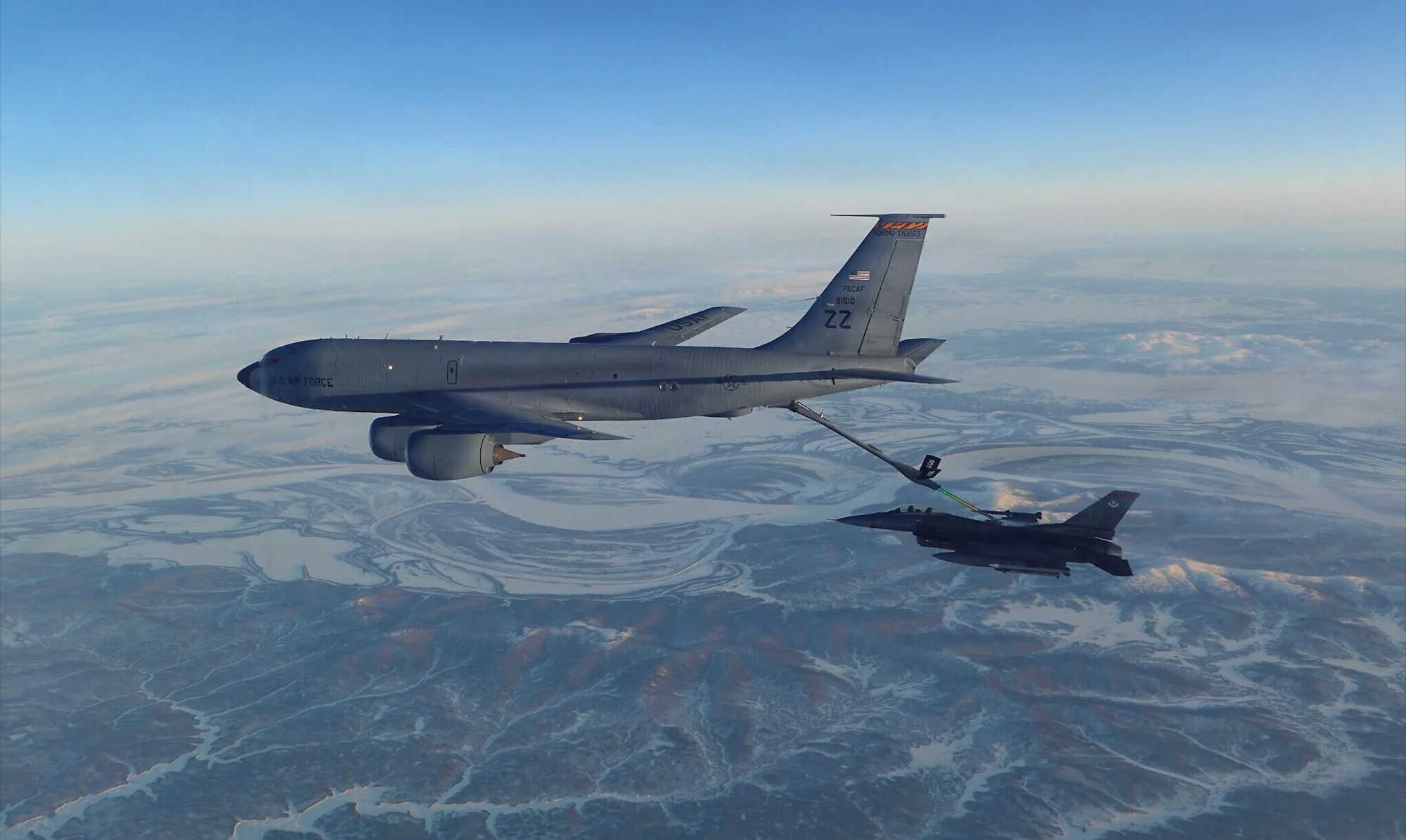
Four U.S. service members were killed when a U.S. KC-135 refueling aircraft went down in western Iraq during operations tied to the war with Iran, with two crew members still unaccounted for as rescue efforts continued. U.S. Central Command said the incident involved two aircraft, occurred in friendly airspace, and was not caused by hostile fire or friendly fire. The crash, coming during a refueling mission over one of the war’s most active operating zones, is the most serious new U.S. military loss reported Friday and adds to a growing list of American incidents since the campaign began on Feb. 28.

The broader U.S. toll has continued to rise. The Pentagon now puts the number of wounded U.S. service members at about 140, with 108 already returned to duty and eight still severely injured. At least seven U.S. troops had been killed in the conflict before the Iraq crash. The strain on U.S. forces has not been limited to battlefield attacks: three U.S. F-15E fighter jets were previously lost in an apparent friendly-fire incident over Kuwait, though all six crew members survived, and the Washington Post reported that a fire aboard the USS Gerald R. Ford injured two sailors while the carrier supported operations connected to the Iran war.
Even with those setbacks, Washington and Israel have kept up a high tempo of strikes. U.S. and Israeli attacks have continued across Iran and against Hezbollah in Lebanon, while top U.S. officials have signaled no immediate retreat. Reuters also reported earlier that Defense Secretary Pete Hegseth said one day this week would be the “most intense day of strikes” yet, while Joint Chiefs Chairman Gen. Dan Caine said U.S. forces were hunting Iranian mine-laying vessels and had already struck thousands of targets during the campaign. President Donald Trump said Friday he believes Iran’s new supreme leader is alive but “damaged,” another sign that U.S. rhetoric remains openly escalatory even as officials also continue to float the possibility of talks.
Iran, for its part, has continued striking back. Reuters reported Friday that Iran is still carrying out missile and drone attacks on Israel while also threatening U.S.-aligned Gulf states and U.S. military bases across the region. Iranian attacks have included strikes targeting Gulf shipping and energy infrastructure, while regional militaries have been intercepting some of the projectiles over multiple countries. The conflict is no longer confined to Iran and Israel; it now touches Iraq, Lebanon and Gulf states, with military and economic effects spreading outward.

One of the war’s most dangerous pressure points remains the Strait of Hormuz. Brent crude moved above $100 a barrel after having surged far higher earlier in the conflict, as energy traders continued pricing in the risk of a prolonged choke point in the Gulf. Iran’s new supreme leader, Mojtaba Khamenei, said the strait should remain shut, even as Iran’s U.N. envoy said Tehran was not going to close the waterway outright and still respected freedom of navigation under international law. Those mixed signals have done little to calm markets, especially after verified reporting showed ships being struck near the strait and U.S. officials acknowledging that commercial escorts were not yet in place.
The International Energy Agency said the war has produced the largest oil supply disruption in history, with March supply projected to fall by 8 million barrels a day, prompting the release of a record 400 million barrels from strategic reserves. Even so, the market remains tight enough that Goldman Sachs said Friday its average Brent forecast for March had now moved above $100 a barrel. That combination — physical disruption, emergency reserve releases, and persistent market anxiety — has become one of the clearest economic markers of how severe the crisis has become.
At the same time, Washington has taken an extraordinary step on Russian oil: the United States has issued a 30-day waiver allowing purchases of certain sanctioned Russian oil at sea in an effort to ease the energy shock, while the Treasury Department’s Office of Foreign Assets Control confirmed on March 5 that it issued Russia-related General License 133 authorizing the delivery and sale of Russian-origin crude and petroleum products loaded on vessels as of March 5 to India. The move underscores how deeply the Iran war is now influencing global sanctions policy and energy security calculations.
That policy shift also carries implications far beyond the Gulf. Reuters reported Friday that Ukraine is now pressing allies not to let the Iran war drain attention and military resources from Russia’s invasion, warning that Gulf states are burning through air-defense interceptors at a rate that outpaces what Ukraine received from the United States over several years. Reuters also reported that higher oil prices are bolstering Russia’s revenues just as Kyiv is trying to hold together outside support. In other words, while the war against Iran is its own crisis, it is also feeding Russia financially and complicating Ukraine’s battlefield and diplomatic position.
Meanwhile in Asia, Taiwan’s parliament on Friday authorized the government to sign roughly $9 billion in stalled U.S. arms deals amid continued concern about Chinese military pressure. AP separately reported that analysts are watching an unusual recent falloff in Chinese military flights around Taiwan with caution, rather than treating it as genuine de-escalation. That means the Iran war is unfolding against a wider backdrop of unresolved global confrontation, not in isolation.

Warnings about the danger of an even wider war have grown sharper. Cardinal Pietro Parolin, the Vatican’s top diplomat, said the U.S.-Israeli attacks on Iran were undermining international law and warned that if countries claimed a right to launch preventive war, “the entire world could risk going up in flames.”