




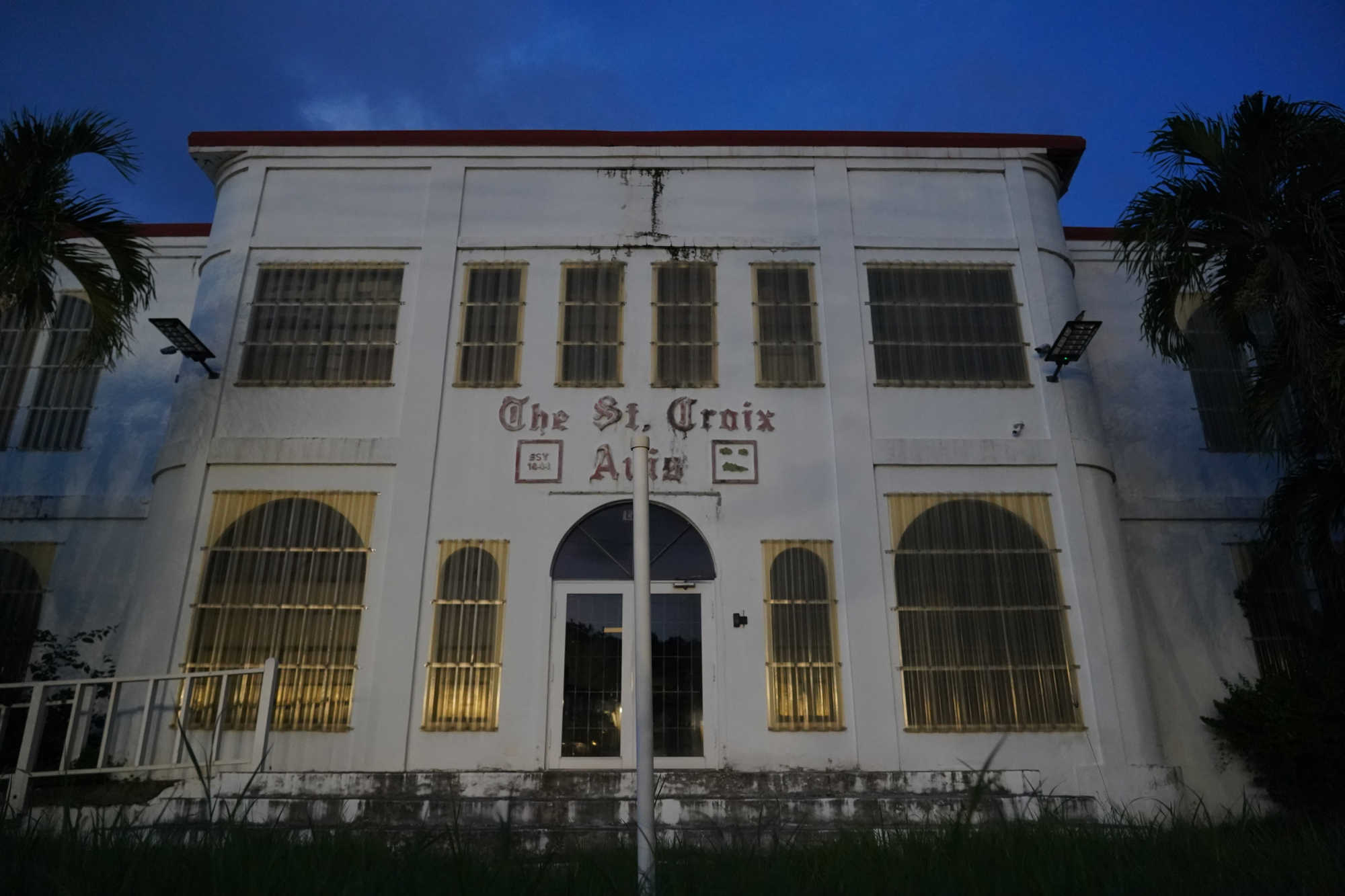
The V.I. Water and Power Authority is facing renewed public scrutiny following explosive allegations from Rena Brodhurst, owner of the now-closed St. Croix Avis, who accused the utility of harassment, fraudulent billing, and threats to disconnect her home’s power in retaliation for disputing “fake” charges tied to her shuttered business.

In a searing letter addressed to WAPA’s Collector Urella Dore and Collections and Key Accounts Manager Daphne Durand Mayers, Brodhurst described years of distress, calling the authority’s actions “extortionate” and “beyond the pale of common decency.” The letter, dated September 10, 2025, was also sent to several federal officials, including FBI Director Kash Patel and U.S. Attorney General Pam Bondi.
“I’m in receipt of your extortion letter… where you threaten to disconnect power to my home, all stemming from the fake bills you sent for WAPA phantom power you claimed the closed St. Croix Avis newspaper consumed over a twelve-month period,” Brodhurst wrote.
A Timeline of Mounting Bills After Closure

Brodhurst’s company, Brodhurst Printery, Inc., operated the St. Croix Avis for decades before she closed the 180-year-old paper in January 2024, citing financial strain. She said she expected electricity costs to drop substantially once the building was shuttered — with only three lights left on — but instead, her bills skyrocketed.
According to documents she provided, the Avis’s final operational bill, covering November–December 2023, was $3,420.40, and another covering December 2023–January 2024 was $3,310.99, both of which she paid in full. Yet, in the months that followed, WAPA issued what she described as “fake and nonsensical bills” that grew inexplicably higher despite no ongoing operations.
By March–April 2024, the bill had soared to $11,214.95, followed by charges of $5,800.21, $6,879.96, and $3,547.12 in subsequent billing periods. Brodhurst’s timeline shows that even after WAPA physically cut power to the Avis building at the pole on July 12, 2024, the utility continued sending bills — including charges as late as November 2024, bringing the total to $49,986.90.
[Rena Brodhurst's Response to WAPA]
She said her frustration began months earlier, when she visited WAPA’s Sunny Isles office in February 2024 to ask why the closed Avis was still being billed. “The lovely customer service representative told me the meter department would be sent out to investigate and not to worry about disconnection because WAPA would get back to me with an explanation,” Brodhurst wrote.
After waiting a week with no response, she called repeatedly and received no answers. She then hired an electrician who, she said, concluded that the meter “was a nonfunctional dud.” Despite that, she said, WAPA’s collections department “gleefully continued sending fake bills.”
[WAPA Bills & Disconnect Notices]
On July 12, 2024, Brodhurst alleged that a WAPA crew cut power at the pole — an act she described as “worthy of the Gambino Crime Family.” A former employee inside the Avis building at the time reportedly heard a loud noise and saw the bucket truck extended to the pole. Brodhurst said she later learned that only the key accounts manager could authorize that disconnection.
“Still, you didn’t call me like the St. Croix customer representative said would happen to explain the fake bills,” she wrote. “Instead you kept on sending The St. Croix Avis fake bills until November of 2024. At this point, I became convinced that you and WAPA were not rational but simply engaging in gangster behavior.”
By December 17, 2024, Brodhurst said she “begged” a customer service representative to end the account. “I told the brown-skinned Hispanic looking lady, no reconnection for the St. Croix Avis, I simply wanted out of WAPA’s madness of blatant fake overbilling,” she wrote. She filled out the forms to close the account, anticipating that WAPA would “continue to charge me willy-nilly for something I wasn’t consuming or needed.”
New Allegations in 2025
Brodhurst’s ordeal did not end there. In August 2025, she said she began experiencing power fluctuations at her home, where appliances were repeatedly turning off and on. After hiring an electrician, she said it was determined that the problem originated with WAPA’s lines.
When a crew arrived to fix the issue, a supervisor allegedly suggested she might not have paid her bill. “He told me, maybe you didn’t pay your bill. I told him I always pay my bill and I’ve never received a late notice nor disconnect notice,” she wrote. The crew eventually repaired the problem.
The following month, Brodhurst said her residential bill nearly tripled — from $368.21 in August to $938.51 in September — coinciding with the receipt of WAPA’s September 10 “extortion letter.” That letter informed her that the Avis’s outstanding balance of $26,569.13 would be transferred to her personal account if not paid within 30 days.
“Now you come like a hound from hell, threatening to deprive me of electricity at my home,” Brodhurst wrote. “A WAPA account that has always paid on time and has never owed one penny. This evil is beyond anything Satan could conjure up.”
She warned WAPA executives that if the agency disconnected her power, she would sue them personally, including CEO Karl Knight and the board of directors, writing, “Your mafia behavior is beyond the pale of common decency.”
Brodhurst accused the authority of endangering lives by targeting a household with medical needs. “You don’t know if anyone in my household is dependent on refrigerated insulin to prevent diabetic death or refrigerated eye drops to prevent blindness,” she wrote.
She also questioned how WAPA had managed the “unprecedented millions of dollars” it received from the federal government and from Governor Albert Bryan’s hurricane recovery allocations. “Why does WAPA still owe the St. Croix Avis for advertising ordered?” she asked. “I heard I’m not the only one dealing with the wrath of WAPA’s shakedowns.”
Brodhurst urged that a “class action lawsuit is in order” and called for a restraining order against the utility, saying WAPA had become a “monopoly using its powers to kill and blind people in a household that has an account in good standing.”
WAPA CEO Admits Internal Failure
In an interview with the Consortium on Monday evening, CEO Karl Knight confirmed that his office had reviewed Brodhurst’s letter and launched an internal investigation.
“Over the weekend, my team… reached out to her to find out exactly where the process had broken down,” Knight said. “We verified the meter and the functionality of the meter, and to the extent that we need to make adjustments to past billing, we are prepared to do so.”
Knight said the situation “should not have happened” and acknowledged that it “fell through the cracks” within the organization. “Something like this should’ve been caught earlier on and handled in a different fashion,” he said.
The CEO stressed that he found “no malice” in the handling of the account, saying the issue began before his tenure. “I certainly hold no malice toward Ms. Brodhurst or the St. Croix Avis — that’s quite an institution,” he said. “But it was mishandled, and we’re taking steps to correct that error.”
Knight said he intends to ensure no customer — regardless of their profile — faces similar billing lapses. “Whether it’s a high-profile customer or a lower-profile one, we have to make sure these mistakes are not being made — and when they are, that we catch them, fix them, and apologize,” he said.
Addressing Brodhurst’s claim that WAPA improperly transferred or attempted to transfer the Avis’s business balance to her home account, Knight acknowledged that the decision was under review. “It’s a matter that has been the subject of internal discussion,” he said. “I imagine it could be a remedy if we feel that there was some attempt to evade payment on an account by opening a new account. I don’t know if that was the best remedy to propose, but that is a matter we are discussing internally and ultimately we will resolve it.”
Knight later added that he does not believe the action taken was the best course of action, saying the practice likely arose from a misguided attempt to close a delinquent business account. “In the case of a shuttered business, that probably wasn’t the most appropriate remedy to that billing dispute,” he said.
Ongoing Billing System Problems and Planned Fixes
Knight also addressed broader concerns raised by residents about WAPA’s billing reliability. “There’s no real incentive for anybody to retaliate through billing,” he said, calling such perceptions “misconceptions.”
He acknowledged long-standing flaws in WAPA’s estimation process. “We became too dependent on the estimating process, and the estimating process is not a smart process,” he said. “Without human intervention, the computer will continue to estimate based on historical data. When you take an estimate of an estimate, your accuracy starts to be skewed.”
Knight said WAPA is introducing a smart metering system, officially known as the Advanced Metering Infrastructure (AMI), to restore billing accuracy. “We are hoping that over a two-year period… every meter is read every month and every bill is accurate,” he said, adding that installation would begin on St. John before expanding territorywide.
“Sometimes we’ve had to reverse bills where it’s not accurate and make adjustments as necessary,” he added. “We recognize that we’re still resolving issues and not quite where we need to be with billing accuracy, but we’re working on it.”
Governor Bryan and Possible Legal Action
Governor Albert Bryan Jr., who spoke to the Consortium on October 3, expressed shocked by the contents of Brodhurst’s letter and had contacted Knight directly to address the matter.

Meanwhile, Brodhurst told the Consortium that attorney Lee Rohn is weighing a class action lawsuit against WAPA. She said she would “not mind being at the forefront” of the case, noting that her situation could bring public attention to the struggles of other residents, including seniors, who may not have the same visibility or resources to fight back.