




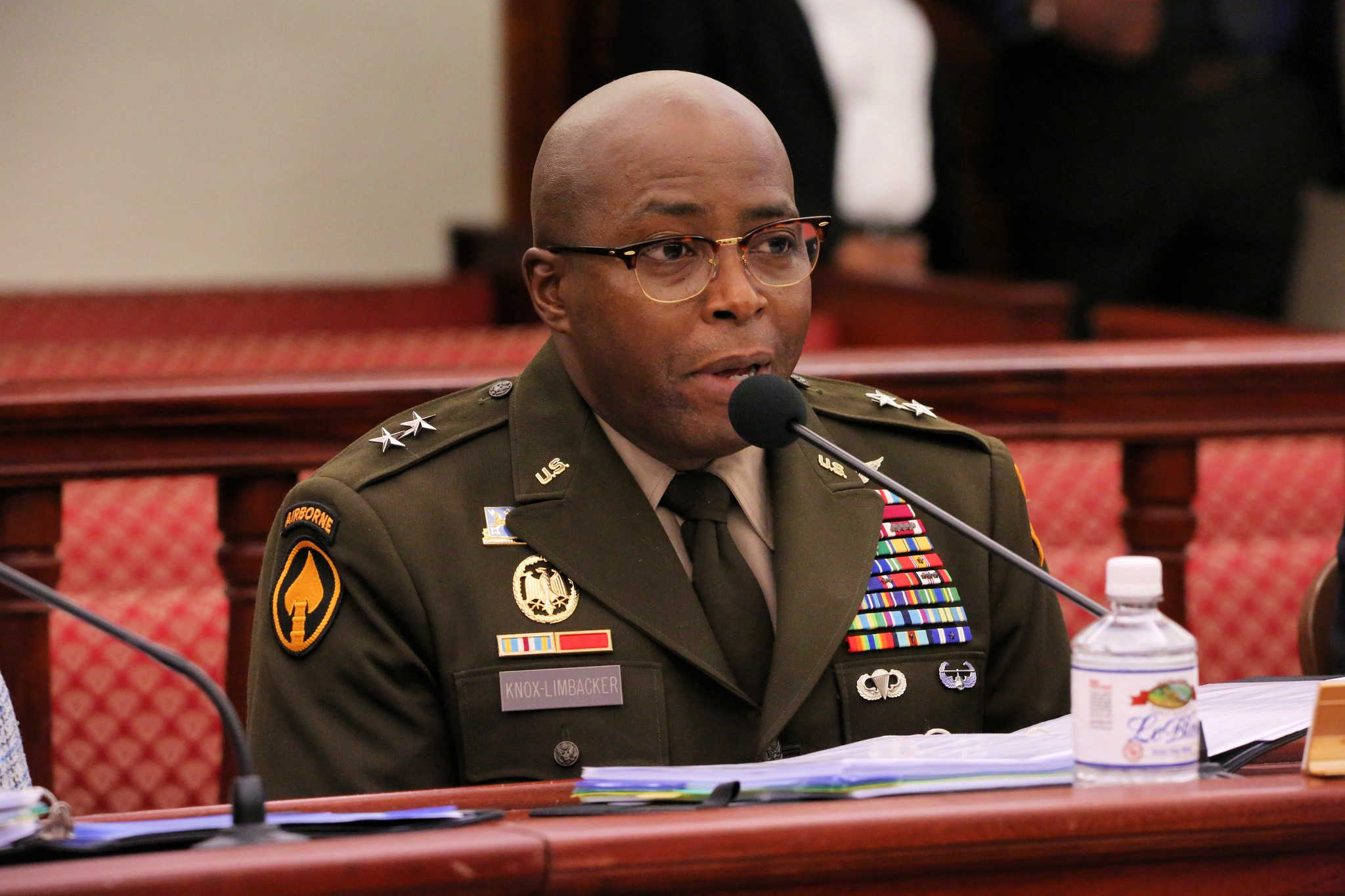
Major-General Kodjo Knox-Limbacker. Photo Credit: V.I. LEGISLATURE
The V.I. National Guard was praised by lawmakers on Friday for qualities one may expect from a military organization – precision and thoroughness – as representatives presented their fiscal year 2024 budget to the Senate Committee on Budget, Appropriations and Finance.

Major-General Kodjo Knox-Limbacker, Adjutant General of the VING, told lawmakers that the agency has proposed a budgetary allocation of $2.7 million from the territory’s general fund, designed to maintain a "ready, relevant, and responsive Army and Air National Guard joint force." Nikita Ward, the Office of the Adjutant General’s executive director, explained that the funding would go towards supporting 19 full-time positions with a total salary allocation of just over $1 million. A sum of $220,346 represents the local match for capital projects and $400,882 is dedicated to the total fringe benefits for the employees. Operational services and miscellaneous charges are represented by $836,370, she noted.
He emphasized that the requested funds from the V.I. government is dwarfed by the federal projected contribution of $52.8 million, which is crucial to safeguarding the territory and supporting the National Guard's wartime mission. The federal dollars are anticipated to increase by 1 percent over the last fiscal year.
However, the local dollars were still very much needed. Ms. Ward explained that, "It is of utmost importance to note that the requested general fund match for the master cooperative agreement, operations, and maintenance costs must be committed in order to receive our federal share."
U.S. Property and Fiscal Officer for VING, Colonel Deborah Lobbenmeier, explained the value of the federal government’s investment in the territory through the VING. Of the $52.8 million expected to be received in the upcoming fiscal year, “we estimate that…75 percent or approximately $39.6 million will remain in the Virgin Islands,” Colonel Lobbenmeier said.
MG Knox-Limbacker went on to discuss the changes implemented within the agency, which included increasing readiness, shifting the performance culture, restructuring the force to stay relevant, and focusing on developing future leaders. He reassured the committee that VING is a critical part of the operational reserve force of the Army and Air Force, prepared to meet challenges and take advantage of opportunities for the nation. The Adjutant General noted the increased operational tempo of the VI National Guard, citing it as among the highest in its nearly 50-year history since its founding on October 19, 1973. He stated, "Our National Guard continues to be always ready, and always there," emphasizing their efforts in maintaining administrative, security, and training functions.
Outlining several key activities undertaken by his agency, including support for many of the Virgin Islands' emergency functions such as naval operations, public safety, monitoring toxic gas releases from oil refineries, and supporting tourism-related events, MG Knox-Limbacker noted that the National Guard had "increased its support within this territory twofold" during Governor Albert Bryan Jr.’s tenure, providing new employment opportunities and a greater capacity to support federal government initiatives.
MG Knox-Limbacker emphasized his force's training achievements, stating that over 90 percent of the units had successfully completed all annual and inactive duty training requirements for the year. He also outlined the agency's commitment to readiness, citing its participation in national-level exercises and its plans to deploy more units to the African theater in the coming year. "Whether it is support for national defense strategies overseas or support at home during times of crisis, they continue to exceed the standards and embody the warrior ethos," he said of the men and women under his command.
When it came time to answer questions from committee members, MG Knox-Limbacker disclosed to Senator Kenneth Gittens that the Army Aviation Support Facility that was originally scheduled for completion in 2025 is now delayed until 2027 due to construction cost overruns. With build-out costs now estimated at $1,500 per square foot, the initial $39 million allocated for the project is no longer sufficient, meaning that the VI National Guard will either have to build a smaller facility, or request additional funding. MG Knox-Limbacker reassured that the federal National Guard Bureau is committed to ensuring the full facility is built, and thus the project is continuing, albeit with a revised completion date.
In keeping with her previous comments and concerns regarding inter-agency collaboration, Senator Donna Frett-Gregory, budget committee chair, asked MG Knox-Limbacker about the workings of the National Guard ChalleNGe program for at-risk youth. The adjutant general explained that collaboration is indeed happening between the National Guard and various agencies, including Human Services and Education, from whom the NG gets its program referrals, to support at-risk youth. For students with criminal activity, there are different systems in place. The Youth ChalleNGe program is about "making sure they graduate high school to get a GED and actually be in an environment that's controlled based on their parents or the courts recommendation," MG Knox-Limbacker noted.
He reassured Senator Marise James, former Staff Judge Advocate for VING, that the Forward March program would be energized this year. The initial focus had been on ensuring that the About Face program for younger students was running effectively, and now with the right personnel and resources, the Forward March program for those ages 18-29 would begin to be rolled out.
Ms. James also enquired about morale within the National Guard, based on what she said were concerns about people being assigned to duties they are not qualified for, and other matters. However, she said that she would discuss the matter with him in a more private forum.

Ultimately, Major General Knox-Limbacker acknowledged that not every member of the over 600 men and women in the VI National Guard would be happy about their circumstances, but he highlighted achievements such as the solving of many of the deficiencies previously identified by the National Guard Bureau and the Department of Defense, and the increase in recruitment numbers as positive signs of progress. He concluded his testimony by thanking the community, legislative branches, the governor, and the servicemen and women for their contributions and support to the VI National Guard.


Advertisements