

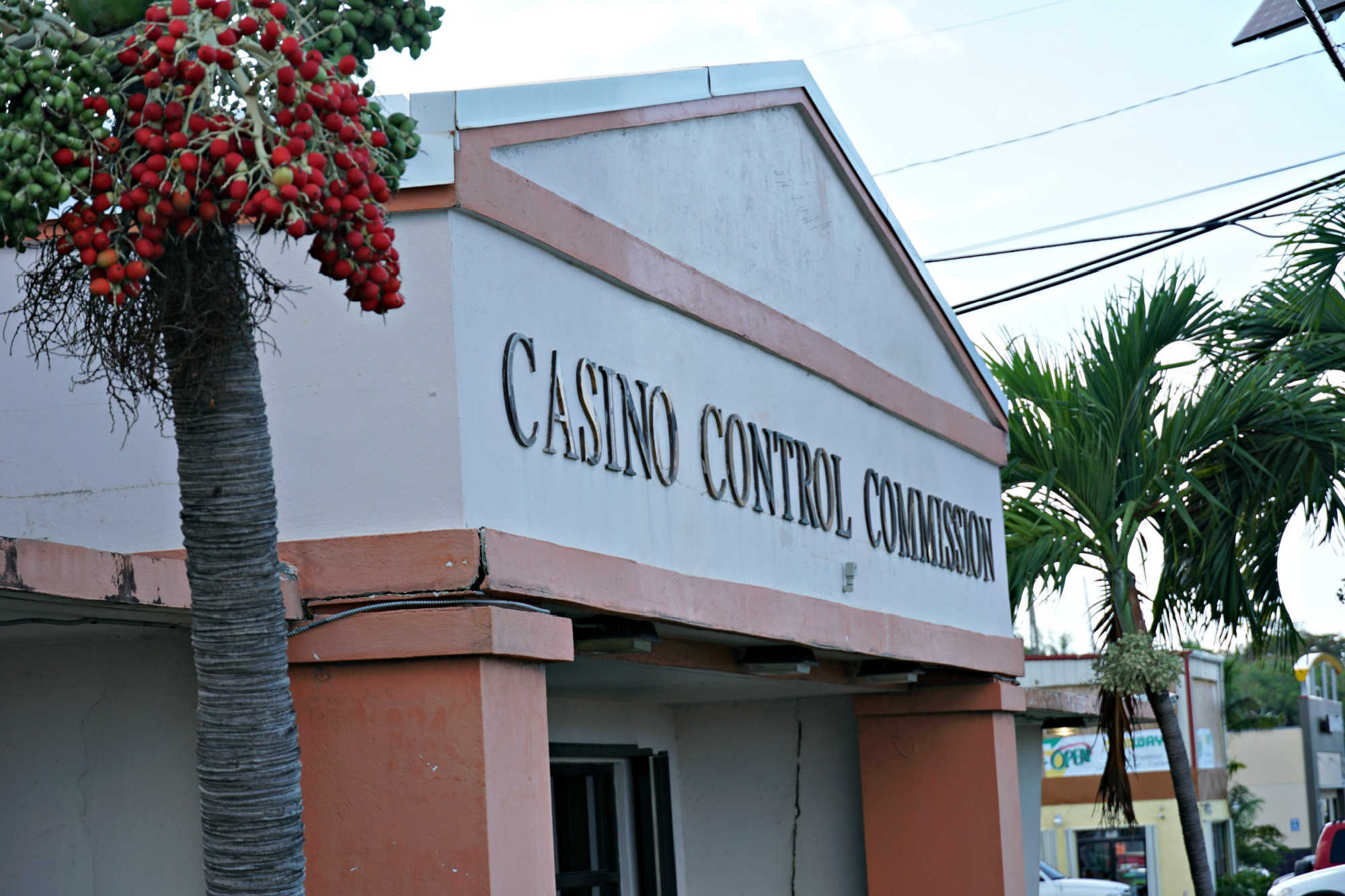
The Casino Control Commission office in Orange Grove, St. Croix. Photo Credit: V.I. CONSORTIUM.
A proposed $300,000 increase to the Virgin Islands Casino Control Commission’s general fund appropriation for Fiscal Year 2026 has prompted both support and scrutiny from lawmakers. The additional funding would allow the Commission to hire two new employees and implement previously approved salary increases for all staff, according to testimony delivered last week by Marvin Pickering, the Commission’s chief executive officer.

“The governor has recommended a budget of $1,723,800,” Pickering told the Committee on Budget, Appropriations, and Finance, noting that the Commission typically receives $1,423,800 from the general fund. He clarified that 100% of the general fund allocation is used to cover salaries and fringe benefits for the Commission’s 15 staff and commissioners. Wage increases approved in 2023 had not been accompanied by a corresponding budget increase until now.
The new funds will also support two key hires: an IT support specialist and a casino inspector, with a combined salary and fringe cost of $163,477. Pickering said the hires are part of the Commission’s plan to finally implement the Internet Gaming and Internet Gambling Act, which was enacted in 2001 but has seen little movement since.
“It is incumbent on us to have an IT person who is knowledgeable in cybersecurity, surveillance, anti-money laundering and other highly skilled fields,” he said. An additional inspector is necessary to “monitor compliance with industry standards and Virgin Islands law.”
Senator Franklin Johnson questioned the urgency of the expansion. “We anticipate that rather quickly, that we could implement the Internet Gaming and Gambling Act… We need to be prepared for when that happens,” Pickering replied. Johnson pressed further, asking whether this would happen “in the very near future.” Pickering remained firm: “We certainly going to make a push for it,” he said.
But Senator Kurt Vialet suggested the legislation may be too outdated for rapid implementation. “It was a strange bill, because specific entities were named that were going to be in charge of Internet Gaming. I don't know if those entities are still around,” he said. “Because that was a strangely written bill, and there's going to need to be some change so that we are able to move forward.”
In a separate line of questioning, Senator Hubert Frederick challenged the need for continued general fund support. “They're so impressive that I'm beginning to wonder why we're funding this agency,” he remarked, praising the Commission's cost control efforts. “You've taken the fluff out of this agency. It's running mean and clean. We need a rate of return as a taxpayer. We need less money being allocated or appropriated to your agency.”
Pickering countered that salaries and fringe benefits are legally mandated to be paid from the general fund. “The set that the general fund doesn't have to fund, that's a return on your investment,” he explained.
Vialet acknowledged the agency’s revenue performance: “All the gross casino revenue collected for this fiscal year thus far is $1.7 million, which is actually more than we give to the entity.”
Despite that, Senator Ray Fonseca criticized the Commission’s travel spending. “Your travel is more than the whole Department of License and Consumer Affairs… Your ticket allotments for inter-island travel is also more than Licensing, and it's also more than the Bureau of Information Technology… We need to start trimming this cow, because the government is in a funding shortfall,” he said. Like Frederick, Fonseca called for the Commission to “start giving something back to the government.”
Senator Marise James defended the Commission’s mission. “I think that we need to understand that the Casino Commission is a regulatory entity… It's very important that you express that you do not generate revenues, that everything you're doing is to make sure that our laws that we, the Legislature, have enacted, are being adhered to.”

Pickering concluded by stating that the Commission’s total annual operating cost is closer to $2.5 million, and that there is “no way” the agency could fully self-fund each year. In addition to general fund support, the Commission receives funding from licensing fees and casino revenue taxes.


Advertisements