

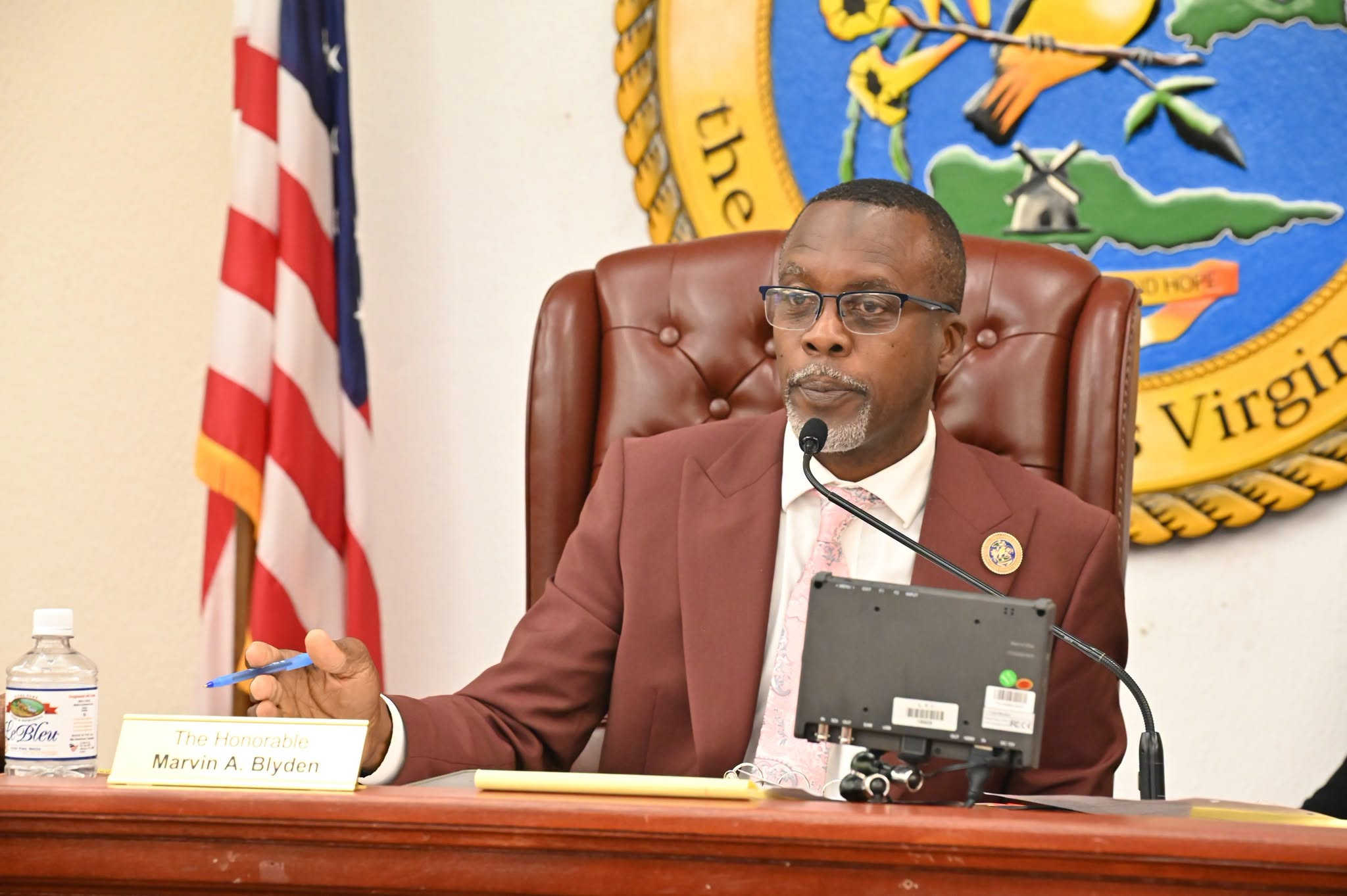
Senator Marvin Blyden has given the Virgin Islands Housing Finance Authority until 5 p.m. Thursday, October 8, to provide a detailed accounting of the effects of its federal suspension, warning that he will initiate subpoena proceedings if the agency fails to produce a complete and legally sufficient response.
The October 2 letter to VIHFA Executive Director Derek Gabriel represents a final demand for information first sought in July and August. Mr. Blyden, chairman of the Committee on Housing, Transportation and Telecommunications, said the absence of the requested details had already hindered lawmakers’ ability to consider local assistance for affected programs and nonprofit organizations during deliberations on the fiscal year 2027 budget.
The committee has also scheduled a meeting for 2 p.m. Friday, October 9, at the Earle B. Ottley Legislative Hall on St. Thomas to consider action concerning subpoenas for VIHFA officials’ appearance and the production of records. The meeting notice makes that step conditional on the authority failing to provide complete and satisfactory information by the previous afternoon’s deadline. If VIHFA complies on time, members will be told whether the meeting is canceled or its agenda amended.
Mr. Blyden wrote: “This letter constitutes the final opportunity for voluntary compliance.” The dispute centers on how much VIHFA must disclose about the practical consequences of the U.S. Department of Housing and Urban Development’s suspension while the authority challenges the federal action and related investigative activity continues. Mr. Blyden’s latest demand was accompanied by an eight-page opinion from the Office of Legislative Legal Counsel concluding that VIHFA had not established a legally sufficient basis for withholding its full written response on confidentiality grounds.

Mr. Blyden said the committee requested detailed information on July 20 and August 5. VIHFA was also invited to the committee’s September 30 hearing but declined to appear, primarily citing confidentiality concerns surrounding the HUD matter and Mr. Gabriel’s absence from the territory, according to the letter.
The senator linked the dispute directly to services provided to residents. He said lawmakers wanted to identify the programs and organizations affected, determine the potential loss or disruption of federal funding, and evaluate whether local money could reasonably cover particular gaps.
He wrote: “VIHFA’s failure to provide the requested information has deprived the Legislature of a meaningful opportunity to consider assistance for these programs and nonprofit organizations during its deliberations on the Fiscal Year 2027 budget, which has now been passed.”
The letter does not establish an overall dollar amount lost or identify a complete list of organizations whose funding has been interrupted. Those are among the matters the committee is seeking to clarify through the requested records.
VIHFA did respond to the earlier correspondence, although the adequacy of those responses is disputed. According to the September 30 legal memorandum, the authority said in a July 23 response that HUD had not imposed a payment hold or stop-work order, that it was seeking clarification and contesting the suspension, and that public discussion could prejudice resolution of the matter. That account describes VIHFA’s position in July; the final demand seeks updated payment and project information.
The memorandum says Mr. Blyden’s August 5 follow-up acknowledged that attorney-client communications, personal identifying information and particular investigative material might require protection. It requested the legal basis for withholding information, appropriately redacted records and a confidential briefing if necessary. VIHFA responded on August 10 that certain information had to remain confidential during the suspension and related investigative activity, but did not identify the legal basis or scope of that restriction, according to counsel’s review.
Assistant Legal Counsel Kathryn E. Hill prepared the opinion through Chief Legal Counsel Amos W. Carty Jr. Their office reviewed the July and August correspondence and HUD’s July 20 suspension notice. The opinion concludes that neither the notice nor the cited federal suspension regulations imposes a blanket obligation preventing VIHFA from disclosing independently maintained program, financial and operational information.
Counsel distinguished underlying facts about public programs and spending from protected legal communications and litigation work product. The opinion says information does not become privileged simply because it was given to an attorney or reviewed by counsel. It also recognizes that particular records may be protected by a statute, a qualifying privilege, a court order or a binding federal nondisclosure directive, requiring an assessment of the specific information at issue.
The final demand translates that position into eight categories of requested information. VIHFA is directed to identify every program, project, activity, grant, cooperative agreement, federal award, government entity, nonprofit organization, contractor and subrecipient affected or potentially affected by the suspension.
For each affected or potentially affected award, the committee wants the original award amount, the amounts obligated and spent, the undisbursed balance, the funding source and the amount currently at risk. It also seeks the status of the authority’s access to federal payment and drawdown systems and information about any payment hold, stop-work directive, special condition, termination notice or other restriction.
The request extends to approved projects, contracts, agreements and commitments, including those that will require another obligation, an amendment, increased funding, a contract award, renewal, extension or other federal transaction. VIHFA must also explain the present and potential effects on homeowners, renters, applicants, contractors, nonprofits, subrecipients and other intended beneficiaries without disclosing unnecessary personal identifying information.
Mr. Blyden is seeking the procedural status of VIHFA’s challenge or appeal, including actions taken, deadlines, the relief requested and any exception, waiver, administrative agreement or other measure being pursued. The remaining categories cover corrective measures completed or outstanding, the officials responsible and their deadlines, and material communications from HUD or other federal agencies about the suspension’s scope and practical consequences.
Any withholding or redaction must be accompanied by a written log identifying the information withheld, the precise legal authority relied upon, why that authority applies and whether the rest of the document or response has been produced. The letter requires narrowly tailored redactions and production of all nonprotected portions. Sensitive information whose disclosure is not legally prohibited may be submitted confidentially or presented in a confidential briefing under appropriate safeguards.
If information remains unavailable or incomplete, VIHFA is directed to produce what it has, identify what is outstanding, explain why and provide a firm date for supplementing the response.
The demand comes more than two months after HUD’s July 20 notice immediately suspended VIHFA from future participation in covered federal procurement and nonprocurement transactions pending investigation. The notice extends to covered transactions throughout the federal executive branch. Its restrictions on future transactions do not, by themselves, establish that every existing federal award has been terminated or every payment stopped.
The Consortium reported September 12 that the suspension had delayed individual home-repair and homeownership efforts and affected public projects awaiting funding or authorization. That reporting illustrated why an award-by-award and project-by-project accounting matters: residents and agencies can face different consequences depending on what agreements or approvals remain necessary.
HUD’s fiscal year 2026 Housing Trust Fund allocation notice provides a separate example of the suspension’s continuing relevance to new funding decisions. Published September 4, it lists $70,897.89 for the Virgin Islands while expressly making that allocation subject to VIHFA’s suspension and reserving HUD’s rights and remedies. The notice does not say the allocation was canceled.
The Bryan administration has also sought a clearer route to resolving the federal dispute. In a September 30 statement, Government House said Governor Albert Bryan Jr. had requested a written corrective-action framework, measurable benchmarks and direct engagement with HUD officials empowered to make decisions. He also asked the Department of the Interior to help secure that engagement.
For the committee, the immediate next step remains VIHFA’s written production by October 8. Mr. Blyden’s letter says an inadequate response would lead him to initiate proceedings for subpoenas compelling appropriate officials to appear and produce records, invoking the Legislature’s investigative authority under section 6(g) of the Revised Organic Act.

He wrote: “The Committee remains willing to protect legitimately privileged and confidential information. What it cannot accept is the continued withholding of nonprotected information concerning public funds, public programs, public projects, and their effects upon the people of the Virgin Islands.