

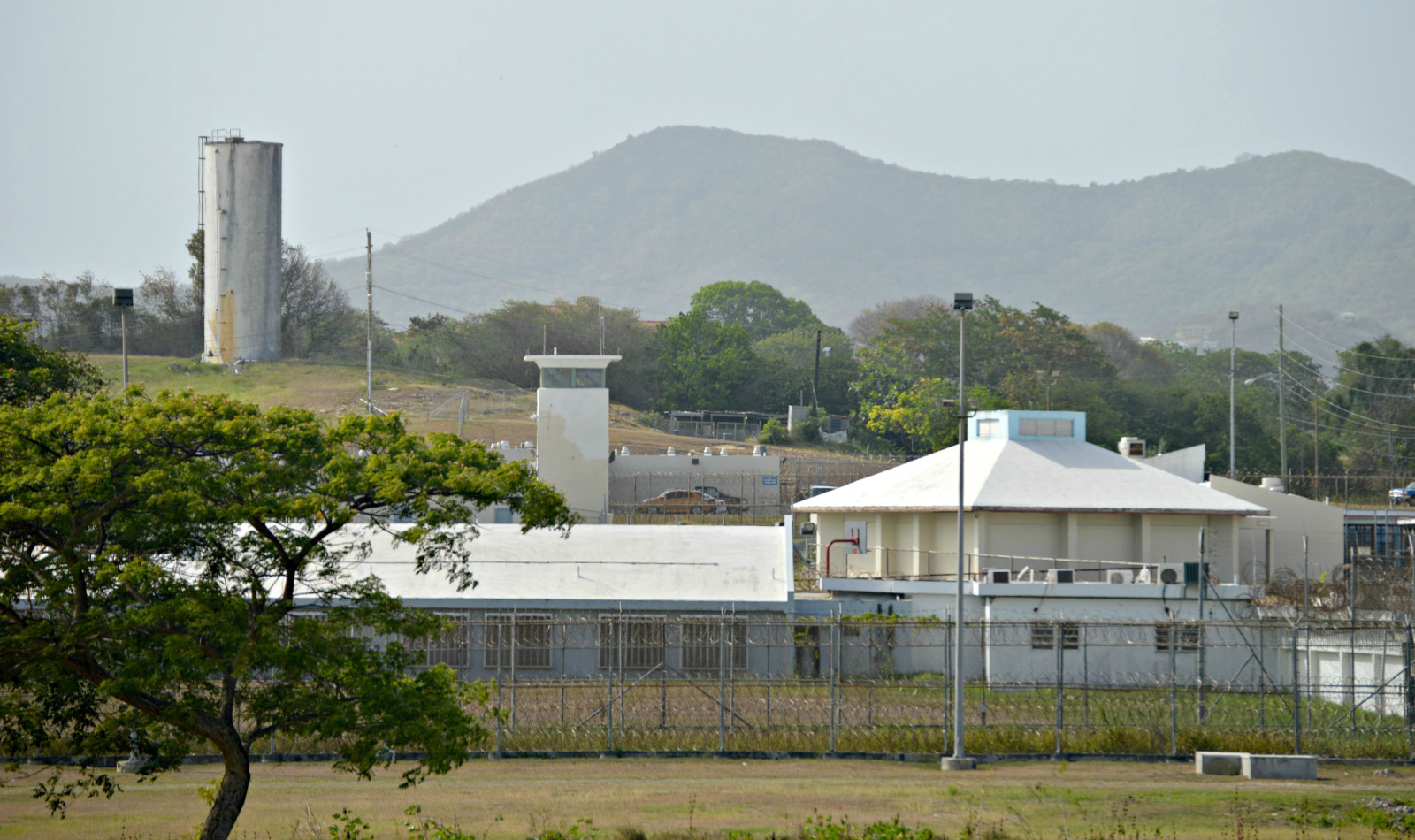
Legislation creating criminal penalties for incarcerated people who possess or use unauthorized electronic communication or recording devices advanced Thursday from the Senate Committee on Homeland Security, Justice, and Public Safety.

Bill 36-0301 received support from the V.I. Bureau of Corrections and the Department of Justice, but DOJ presented lawmakers with ten proposed amendments, including provisions to punish people who smuggle devices into correctional facilities, protect authorized communications and require any new prison sentence to run consecutively.
The measure, sponsored by Senator Kenneth Gittens, would amend Title 14 of the Virgin Islands Code to prohibit incarcerated individuals from possessing or using electronic communication or recording devices.
Introducing the bill, Mr. Gittens said unauthorized cellphones and other electronic devices “undermine the mission of the Bureau.”

He said the devices are used to “facilitate criminal activity, intimidate victims and witnesses, compromise investigations, coordinate contraband trafficking, threaten staff safety, and broadcast acts of violence that should never occur inside a secured institution.”
Mr. Gittens acknowledged that the devices “are not walking through the prison on their own.”
Instead, he said, they may be smuggled into correctional facilities by visitors, “introduced by individuals working within the institution, or entering because security screen procedures have failed.”
Although Bill 36-0301 focuses on possession and use by inmates, Mr. Gittens said he hoped the measure would also reinforce the need for accountability among those responsible for introducing contraband.
BOC Supports Stronger Statutory Authority
Bureau of Corrections Director Wynnie Testamark supported the legislation, describing contraband electronic devices as a significant security concern.
“The growing availability of contraband electronic devices…has become one of the most significant security challenges facing correctional agencies nationwide,” she testified.
Locally, confiscations at the John A. Bell facility have continued to decline after a substantial increase in 2024, Ms. Testamark said.
At the Criminal Justice Center on St. Thomas, however, there was a “slight increase observed during the first half of 2026.”
According to Ms. Testamark, BOC “has taken proactive steps to address these evolving threats.”
Those efforts include a “comprehensive contraband interdiction strategy”, along with updated policies, training and assistance from a specialized canine.
Bill 36-0301 “complements these existing efforts by providing stronger statutory authority to address unauthorized electronic devices,” she said.
DOJ Seeks Offense for Smuggling Devices
The Department of Justice also supported the measure but submitted ten recommended amendments. Chief Deputy Attorney General Ian Clement outlined four of those proposals during the hearing.
Mr. Clement first noted that the bill does not create an offense covering the introduction, delivery or conveyance of prohibited devices into a correctional facility.
He encouraged lawmakers to “add an offense that makes it illegal for any person to introduce, deliver, provide, attempt, or conspire to provide a prohibited device or any component of one to someone in the custody of the Bureau.”
Such a provision would extend criminal liability beyond inmates to visitors, employees or others who may help bring electronic devices into a facility.
Mr. Clement also recommended including an “authorized use exemption” to prevent legitimate BOC activities from being criminalized.
He cited authorized video communications between an inmate and an attorney as an example of activity that should remain permissible.
DOJ Says Proposed Penalty "Lacks Teeth"
Mr. Clement also warned that the bill’s proposed punishment “lacks teeth.”
As drafted, Bill 36-0301 provides for imprisonment of not less than one year and not more than five years, a fine of no more than $5,000, or both.
“A $5,000 fine against an indigent inmate yields nothing, and a sentence of one to five years imposed concurrently with his current sentence costs him nothing at all,” Mr. Clement testified.
He recommended that the measure explicitly state that “any prison term imposed under this subsection shall run consecutively to any sentence a person is already serving.”
Under that proposal, a person convicted under the bill would serve the additional sentence after completing the prison term already being served.
Violence Provision Described as Unclear
DOJ also recommended deleting or “substantially rewrite” Subsection 5 of the bill.
That provision would make it a felony to knowingly participate in an act of violence near a prohibited electronic device, allow such an incident to be recorded without reporting it to the warden, BOC director or a correctional officer, or attempt to prevent the incident from being reported.
According to Mr. Clement, “the terms are unclear.”
He warned that under the current language, “an inmate who commits an assault without knowing that a third person across the room is filming is guilty of a felony.”
Mr. Clement instead proposed a “graduated penalty based on the device’s use.”
That approach would distinguish between simple possession of a device and more serious conduct involving its use to facilitate, record or distribute criminal activity.
Committee members largely supported the legislation, while occasionally emphasizing that people responsible for introducing contraband should also face penalties.

Mr. Gittens indicated that amendments may be attached when Bill 36-0301 is considered by the Committee on Rules and Judiciary.