




WTJX could begin laying off employees after losing $1.3 million in annual federal public broadcasting support previously received through the Corporation for Public Broadcasting, leaving the territory’s public broadcaster with a $700,000 shortfall even after projected restructuring savings.

The funding loss is on the federal side and is separate from WTJX’s relationship with PBS. The Corporation for Public Broadcasting served as the conduit for federal support to public broadcasters such as WTJX. PBS, meanwhile, remains a separate financial obligation for the station through annual dues.
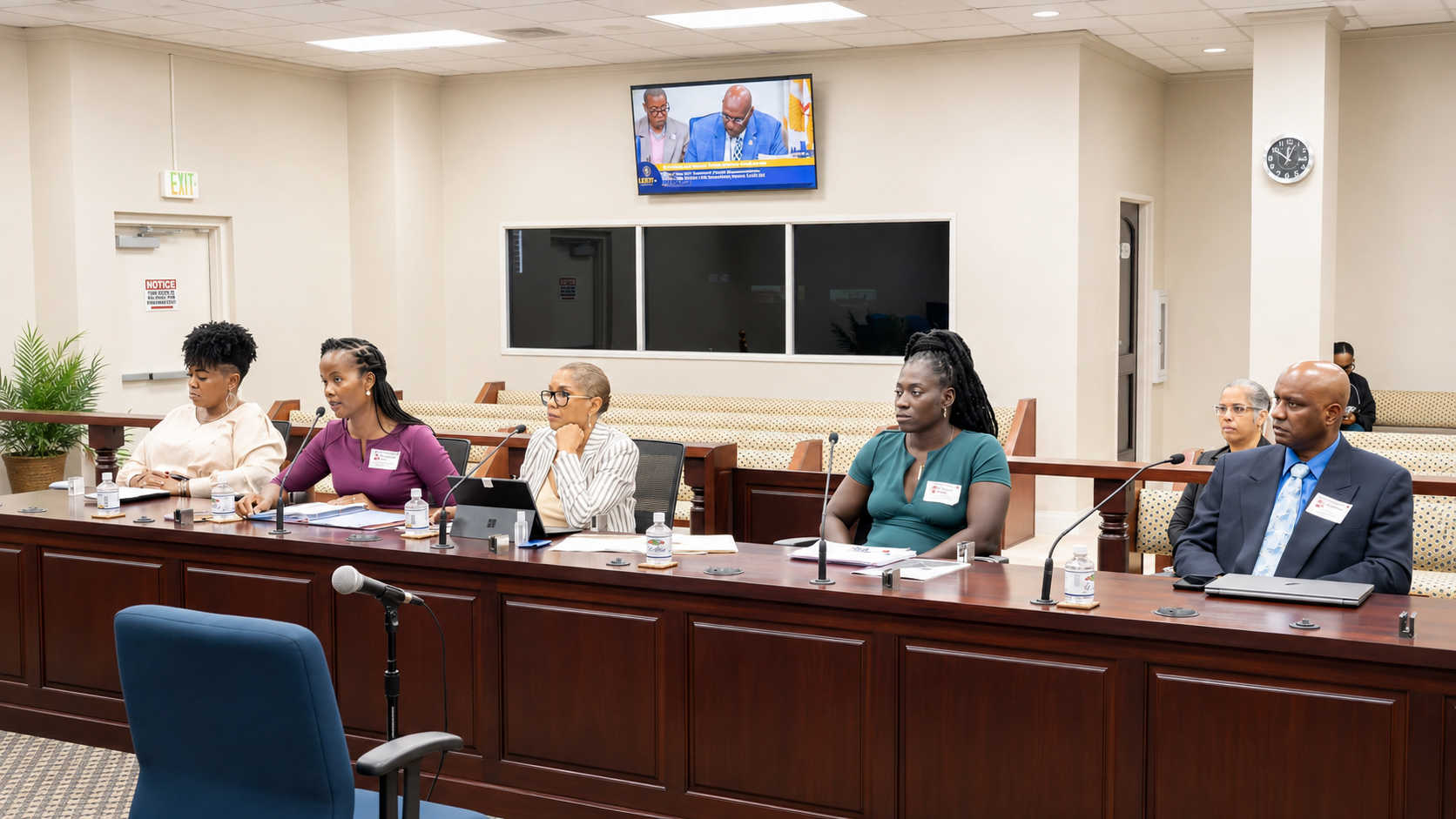
Chief Executive Officer Tanya-Marie Singh told lawmakers during Tuesday’s budget hearing that WTJX “may be looking at a first round of layoffs if we do not receive additional funding.”
That first round could affect three employees.

Chief Financial Officer Nedra Thomas said $133,592.66 would be needed to “save” the three positions.
WTJX expects an internal restructuring effort to save approximately $600,000, but that still leaves a $700,000 funding gap following the $1.3 million annual federal funding loss.
WTJX Seeks Between $4.93M and $5.03 Million
Singh requested a fiscal year 2027 budget of $4,931,902.
Thomas told lawmakers that $5,031,902 would allow WTJX to retain the three employees currently at risk. The station’s financial problems have also affected negotiations with the union representing WTJX employees.
Those discussions were suspended after the federal funding loss and are not expected to resume until the budget hearing has concluded and management has a clearer picture of the station’s financial outlook.
WTJX is currently unable to provide salary increases.
Singh said management has been “trying to save money through attrition,” including by not automatically filling positions when employees leave. That strategy, however, has limits. WTJX says it still needs to fill important leadership positions in engineering and fundraising.
Fundraising Position Remains Vacant
The absence of a fundraising director has become particularly significant as WTJX searches for replacement revenue.
The station raised $222,282 in FY 2024 and $252,953 in FY 2025.
Year to date in FY 2026, donations and other support total $182,611, with approximately a month and a half remaining in the fiscal year.
Companies participating in the Economic Development Commission program can now make contributions to WTJX in exchange for credits, but the station currently lacks a dedicated employee focused on pursuing those contributions.
“Because we're so immersed in the operations, we really need somebody that's doing that work,” Ms. Singh said to Senator Novelle Francis.
PBS Dues Are a Separate Financial Problem
Apart from the $1.3 million loss in federal support previously received through CPB, WTJX must continue meeting its separate financial obligations to PBS.
The station has paid its FY 2027 PBS dues. The following year remains unfunded. “However, we do not have the funding to pay the FY 2028 dues,” Ms. Singh said. That payment is due during summer 2027. Thomas estimated that the FY 2028 dues could reach approximately $708,000 “based on trends.”
WTJX has submitted a $500,000 supplemental budget request to help meet that obligation. Singh said the station was “instructed to only ask for $500,000, knowing that we need more than that.”
Lawmakers Question Whether More Government Funding is the Answer
The request received a mixed reaction from senators.
Sen. Hubert Frederick asked WTJX officials about “creativity” in responding to the financial shortfall and questioned “what adjustments have you on the board made to now correct, right-size organization?”
Singh pointed to the decision not to fund certain positions after employees leave as one of the measures being taken to reduce expenses.
Frederick cautioned against assuming that additional government funding must be the only solution.
“I don't want everyone to leave here thinking us giving you money is the only option here. There are other things that you guys could still do that would help,” Sen. Frederick said to Ms. Singh.
Singh agreed with the broader point but emphasized the magnitude of losing $1.3 million in recurring annual support.
“there's just things we cannot get around in terms of progressing” because of that loss, she said.
Sen. Ray Fonseca asked whether WTJX’s board had considered “reducing professional service contracts and renegotiating leases and tower agreements.”
According to Singh, the leases are “set.”
More Than $400K in FEMA Funds Draws Scrutiny
Lawmakers also focused on cash reserves held by WTJX. Thomas explained that some money is being “saving that money to contribute to our recovery.”
Other reserves are intended for “upgrades on our equipment for production.” Just over $400,000 consists of FEMA stabilization funds and “have to be kept separate,” Thomas said. WTJX has designated that money for capital projects in its pipeline.
Sen. Carla Joseph questioned whether those capital projects should take precedence while employees face potential layoffs and the government itself is experiencing financial pressure.
“Right now the government is strapped for money,” she said. “You're asking us for like half a million. But if you have pots of monies there sitting, you need to use that money.”
Joseph recommended that WTJX consider using existing resources for “austerity” purposes.
Sen. Dwayne DeGraff similarly urged management to prioritize jobs. “Put the money toward the employees. Hold those other things that you're looking to do…don't let that $400,000 that you have sit, and you need money for employees.”
Singh later explained that the money is tied to necessary broadcast infrastructure. “We must have a microwave path, and that costs money, and that is where the $400,000 is going.”
Jobs Versus Capital Projects Could Become a Larger Decision
Francis said lawmakers and WTJX may ultimately have to decide whether preserving positions should take priority over planned capital investments. “At some point, then we have to decide whether or not the capital projects will be the priority over these positions that have now been impacted by that.”
He said such a decision would need to be made “collectively” and “based on the availability of funding.”
For now, WTJX is attempting to absorb part of the $1.3 million annual federal funding loss through approximately $600,000 in restructuring savings while pursuing additional funding to close the remaining $700,000 gap.
At the same time, the station must decide how to protect employees, fill critical positions, preserve money for infrastructure and prepare for a separate PBS dues obligation that could approach $708,000 in FY 2028.

Without additional resources, management says three employees could be the first affected by layoffs.