


Small Business Administration Atlantic Regional Administrator Matt Coleman said Friday that the federal government is mobilizing a “whole of government approach” in response to what he described as unfair trade actions by the British Virgin Islands that are financially harming U.S. Virgin Islands marine small businesses.

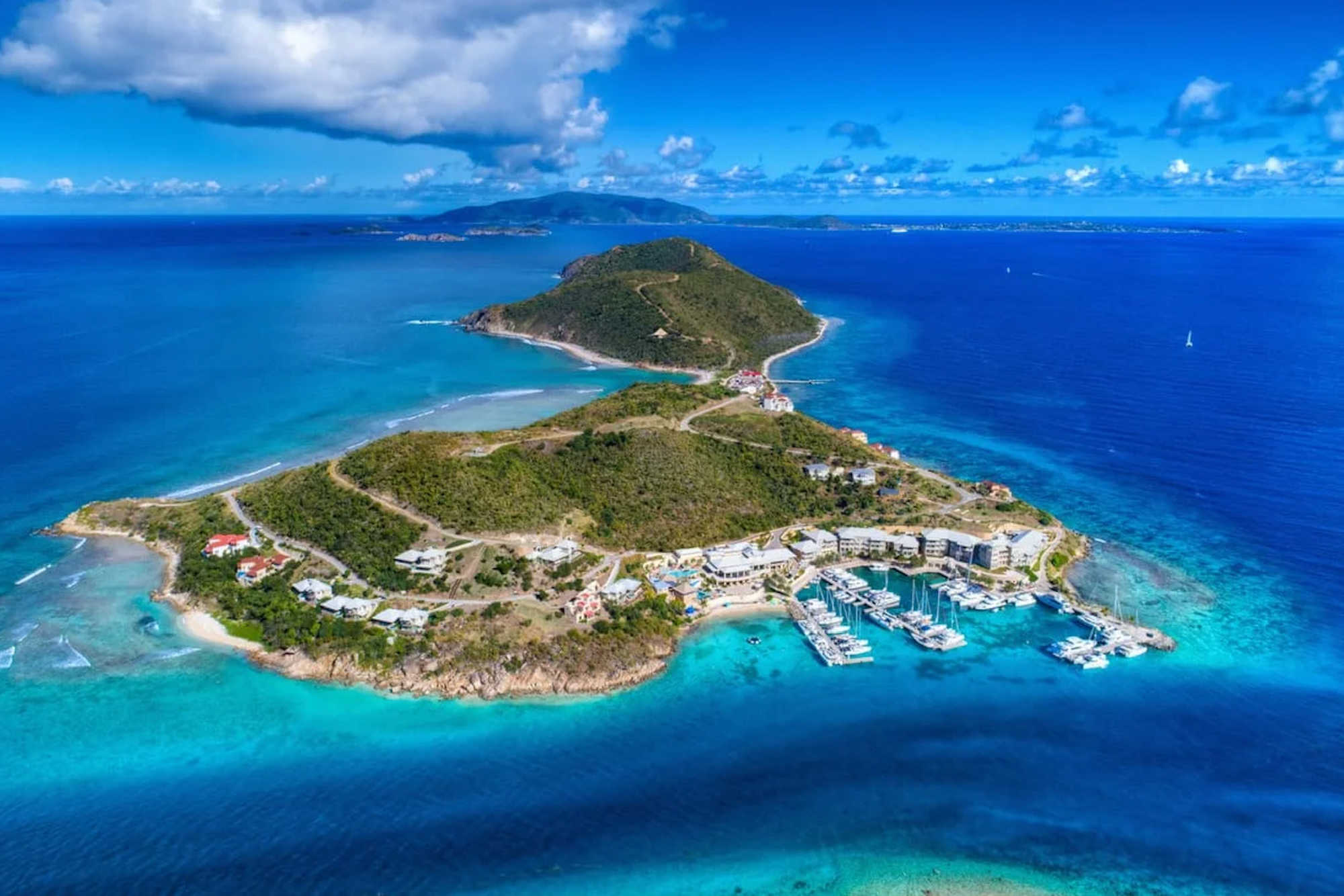
Speaking February 20 from St. John — with Tortola visible behind him across the channel — Coleman noted that he is the first SBA regional administrator in about 30 years to visit the island. He pointed across the water to Tortola, the capital of the British Virgin Islands, located about one and a half miles away.
He said the BVI government recently enacted trade measures that “monetarily punish U.S. marine small businesses crossing that historically shared waterway between our islands,” including fee hikes “from $400 to $24,000 annually.”
“That’s a whopping 6,000% increase,” Coleman said, adding, “and it’s absolutely numbing.”

Coleman stated that the SBA is leading efforts to address the economic challenges through coordination with federal partners, including the U.S. Department of State, the Department of Commerce, the Department of Homeland Security, and other agencies and sub-agencies.
“The SBA is leading the charge to address these economic challenges through a whole of government approach,” he said.
He also said he is looking forward to meeting with members of the charter vessel industry and the Virgin Islands Professional Charter Association, which he said represents members of a 5,000-employee industry generating a $166 million economic impact across St. John, St. Thomas and St. Croix.
“The SBA will continue to update you on our progress,” Coleman said.
The comments come amid ongoing tensions between the U.S. Virgin Islands and the British Virgin Islands over sharply increased charter vessel licensing and entry fees.
A recent federal trade report to Congress under the Caribbean Basin Economic Recovery Act stated that the British Virgin Islands’ Commercial Recreational Vessel Licensing Act changes are “significantly affecting” the U.S. Virgin Islands marine tourism industry.
The USVI and BVI charter sectors have long operated within an integrated marine tourism framework that depends on cross-border vessel movement. Tensions intensified as the BVI moved forward with a revised licensing structure for non-BVI-based charter operators.
As of June 1, 2025, the British Virgin Islands enacted steep increases in licensing and entry fees. Annual multi-night charter licenses that previously cost about $800 now stand at $24,000 per vessel. Day-trip licenses rose from $200 to $8,500 per vessel, in addition to customary customs and immigration charges that can add another $900 to $1,200 or more for each entry.
Project Fair Waters, a coalition representing a wide span of the USVI’s maritime economy — including charter operators, marine suppliers, fuel providers, marinas, restaurants, grocers, hoteliers and transportation operators — has asserted that the new structure has already prompted at least 90 charter vessels that once operated from the U.S. Virgin Islands to relocate to the British Virgin Islands.
According to the coalition, the shift has pulled nearly $14 million in direct spending out of the U.S. Virgin Islands economy. Projected losses, when accounting for provisioning, maintenance, hospitality and transportation impacts, are estimated to reach $100 million annually.
A delegation led by Crown Bay Marina president Kosei Ohno and joined by attorney Michelle T. Meade previously traveled to Washington, D.C., seeking federal engagement.
Explaining the urgency of that visit, Ohno said: “We came to Washington during the holidays because our season is starting right now. Without swift action, the U.S. Virgin Islands will continue losing American businesses, American jobs, and critical maritime capacity.”
Because the British Virgin Islands’ external affairs fall under the authority of the United Kingdom, territorial officials in the USVI cannot independently negotiate for relief.
Earlier in the dispute, Governor Albert Bryan Jr. met with BVI Premier Dr. Natalio Wheatley regarding the proposed increases. Bryan said he was seeking “an equitable resolution that builds our charter yacht industry, promotes this friendship, and creates economic wins for both territories.” He later warned that if an amicable outcome could not be reached, he could pursue federal support for tariffs, stating: “We are moving forward with our own strategy, and if we need help from the White House, I’ll get it from there too.”

Wheatley said publicly that he was “willing to make some concessions,” particularly for day-trippers, and described the BVI tourism model as one “not based on mass volume,” stressing the desire to keep the environment “pristine.”