



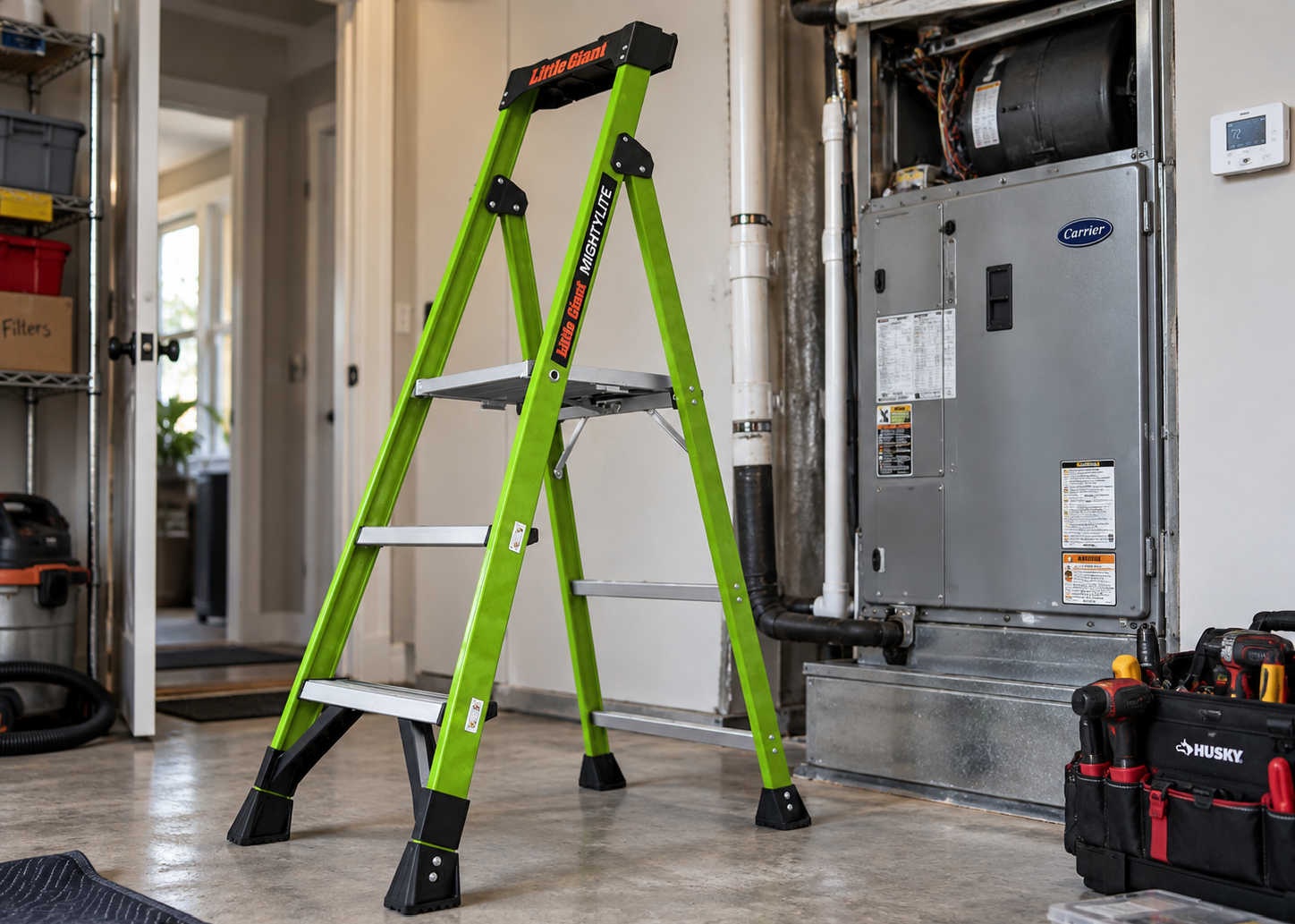
ST. CROIX — A federal magistrate judge has refused to move a product-liability lawsuit arising from an alleged ladder collapse on St. Croix to Utah, keeping the case in the Virgin Islands after finding that Little Giant Ladder Systems failed to establish that the lawsuit could properly have been brought in Utah when it was filed. Magistrate Judge Emile A. Henderson III denied the manufacturer's request on September 8.

According to the lawsuit, Markel Charles Fitchpatrick was using a Little Giant MightyLite eight-foot ladder on June 19, 2025 while servicing an air handler at the St. Croix office of William R. Nash (V.I.), Inc. The plaintiffs allege that Mr. Fitchpatrick was familiar with the ladder, had completed the required safety inspections and was using it in its ordinary and intended manner when the center locking clip separated from the metal structure, causing the ladder to open and collapse. Mr. Fitchpatrick allegedly fell onto a concrete floor and struck his head, ultimately requiring emergency brain surgery and intensive-care treatment in Miami.
Those allegations have not been proven, and the September ruling does not determine whether the ladder was defective or whether any defendant is responsible for Mr. Fitchpatrick's injuries. The decision addresses only where the case should proceed.
Mr. Fitchpatrick and his wife, Micah Lynne Fitchpatrick, filed the lawsuit in the District Court of the Virgin Islands on January 15, 2026 and submitted an amended complaint the following month. The case names Little Giant Ladder Systems, HB Global, HB Mechanical Group, William R. Nash LLC, William R. Nash (V.I.) Inc. and W.W. Grainger as defendants. Federal court records classify the matter as a personal-injury product-liability case.

The plaintiffs allege problems involving the ladder's design, manufacture, assembly, testing, labeling, warnings and safety features and have brought claims under product-liability and warranty theories. Mrs. Fitchpatrick is also seeking damages stemming from her husband's alleged injuries, while the plaintiffs have requested punitive damages.
Little Giant asked the court in March to transfer the lawsuit to the U.S. District Court for the District of Utah. The company is a Utah limited liability company with its principal place of business in Springville and argued that Utah was the more appropriate location because alleged product-design, manufacturing, warning and labeling conduct occurred outside the Virgin Islands and, according to the company, in Utah. Little Giant also said witnesses and records connected to production, sale and distribution of the ladder were located there.
The Fitchpatricks opposed the transfer, emphasizing that the ladder was used and allegedly failed on St. Croix, that the accident occurred here and that the ladder remained in the territory for inspection and testing. They also challenged Little Giant's assumption that the ladder had been manufactured in Utah, telling the court that its label appeared to indicate manufacture in China, though they acknowledged that discovery would be needed to confirm its origin. W.W. Grainger joined Little Giant's transfer request, while the Nash defendants informed the court that they did not object to a transfer but did not adopt the factual or legal arguments made by either side.
Judge Henderson first concluded that the Virgin Islands is a proper venue for the lawsuit because a substantial part of the events underlying the claims allegedly occurred on St. Croix. The court pointed to the plaintiffs' assertion that Mr. Fitchpatrick inspected and opened the ladder here, secured its center locking clip and used it here before the clip allegedly separated and the ladder collapsed. The judge found that St. Croix was therefore more than simply the location where Mr. Fitchpatrick suffered his injuries; it was also where the product allegedly failed in a manner directly tied to the plaintiffs' theories of liability and causation.
The court then examined whether the lawsuit could have been filed in Utah in the first place, a threshold Little Giant was required to satisfy before the court could consider whether Utah would be more convenient. The record showed that the defendants were spread across several jurisdictions: Little Giant is based in Utah, while other defendant companies are connected to Pennsylvania, Florida and the Virgin Islands, and the complaint identifies Grainger as an Illinois corporation. Henderson found that Little Giant had not demonstrated that all of the defendants were subject to the necessary jurisdiction in Utah when the lawsuit began.
The court also found that Little Giant had not supplied evidence establishing that the product-related conduct at the center of the lawsuit actually occurred in Utah. Although the company pointed to its Utah headquarters and argued that the alleged defect originated there, Henderson noted that Little Giant had not submitted factual material showing that design, manufacture, assembly, testing, warning, labeling or similar activities involving the ladder occurred in Utah.

Because Little Giant failed to establish that Utah was a proper venue where the entire lawsuit could originally have been brought, Henderson said the court did not need to proceed to the next stage of weighing convenience to the parties and witnesses or other public-interest considerations. The judge therefore denied the company's motion to change venue.