



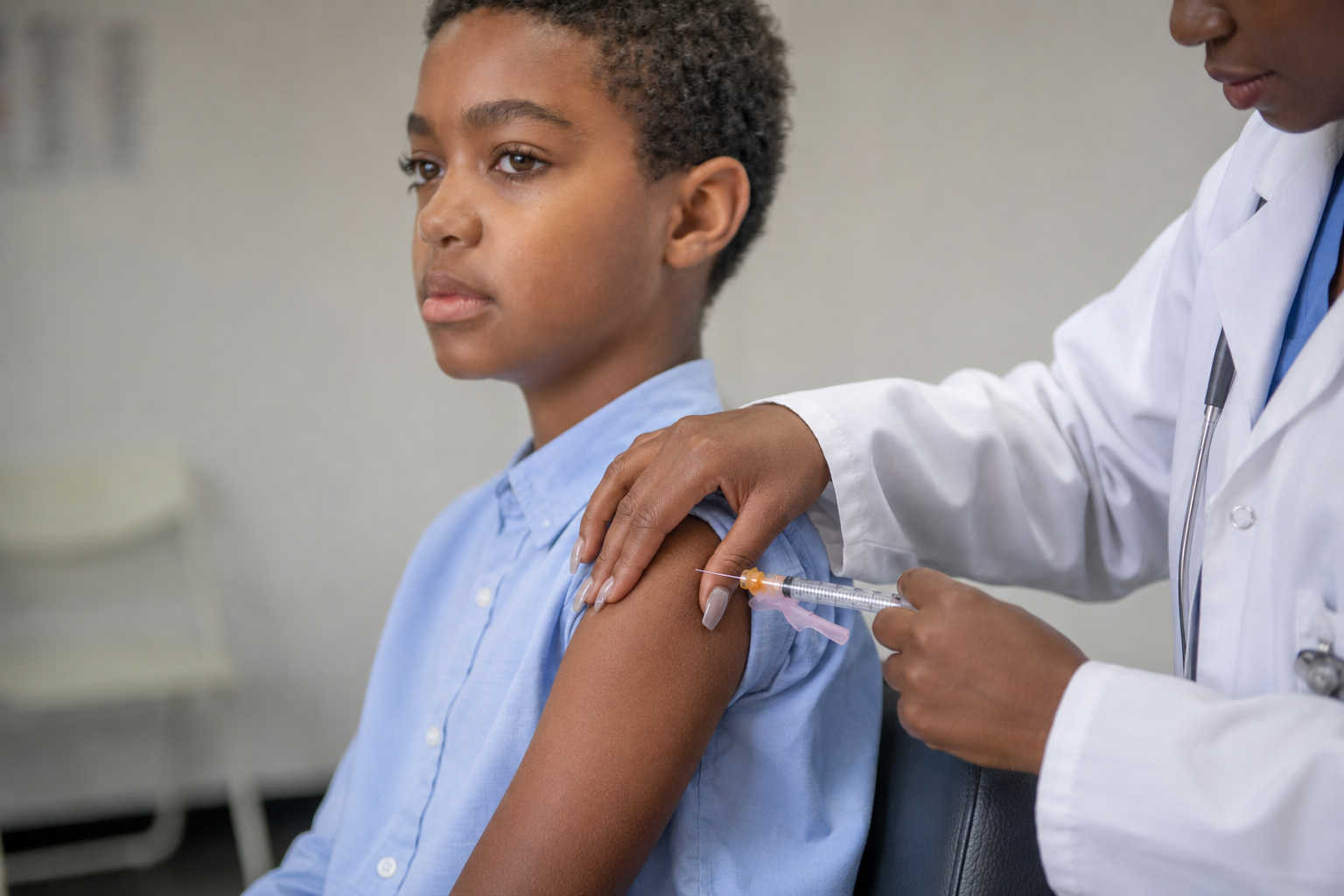
A bill to establish immunization requirements for children and students enrolling in educational institutions advanced with lawmakers’ support Thursday, but only after it became clear that provisions allowing religious exemptions would remain in place.

Bill 36-0278, introduced by Senator Hubert Frederick in the Committee on Health, Hospitals, and Human Services, provides immunization exemptions and requires electronic reporting of immunization compliance to the Department of Health through the Virgin Islands Immunization Registry System, known as VIIRS.
The measure drew broad support as a public health tool, but a recommendation from the Department of Health to remove religious exemptions placed lawmakers in a difficult position between constituent concerns and the department’s warning that broad exemptions could weaken childhood vaccination protections.
Senator Frederick said the bill is centered on “protecting our children.”
“The health of one child is connected to the health of every child. That is not a matter of debate. That is public health science, established and proven for generations,” he said.
According to the St. Croix lawmaker, the territory “still lacks a clear, enforceable, and modern immunization framework tied to school enrollment.”
The Virgin Islands Immunization Registry System has existed for years and currently includes records dating back to 2009. Nicole Craigwell-Syms, assistant commissioner in the Department of Health, testified that 77 percent of healthcare providers are enrolled in VIIRS. However, only 74 percent “are consistently reporting immunization data.” Both figures remain below the department’s 90 percent reporting goal.
Bill 36-0278 seeks to address that gap by making reporting mandatory.
“It makes compliance trackable. The goal is to make outbreaks more detectable before they become a public health emergency,” Senator Frederick said.
The Department of Health largely supported the bill and said plans are underway to identify “barriers to reporting and identify opportunities to improve participation and data sharing.”
According to Assistant Commissioner Craigwell-Syms, current data show that “820 children born between January 1 2020 and December 31 2025, are currently classified as unvaccinated within VIIRS because no vaccination record, exemptions, or documented refusal esists in the system.” As a result, the department cannot confirm their true vaccination status.
That uncertainty formed the basis for the department’s support of stronger reporting requirements. However, DOH did not support the bill’s inclusion of religious exemptions.
Dr. Craigwell-Syms referenced findings from America Families for Vaccines, which she said found that “states which have eliminated religious exemptions have experienced significant improvements in vaccination rates.”
She recommended that lawmakers amend the bill to remove religious exemptions as a “necessary public health measure to increase childhood immunization rates and reduce the risk of vaccine-preventable disease outbreaks within the territory.”
Dr. Craigwell-Syms also maintained that vaccination requirements have “long been recognized by the courts as a valid exercise of governmental authority to protect public health…”
The Department of Health said it supports exemptions only in “medically necessary circumstances.” That position was difficult for most lawmakers to accept.
“I don't think we want to go there or touch that,” said Senator Marvin Blyden.
Seeking clarity from Dr. Craigwell-Syms, Mr. Blyden heard the assistant commissioner explain that, “Even though we respect it, there are areas where the loopholes have become so grandiose…I don't want to use free-for-all too loosely, but it has that potential, because there is really no accountability to the institution.”
Monife Stout, director of immunization, said that during the 2024/2025 school year, 58 of 1,031 kindergarten students requested religious exemptions.
“The number is going to grow, and that is coupled with whether or not, again, we have the vaccinating providers report that information into our system,” Ms. Stout said.
Senator Blyden suggested that lawmakers develop a mechanism to determine whether requests for religious exemptions are “true or factual.”
Senator Novelle Francis said exemption requests should continue to be reviewed on a “case-by-case basis, and a total exemption could present some challenges.” Senator Milton Potter also said he was “a little skeptical about the total removal of the religious exemption.”
“We're placing greater value on allowing for the secular exemptions versus someone's conscience when it comes to their religion. That's the struggle that I have,” Mr. Potter told DOH representatives.
He said he struggled with mandating vaccination for members of the public who have a “legitimate religious conviction.”
“They should have a right to practice their religion, and if they feel that this is a little too intrusive for them and their children, I think it should be a provision in there to allow them to opt out,” Senator Frederick added. He cited members of the Rastafarian faith as an example.
Senator Kurt Vialet said he understood both sides of the argument, but warned that “we also got to be aware that we have had a resurgence of childhood diseaseseveryone under the US flag has the right to identify and create even their own. that were literally eliminated in the US.”
He suggested that some people may request religious exemptions as an easy excuse, and said consideration should be given to ways to “protect individual rights while strengthening the language” to ensure religious exemptions are used as “a way out.”
Senator Alma Francis Heyliger warned that attempts to police religious affiliation could become problematic.
“When we talk about religion, it's going to be hard to define that. Because I could get up today and start my own religion and be a party of one, and I could register that religion,” she said.
“Everyone under the US flag has the right to identify and create even their own,” Ms. Francis Heyliger stated.

Lawmakers ultimately supported the bill as written, with protections for religious exemptions left intact.