

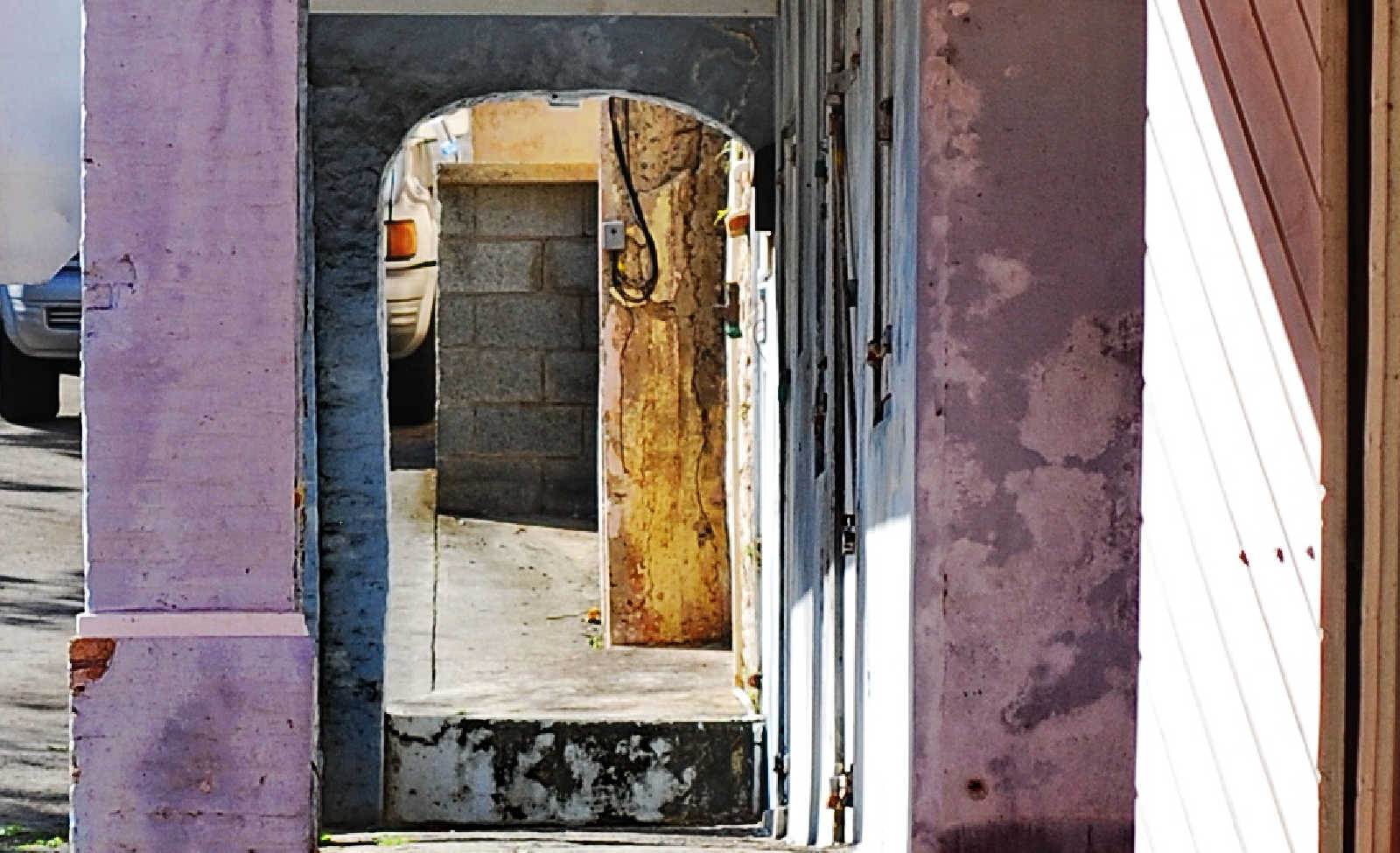
Legislation to “relax certain restrictions as it relates to conservation and preservation of historic and cultural assets in the historic downtown districts” was held in committee on Tuesday after testifiers objected to the draft bill’s proposed implementation.

Senator Kenneth Gittens, the sponsor of Bill 35-0202, explained that the measure was just “one piece of the puzzle” in addressing a myriad of issues in the downtown districts. According to Mr. Gittens, work also has to be done to address fire and safety hazards, the elimination of breeding sites for rodents, and also making downtown areas less attractive for criminal activity.
The intent of Bill 35-0202, the lawmaker told his colleagues in the Committee on Disaster Recovery, Infrastructure, and Planning, is to “allow for much greater flexibility for property owners who truly want to rebuild or repair their properties, but are concerned about the cost and time delays to rebuild to the restrictions currently imposed.” He suggested that restrictions should be loosened as long as “the historic facade on the outside of the structure” is maintained.
However, invited testifiers did not agree. John Woods, chair of the Virgin Islands Board of Land Use Appeals (BLUA) and an architect by profession, told lawmakers that Mr. Gittens’s comment regarding preserving only the facades “does not take into account the historical significance [of] the elements within the building that should also be preserved.” Mr. Woods also argued that the bill as written would be “difficult to administer on the part of the HPC and the BLUA if an appeal is filed.

Jean Pierre Oriol, acting in his capacity as State Historic Preservation Officer, disagreed with the contention that a lengthy permitting process was to blame for the run-down state of many historic buildings within the downtown districts. “I believe that that is a false premise,” he contended, his opinion supported by Deputy State Historic Preservation Officer Sean Krigger. Mr. Krigger said that the real issue was that in most cases, “residents lack the funding to care for those properties.”
President of Our Town Frederiksted Shomari Moorehead, for his part, said that while he supported the overall intention of Bill 35-03202, the bill needed adjustment. “The bill is vague and lacks critical process and controls to protect against potential corruption and fraud,” Mr. Moorehead told lawmakers. He asserted that the bill, as written, “fails to adequately protect our town and the broader community as a national heritage site.” He went on to highlight specific components of the bill that he believed could be re-written to strengthen the legislation.
Meanwhile, local realtor April Newland expressed support for the bill in its current form. She asserted that the “difficult restrictions” that currently exist have “stopped many local and stateside buyers from purchasing and renovating these properties.” She cited “exorbitant costs” and ease of access to required building materials as key challenges to the restoration of historic building to the standards required by the Historical Preservation Commissions.
After listening to the assessments from the technical experts and other stakeholders, lawmakers agreed that the bill needed to be fleshed out. Senator Alma Francis-Heyliger, expressed her opinion that the bill required “major tweaking”, citing specific concerns that the word “relax” had “no real structure” and “could be interpreted by anyone, and it might cause issues.”
Though agreeing to fine tune the legislation, Mr. Gittens nevertheless called for immediate action, as “the buildings are literally crumbling.” He responded to the arguments that the bill was too vague by lamenting the lack of participation from stakeholders. “We've been sitting and waiting for input for how long. We didn't get the input,” he complained.

“The reality is, if we don't do something now, or quickly, we're gonna lose some of these same structures right before us forever,” Mr. Gittens warned.