




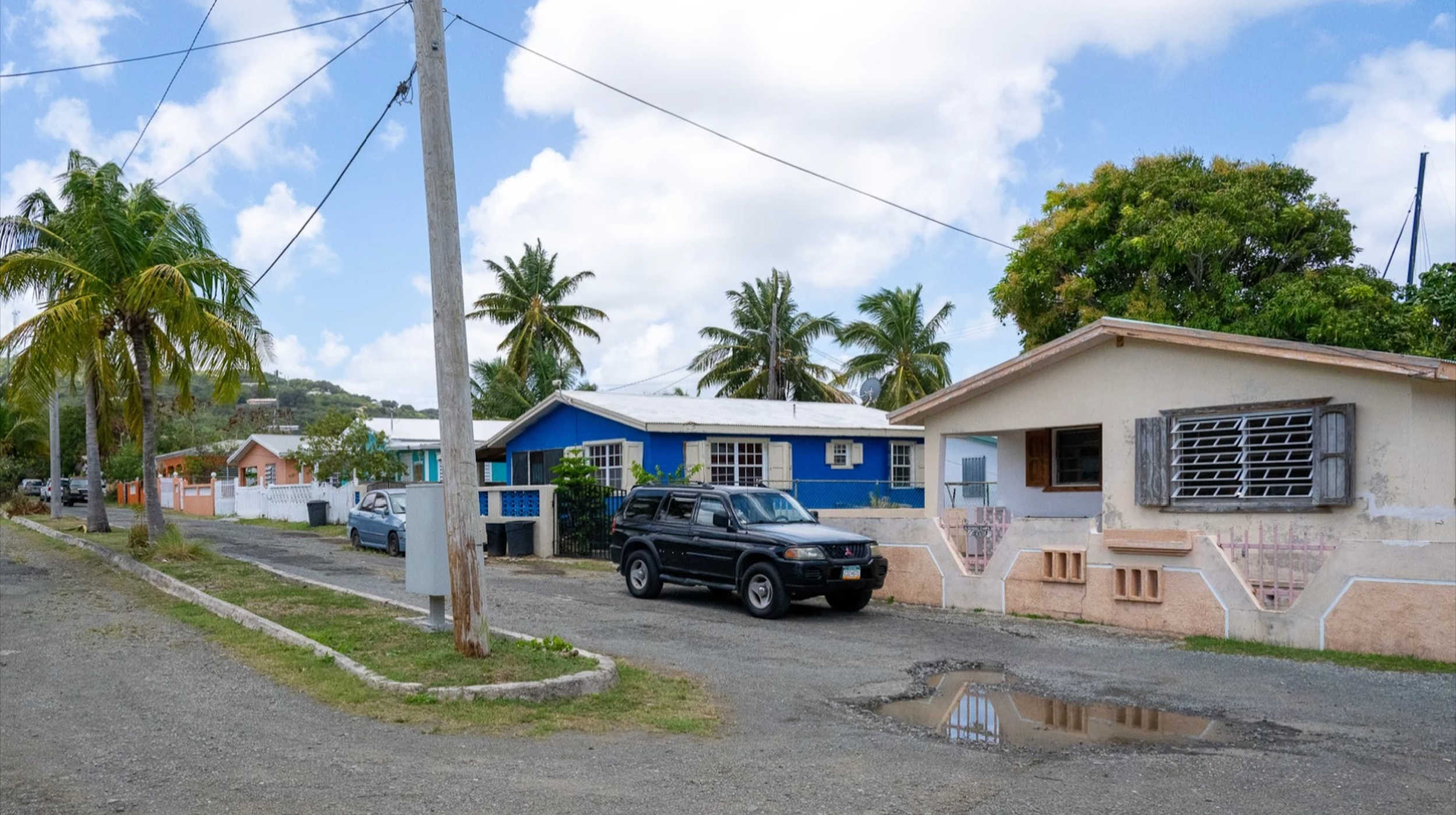
Nearly three years after residents of LBJ Gardens on St. Croix were promised relief, lawmakers advanced legislation intended to compensate homeowners who have been affected by long-running safety, environmental and structural concerns in the community.
Bill 36-0274, introduced by Senator Clifford Joseph, was approved Monday in the Committee on Budget, Appropriations, and Finance. The measure requires the Virgin Islands Housing Finance Authority to pay compensation to LBJ Gardens homeowners who have been required to vacate their homes as a result of actions related to the demolition of properties owned by the Virgin Islands Housing Finance Authority and associated with the operations of the Water and Power Authority and the Waste Management Authority.
“The problems that plagued this community 25 years ago continue to plague the community today,” Senator Joseph said as he introduced the bill. He referenced backed-up sewage, cracked walls and compromised foundations as among the conditions affecting residents.
Mr. Joseph described Bill 36-0274 as a remedy to a longstanding problem. “While it is not perfect, it's a solution the residents and my colleagues and I can live with.”

“We cannot continue to mistreat our residents and look down at them because we don't think where they choose to raise their families isn't worth much,” he declared. Senator Joseph said the government cannot, “in good conscience, make people who have no mortgage on their homes become renters.”
The bill, according to Mr. Joseph, “establishes a fair, uniform, and transparent process to provide settlement, relocation assistance, and replacement housing to eligible displaced owners.”
Bill 36-0274 gives LBJ Gardens homeowners several options, including a direct monetary payment of the “replacement value,” a government-funded purchase of a residence on the open market not to exceed the replacement value, or government-funded construction or rehabilitation of a residence not to exceed the replacement value.
The replacement values included in the measure are $250,000 for a 2-bedroom home, $300,000 for a 3-bedroom home, and $350,000 for a 4-bedroom home. The bill also provides for other costs, including “reasonable closing costs” and “temporary housing expenses not to exceed $25,000.”
Those costs would be funded through a $7 million appropriation from the stamp tax owed, due or becoming due to the Virgin Islands Housing Finance Authority. The funding would remain available until expended or “until the last displaced owner has been fully compensated, whichever date is earlier.” Under the bill, the Housing Finance Authority must make replacement value payments to all displaced owners or place those payments in escrow within 18 months of enactment.
One of the issues affecting LBJ Gardens homeowners is the community’s proximity to propane tanks owned by WAPA. The community falls within a blast zone. WAPA general counsel Dionne Sinclair supported the bill. “Over time, the LBJ Gardens area has evolved from a primarily residential neighborhood into a more industrialized zone,” she said.
Lawmakers also heard emotional testimony from LBJ Gardens resident Wanda Centeno, who reminded them that residents have lived with “uncertainty, health concerns, and environmental hazards” for years. She said promises “have yet to produce meaningful solutions.” While residents have “demonstrated patience,” Ms. Centeno said “government agencies have not demonstrated the same urgency.”
In addition to living in a blast zone, LBJ Gardens residents also contend with “odors, emissions, leaks, and environmental impacts” from the Waste Management Authority’s facilities.
Ms. Centeno told lawmakers that “only a concerted effort between the Legislature and the Government of the Virgin Islands can make right the wrong that we are living.”
Although Bill 36-0274 mandates support within 18 months, Ms. Centeno said “all necessary actions” should be “completed within 6 months or less.”
“The people of LBJ Gardens have already waited years for relief. They should not be asked to wait years more,” she said.
Ms. Centeno also said “residents strongly believe that any compensation program should be based on replacement value rather than traditional appraised value.” She suggested that “conventional appraisals may fail to reflect” the actual cost of purchasing a comparable home.
She said the goal should not be limited to compensation, but should instead be to “make residents whole.”
Julio Rhymer, director of the Office of Management and Budget, agreed that relocating residents is a “matter of public safety.” However, he opposed the use of stamp tax revenues to fund the buyout and relocation effort.
According to Mr. Rhymer, stamp taxes are “essential to the territory’s broader housing strategy.” He said maintaining those funds allows VIHFA to leverage them “alongside the approximately $700 million in CDBG-DR funding to finance and accelerate the development of much-needed housing.”
Mr. Rhymer suggested alternate funding sources, including the “already approved U.S. HUD Mitigation Grant funding of up to $3 million” or actively pursuing a Brownfields Grant “to secure the balance of funding needed, up to an additional $4 million.”
Senator Marise James later said the area does not qualify for the Brownfields Grant. In 2025, Senator James had raised concern that the buyout amounts may not be enough to fund a replacement. She is among the lawmakers who joined Senator Joseph in proposing Bill 36-0274.
Representatives of the Housing Finance Authority also objected to using the agency’s stamp tax revenue to pay residents. Interim executive director Valdez Shelford said “it is important to clarify that the VIHFA has not required that LBJ property owners vacate their homes temporarily nor permanently.”
Ms. Shelford objected to the bill’s “assumption that the current demolition activities…will result in the displacement of homeowners and residents.” She said the demolition of nearby abandoned structures does not require relocation. However, she added that “VIHFA supports efforts to ensure that residents are not, and will not be, adversely impacted by the demolition activities.”
Ms. Shelford also outlined what she described as the appropriate uses of stamp tax revenue, including supplementing housing development costs as construction prices rise. She agreed with Mr. Rhymer that other funding sources exist.
The Committee ultimately voted to approve Bill 36-0274, with lawmakers citing the conditions faced by residents and the need for action.
“I wish it was WAPA paying this money personally…, but they didn't come with any money, so now we have to make this uncomfortable decision,” Senator Hubert Frederick said.
“We standing for St. Croix all the way,” Senator Joseph said after criticizing HFA’s slow pace on housing projects.

As part of a compromise, Senator Joseph said he was “willing to start with $3 million.” An amended version of Bill 36-0274 now moves to the Committee on Rules and Judiciary.