




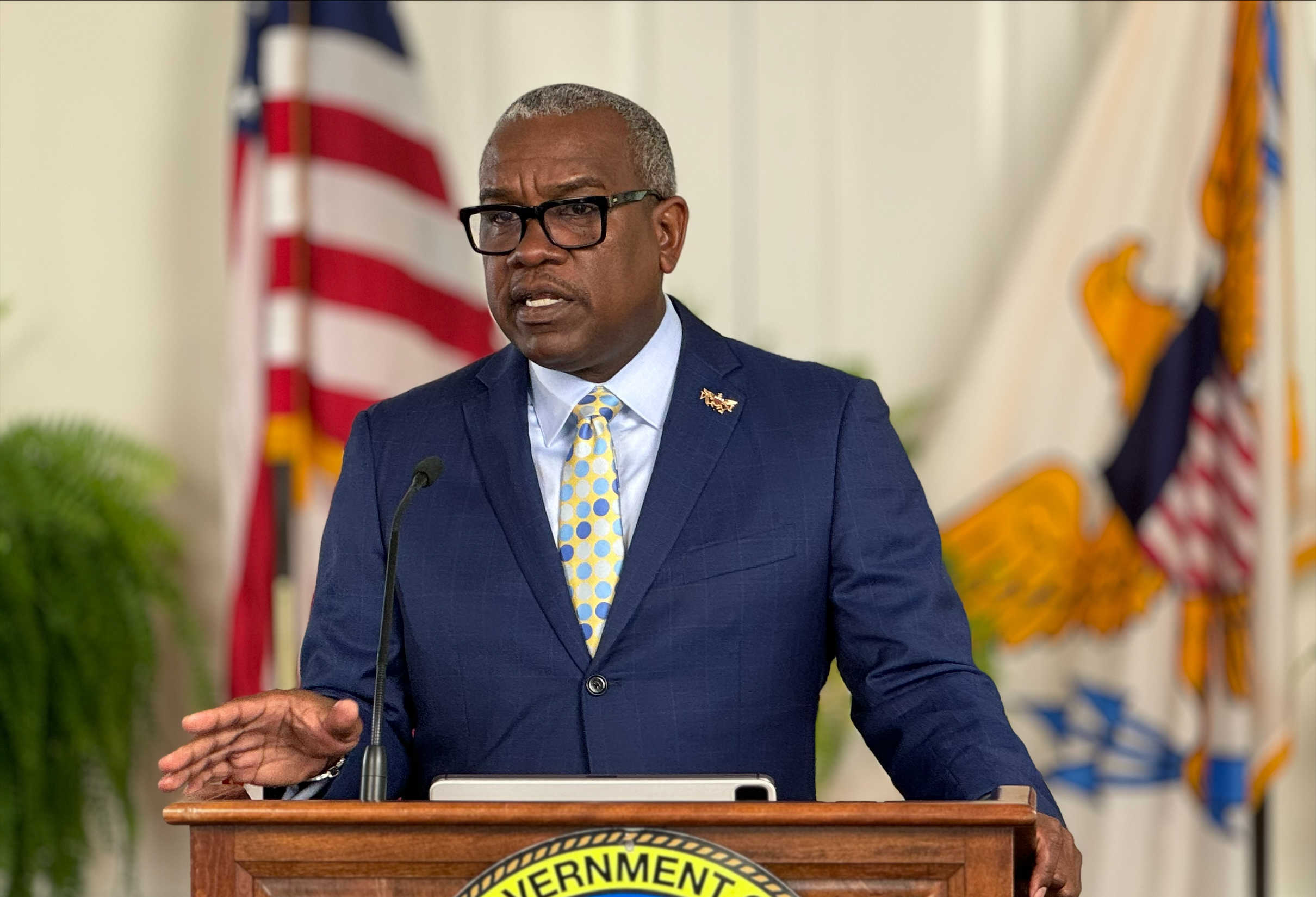
Government vendors weary of waiting months to collect payments on outstanding invoices will soon have the option of receiving their money through a private financial services company, under a new arrangement announced Monday by Governor Albert Bryan Jr. The expedited service, however, will come at a cost to participating businesses.

During his weekly Government House press briefing, Bryan announced a partnership with Municipal Vendor Services Inc. (MVSI), a New Jersey-based financial technology company, intended to "help move and expedite government payments."
Under the arrangement, MVSI will advance payments on approved government invoices, allowing vendors to receive their money without waiting for the government to complete its normal payment process. The Government of the Virgin Islands would subsequently reimburse the company.
"If you have a purchase order and you have the invoice you fulfilled, they verify that you have provided the goods or the services, and they pay you right away, so no more waiting around, finding the invoice, looking to see where it is. They can make that payment for you," Bryan explained.

The V.I. Department of Property and Procurement's public contract register identifies the participating entity as MVSI USVI SPE, LLC, under contract PO-26-200-2001-1291. The agreement is described as an accelerated-payment program for eligible government vendors who voluntarily participate.
The arrangement offers businesses a potentially faster alternative to the territory's longstanding payment system, although vendors electing to use it must pay a service charge.
"You don't have to use that system. But if you do, it's just like using a credit card. There's a service charge for getting that," Bryan said.
MVSI's website advertises payments in as little as 72 hours. Its frequently asked questions clarify that the timeframe begins after an invoice is approved, rather than when it is initially submitted.
The company describes its charge as a single convenience fee, with no separate registration or platform fees. However, neither the governor's announcement nor the company's publicly available information specified how much participating Virgin Islands businesses would pay for expedited settlement.
MVSI's general guidelines also exclude certain categories of payments, including payroll, healthcare invoicing and most traditional construction projects. The precise eligibility provisions governing its Virgin Islands arrangement have not been publicly detailed.
The initiative comes amid years of complaints from businesses and contractors struggling to collect payments for goods and services already delivered to government agencies.
As The Consortium reported in June, Department of Finance Commissioner Kevin McCurdy told lawmakers that outstanding vendor obligations totaled $36 million, including $16 million in invoices older than 90 days.
The commissioner also acknowledged difficulties with the government's invoice-processing system, although he argued that delays sometimes begin when vendors or individual agencies fail to submit paperwork promptly.
For the government, Bryan sees the new arrangement as a way to improve invoice management while reducing the need for more expensive short-term financing.
He likened the service to an interest-free line of credit, under which the company advances money to vendors and the government settles its obligations afterward.
"It cheapens our cost of money," Bryan said.
Invoice tracking would provide another benefit, he argued.
"It helps us account for all the invoices that are out there," the governor said, explaining that invoices sometimes remain unpaid because of administrative lapses involving the delivery and documentation of goods and services.
Bryan said the agreement had been in development for more than six months and described it as a significant opportunity for both the government and its suppliers.

The arrangement does not eliminate the government's outstanding obligations. Rather, it provides participating vendors with another means of obtaining payment while awaiting reimbursement of the private company by the government.