




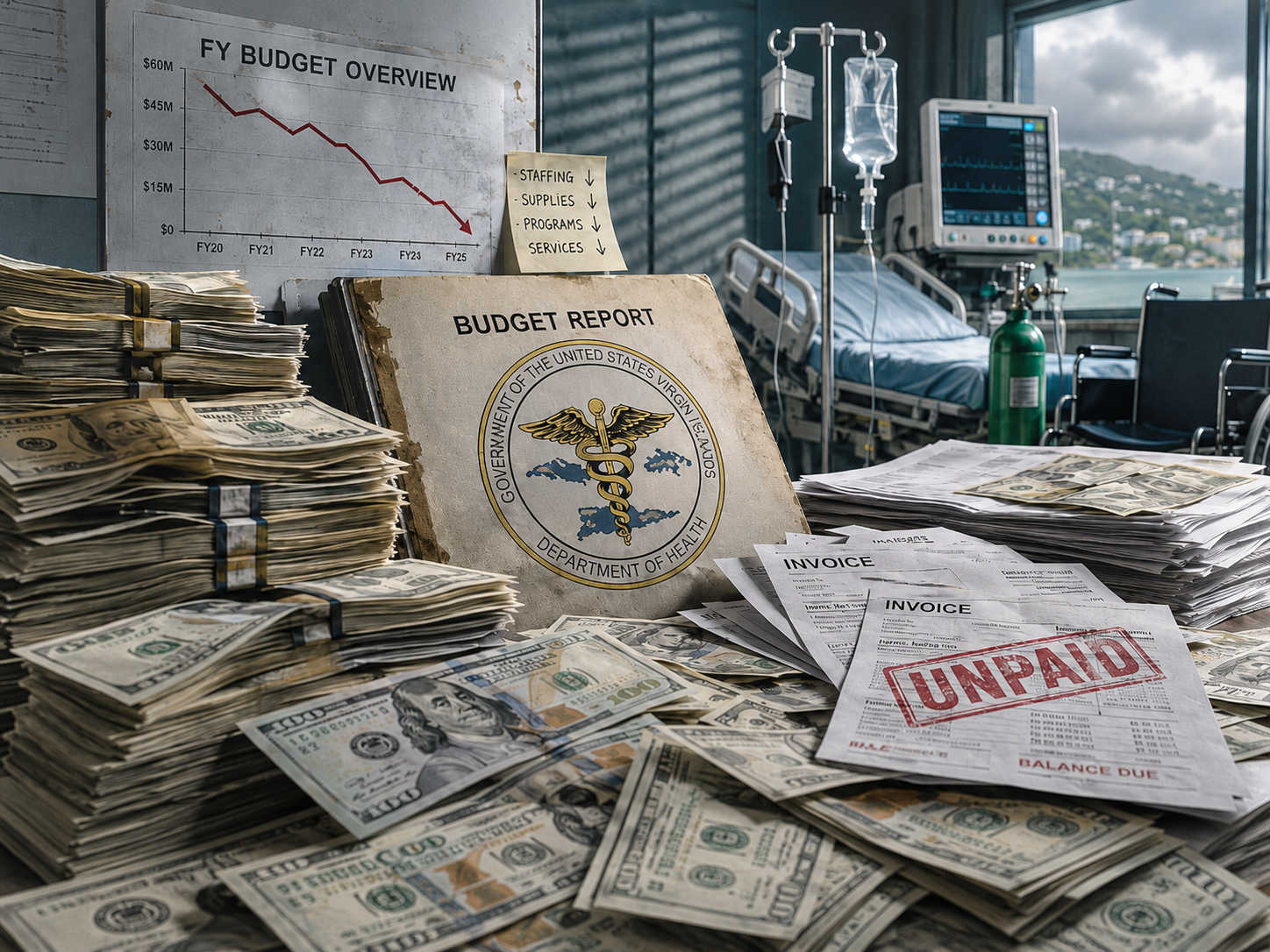
The Department of Health owes vendors more than $8.8 million, faces a $2.8 million shortfall in its Ryan White HIV/AIDS program and has not transferred legally mandated ambulance funding to the V.I. Fire and Emergency Medical Services, officials disclosed during the department’s budget hearing.

The department is also spending approximately $4.4 million on off-island behavioral healthcare, while payment delays have become serious enough that some providers have threatened to return patients to the territory.
Health Commissioner Justa Encarnacion told the Senate Committee on Budget, Appropriations and Finance that the department has $3,288,727.40 in outstanding fiscal year 2025 obligations and $5,557,447.48 in current-year debt, for a combined $8,846,174.88.
Among the largest amounts are $1,637,353.44 owed to Larkin Community Hospital from the General Fund and $1,098,303 owed to One Communication from the Health Revolving Fund.

Outstanding federally funded expenses include two payments to Caribbean Screen Printing totaling more than $92,000.
Off-Island Providers Threaten to Return Patients
Encarnacion described the possible consequences of continued payment delays, saying off-island behavioral health providers have “threatened to have the patients sent back to the territory.”
She said “good communication” has so far prevented that outcome and assured lawmakers that Health is working with the Department of Finance and Office of Management and Budget to resolve the debts.
Asked which obligation was most concerning, Encarnacion declined to select one but acknowledged that “our partners locally are tremendously impacted.”
Sen. Hubert Frederick questioned why debts from previous years, some dating to 2024, were not included in earlier budget submissions. He said the Legislature should have been informed so lawmakers “could have tried to neutralize those amounts instead of carry forward in two-year expenses.”
Deputy Commissioner Renan Steele used off-island behavioral healthcare to explain how some of the obligations accumulate. He said certain invoices arrive “after the fact,” particularly when patients receive additional medical care outside the behavioral health facility.
Lawmakers Identify $3 Million in Vacancy Savings
As senators reviewed the department’s finances, Sen. Kurt Vialet identified approximately “$3 million that won't be spent this year that could be utilized to pay some of the outstanding obligations.”
Vialet said discussions were underway with OMB to prepare legislation redirecting the vacancy savings toward vendor debt.
“Instead of letting it expire, we're going to make sure that we take care of some of the obligations,” he said.
General Fund appropriations available for current-year expenses would expire when the fiscal year ends on September 30.
GVI Buy Blamed for Payment Bottlenecks
Health’s finance staff also told lawmakers that federally funded payments have become trapped in a bottleneck “between approvals to the ERP as well as processing within GVI Buy.”
Vialet said similar difficulties are affecting agencies throughout the government and called for an immediate decision about how outstanding payments will be handled.
“A decision needs to be made within the next one or two weeks as to how all of these vendor payments are going to be processed, because every department has an issue with GVI Buy.”
He recommended temporarily returning to the government’s previous procurement system to move payments before the fiscal year ends.
“At least to get through this fiscal year, we need to go back to our old system and allow it to be processed so we can get individuals paid because it's a bit too much, and I'm scared.”
Ryan White Program Faces $2.8 Million Shortfall
Lawmakers also focused on a funding deficit affecting HIV treatment and prevention.
Encarnacion testified that the Communicable Diseases Division is confronting “rising pharmaceutical costs and declining HIV medication rebate revenues.”
The department is collaborating with pharmacies, federal agencies and other stakeholders to “maintain uninterrupted access to medications.”
Sen. Ray Fonseca said the Legislature’s post-audit report identified a “$2.8 million basically overspending or shortfall” within the Ryan White HIV/AIDS program.
Encarnacion attributed part of the problem to increased medication costs and reduced resources.
“As a result of the new administration federally, we saw a high rise in HIV medication,” she said.
Along with the reduction in funding, Health was “not able to keep up with the spending on that.”
Chief Medical Officer Dr. Tai Hunte Caesar said the primary cause of the deficit was the “decreased amount of reimbursements from the private insurances.”
The department has adopted what officials described as “innovative” measures to reduce dependence on federal grant funding while preserving patient care.
That includes transferring eligible patients to the Medical Assistance Program so their treatment costs can be covered through that program.
Ryan White funding currently covers 146 patients, and 20 percent have been identified as eligible for MAP.
Health is also seeking possible additional funding from the executive and legislative branches for the Communicable Diseases Division.
Encarnacion warned of the consequences if the territory fails to maintain HIV treatment and prevention services.
“If we do not support HIV funding, what’s going to happen is that we’re going to start to see children born with HIV like we used to years ago…”
Department Seeks to Reduce Off-Island Behavioral Care
Sen. Marvin Blyden raised concerns about the approximately $4.4 million spent on off-island behavioral healthcare.
Steele said Health has developed a proposal “where we are looking at a transitional living segment as well as a short-term residential.”
Officials hope the proposal will build local treatment capacity and reduce the number of patients who must be sent to mainland facilities.
VIFEMS Still Awaiting Required Ambulance Funds
The failure to transfer funding to VIFEMS for ambulance services was another major concern during Wednesday’s hearing.
During the VIFEMS budget hearing, Director Antonio Stevens said the agency had never received the legally required allotment and was struggling to purchase supplies needed for ambulance calls.
Encarnacion said Health had met with OMB to discuss the matter and described VIFEMS as “understanding.”
She said the agencies were “in the middle of dialogue and reconciliation.”
When Committee Chairman Sen. Novelle Francis Jr. asked when the process would be completed, Encarnacion said it “shouldn’t be too long.”
Vialet encouraged Health to provide money for pharmaceutical supplies while the broader funding arrangement is resolved.
“It would be a shame for us to have money, and they don't have pharmaceuticals and those ambulances,” he said.
Calvin Durant told lawmakers that “there is no mechanism currently in place for that transfer.”
The absence of an established procedure may have contributed to VIFEMS not receiving the required funding.
Health Seeks $31 Million From General Fund
For fiscal year 2027, the Department of Health is requesting $31,790,725 from the General Fund.
The department expects $27,563,462 in federal funding, along with $1.5 million from the Health Revolving Fund and $538,185 in non-appropriated funds.
Health’s total federal grant portfolio stands at $87,542,571.
The department’s expenses substantially exceed the revenue it directly generates. As of June 30, actual revenue totaled $793,486.31.
That amount includes $498,899 generated by the Environmental Health and Safety Division and $112,179 collected through community health clinics.
Health hopes to increase revenue by strengthening Environmental Health and conducting more inspections.
Vialet also recommended using existing personnel to provide additional billable services at the department’s clinics.