
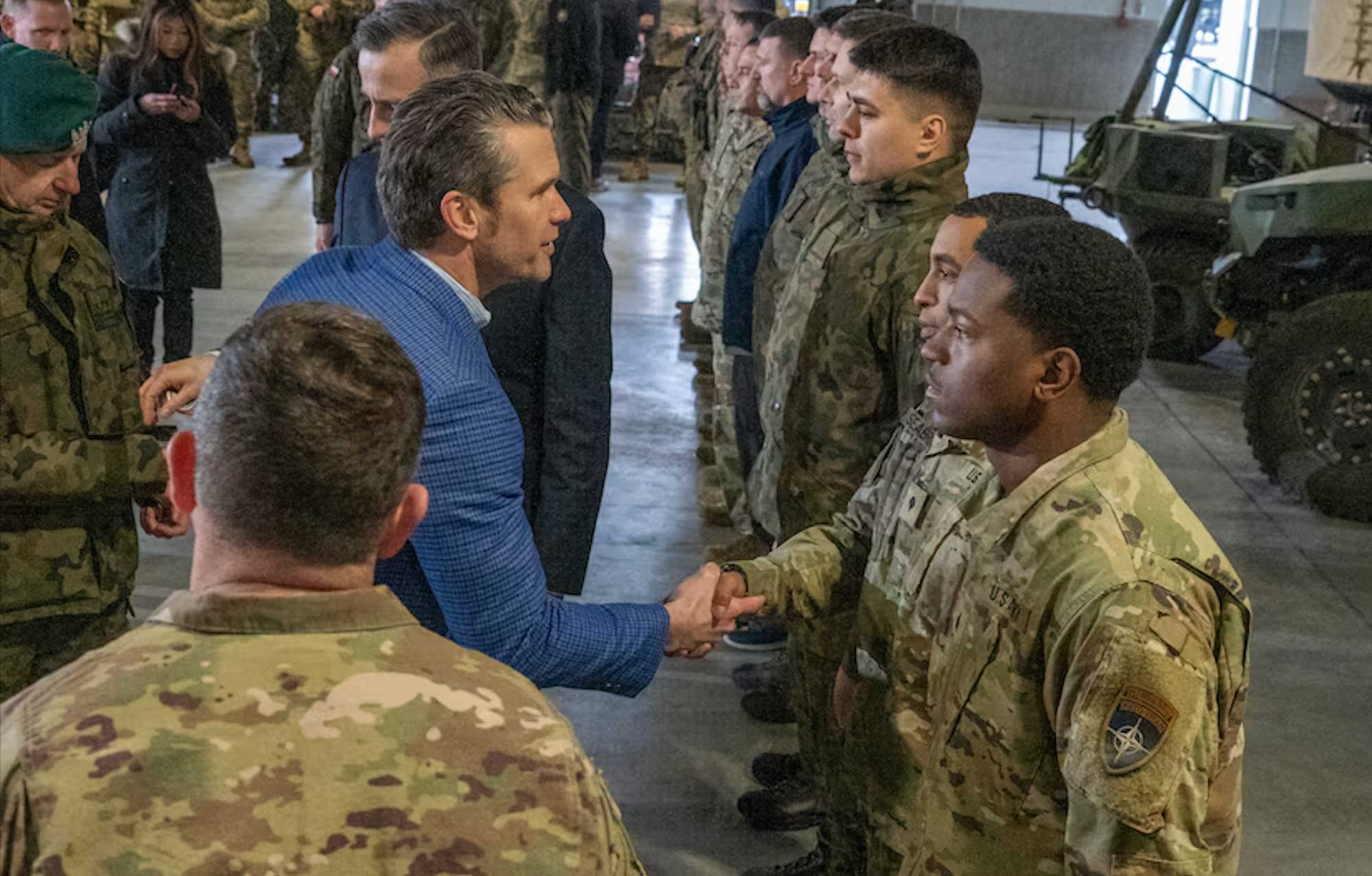
United States Defense Secretary Pete Hegseth told Marines aboard the USS Iwo Jima in Puerto Rico this week that their deployment to the Caribbean was “not training,” underscoring the seriousness of Washington’s latest military escalation in the region.
“What you’re doing right now is not training; this is a real-world exercise on behalf of the vital national interests of the United States of America to end the poisoning of the American people,” Hegseth said on Monday, pointing to the administration’s campaign to stop narcotics from reaching U.S. shores. He was joined on the warship by Dan Caine, chairman of the Joint Chiefs of Staff.
Hegseth’s remarks came as roughly 4,500 U.S. troops were deployed throughout the Caribbean in what officials describe as an aggressive posture toward Venezuela. Surface ships, surveillance aircraft, and a U.S. submarine near Trinidad and Tobago are part of the operation, which follows the Trump administration’s designation of Venezuelan-linked cartels as foreign terrorist organizations.
The Virgin Islands is directly involved in the buildup. Soldiers have begun arriving on St. Croix, where they are being housed at the PHRT Village—commonly known locally as the “Man Camp”—located at the south shore refinery and terminal facility.

Governor Albert Bryan Jr. voiced his support for the deployment, noting both security and economic benefits. “If we could stop this flow of drugs to our shores, why wouldn’t we be for that?” he said. Bryan explained that traffickers are increasingly using Caribbean routes as enforcement tightens along the U.S. southern border. “Along with the cocaine comes a lot of bad actors, murder and a lot of things we don’t want. So I am for it.”
Bryan added that stationing troops on St. Croix brings a positive spillover. “I understand we have some soldiers staying here in St. Croix as well too,” he said. “If you want to put two or three hundred soldiers here in St. Croix as part of that initiative, they gotta eat, drink and make merriment in our community. We are happy to have them.”
The military action mission is focused on intercepting narcotics shipments headed toward the United States. Observers expect the operations will also encounter migrants traveling by sea from Haiti, the Dominican Republic, and elsewhere in the region.
The heightened U.S. presence follows a series of escalations with Venezuela, including a recent strike in the Caribbean that destroyed a boat, killing 11 people. President Donald Trump described the vessel as tied to Venezuelan gangs and used for narcotics trafficking. In a post on Truth Social, he warned, “Please let this serve as notice to anybody even thinking about bringing drugs into the United States of America. BEWARE!”
Puerto Rico’s governor, Jenniffer Gonzalez, also weighed in, praising Hegseth’s visit and thanking Trump for “recognizing the strategic value Puerto Rico has to the national security of the United States and the fight against drug cartels in our hemisphere, perpetuated by narco-dictator Nicolas Maduro.”
With U.S. troops spread across Puerto Rico, Trinidad and Tobago, and the Virgin Islands, the Caribbean is now a key stage for Washington’s counter-narcotics mission, one that Secretary of State Marco Rubio recently described as the beginning of a wider campaign: “The president of the United States is going to wage war on narco-terrorist organizations.