



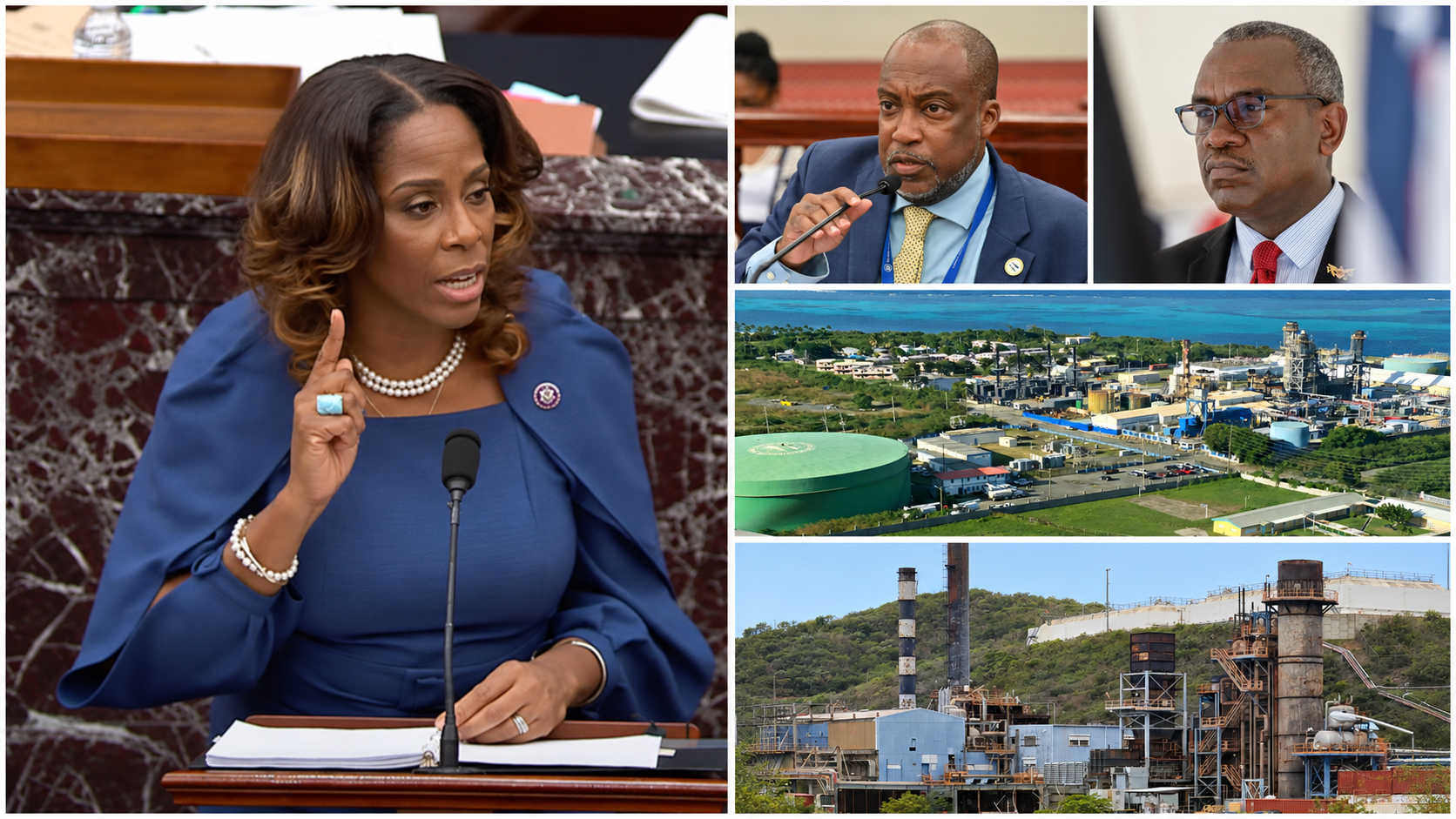
Governor-elect Stacey Plaskett accused the Virgin Islands Water and Power Authority of failing to pursue emergency assistance allegedly offered by the U.S. Department of Energy earlier this year and withholding information about federal support from her and the public, according to an October 25 letter obtained by The Virgin Islands Consortium.

The two-page correspondence, written before Plaskett's November 3 election victory and addressed to WAPA Governing Board Chairman Hubert Turnbull, urges the utility to immediately request an emergency order under Section 202(c) of the Federal Power Act, a federal authority that can temporarily authorize measures to address electricity generation shortages and threats to grid reliability.
The letter provides new context for the growing disagreement between Plaskett and Governor Albert Bryan Jr., who argued during Monday's Government House briefing that declaring another state of emergency would accomplish little because WAPA already has federal funding, technical assistance and generators available.
Plaskett's letter raises a different question: whether WAPA has failed to pursue a specific form of federal emergency intervention that could provide additional operational flexibility.

"WAPA has not pursued all avenues of federal support. I have recently learned that earlier this year, DOE offered WAPA the support of an emergency order under Section 202(c)," Plaskett wrote.
She also alleged that an earlier opportunity for federal technical assistance had gone unused.
"In 2024, the then-Secretary of Energy gave a detailed report offering technical and other support, which WAPA never agreed to accept," the letter states.
Plaskett then accused the utility's leadership of failing to disclose those interactions.
"You have kept all of these interactions and offers of support away from myself and indeed the public, who are at the mercy of the utility," she wrote.
Federal technical assistance was offered to WAPA in 2024. As VIC reported in August of that year, then-Energy Secretary Jennifer Granholm visited the Virgin Islands, toured WAPA's Randolph Harley Power Plant and expressed the Department of Energy's willingness to provide technical support.
However, the October 25 letter does not include the federal correspondence documenting the alleged 2026 emergency-order offer or the purported refusal of assistance in 2024. Those specific assertions have not been independently verified.
Plaskett argued that WAPA's persistent generation shortages and inadequate reserve capacity warranted immediate federal intervention rather than continued reliance on existing measures.
"Given the repeated outages and the lack of adequate reserve capacity, it is unconscionable that WAPA has not submitted an application to avail itself of this support," she wrote.
She described the consequences for Virgin Islanders as extending beyond the inconvenience of losing electricity.
"Residents have lost food and medicine, homes have lost running water, and government operations and businesses have been disrupted," the letter states.
Under Section 202(c) of the Federal Power Act, the Secretary of Energy may issue temporary orders directing electricity generation, transmission and related operations when shortages or other emergencies threaten reliable service.
Plaskett identified several possible applications for WAPA, including temporarily operating generators subject to regulatory or operational restrictions, using privately owned backup generators at hotels and businesses to reduce demand on WAPA's system, improving transmission reliability through vegetation management, and arranging temporary generation.
She acknowledged that such an order would not permanently resolve WAPA's underlying problems but argued that it could provide immediate support while longer-term solutions are developed.
Similar federal emergency authority has already been used elsewhere in the United States and its territories.
On August 5, 2026, the Department of Energy issued an emergency order to the Guam Power Authority after the utility applied for relief from generation constraints.
The department has also issued and extended emergency orders supporting Puerto Rico's electricity system. Most recently, on November 6, DOE renewed orders allowing specified generation operations and measures intended to improve transmission reliability through February 5, 2027.
Those orders demonstrate that the federal authority remains active, although any comparable relief for the Virgin Islands would require a determination by DOE and would depend on WAPA's specific circumstances.
The urgency surrounding the issue has intensified as fresh power failures spread across the territory.
WAPA alerts documented islandwide power interruptions on St. Croix on November 7, November 10 and again on Wednesday, November 11, with the latest outages attributed to a loss of generation at the Richmond Power Plant.
Following Wednesday's interruption, WAPA issued a tentative rotational schedule affecting multiple feeders, with outages scheduled throughout the afternoon and evening as the utility worked to restore sufficient generating capacity.
The latest St. Croix failures have occurred as St. Thomas and St. John continue experiencing rotational outages associated with mechanical problems and repairs involving several Wärtsilä generating units at the Randolph Harley Power Plant.
Against that backdrop, Bryan's recent dismissal of the need for another territorial emergency declaration contrasts with Plaskett's insistence that additional emergency measures should be pursued.
"We already have federal dollars. We already have federal technical assistance. We have generators on the ground," Bryan said during Monday's briefing, as reported by the Consortium.
He acknowledged that an emergency declaration might help obtain an Environmental Protection Agency waiver involving additional generating equipment but maintained that WAPA's primary need was sufficient time to finish repairs.
"What we need is time," the governor said.
Bryan also acknowledged receiving correspondence from Plaskett urging emergency action.
The October 25 letter, however, specifically calls for a federal Section 202(c) order, which is distinct from a territorial emergency declaration. DOE has authority to issue such an order when the statutory conditions are met, including acting without an application.
In her first post-election interview with the Consortium on November 4, Plaskett pledged to declare a WAPA-related state of emergency upon taking office January 4, 2027, and seek federal assistance from the Department of Energy, the White House and Congress.
Her October correspondence establishes that she had already pressed for federal emergency action before her election victory.
Plaskett copied the letter to Governor Bryan, then-Senate President Milton Potter and WAPA Chief Executive Officer Karl Knight.
The remaining questions include whether DOE formally offered WAPA emergency relief earlier this year, why the utility did not submit the application Plaskett requested, and whether WAPA management or its governing board formally responded to her concerns.
The letter concludes with another appeal for immediate action.
"I urge the Governing Board to direct WAPA management to complete and submit the application without delay," Plaskett wrote. "WAPA and the Governor have the authority to provide immediate support for the people of the Virgin Islands through the Department of Energy."

"We need to use every tool that has been made available to us from our federal partners."