

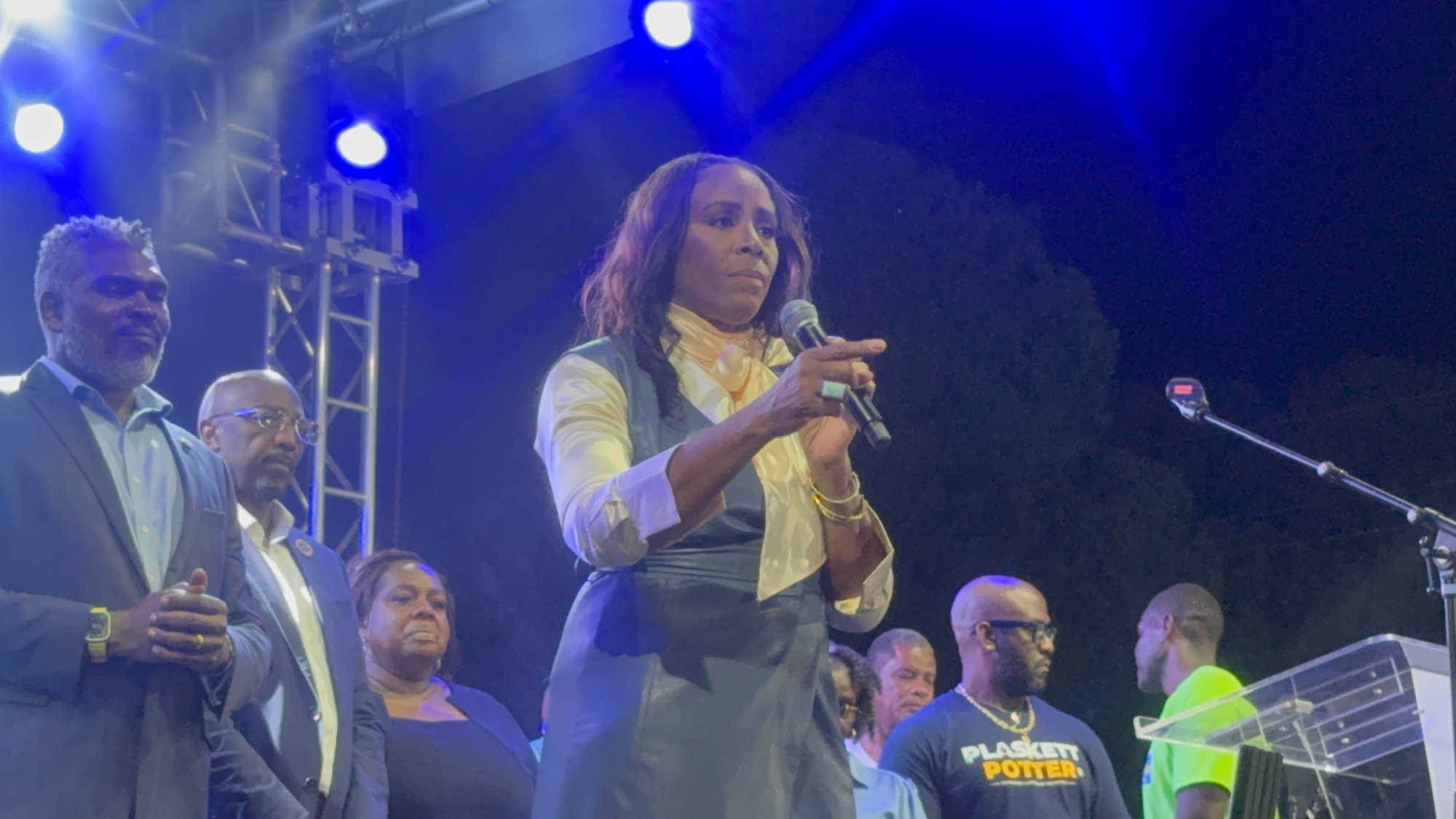
Governor-elect Stacey Plaskett plans to declare a state of emergency over the Virgin Islands Water and Power Authority upon taking office in January and seek assistance from the federal government, including the U.S. Department of Energy, President of the United States and Congress, as part of an aggressive effort to address the territory's longstanding electricity crisis.

In her first interview following Tuesday night's landslide election victory, Plaskett told V.I. Consortium that reliable and affordable electricity would be among the immediate priorities of her administration. She also identified healthcare, housing and education as critical areas requiring attention, while revealing that Lieutenant Governor-elect Milton Potter has already been tasked with assembling a team to examine a comprehensive reorganization of the territorial government.
Potter, speaking separately during the same interview, expanded on that initiative, outlining plans to restructure government operations, retrain employees for expanded responsibilities, incorporate artificial intelligence where appropriate, establish public-facing performance dashboards and introduce a centralized 311 service to improve residents' access to government.
The announcements offered the clearest indication yet of how the incoming administration intends to translate its campaign commitments into action. Plaskett and Potter are scheduled to assume office on January 4, 2027, the first Monday in January, as prescribed by the Revised Organic Act of the Virgin Islands. Details of their inaugural ceremonies have not yet been announced.

WAPA emergency declaration and federal assistance
Plaskett identified WAPA as an immediate concern when asked what the administration would prioritize following its election victory.
"We must do what's necessary to bring reliable, affordable utilities to the people of the Virgin Islands," she said.
The governor-elect then outlined what she intends to do upon taking office.
"So in January, that looks like declaring a state of emergency and requesting emergency assistance from the federal government, both from the Department of Energy as well as from the President of the United States and the Congress to see how they can support us in that."
The declaration would represent a significant early action by the new administration, signaling its intention to treat WAPA's operational and financial problems as an emergency requiring assistance beyond the resources currently available to the territorial government.
Plaskett did not specify during the interview which emergency powers she intends to invoke, the amount of federal assistance she would request or the timeline within which such assistance might be secured.
However, the proposed declaration is consistent with the expanded energy policy published by the Plaskett-Potter campaign, which calls for an energy-related state of emergency and a request for a federal disaster declaration.
The campaign's plan identifies several potential federal mechanisms for securing assistance, including emergency powers available to the Department of Energy under Section 202(c) of the Federal Power Act.
The proposal also contemplates using existing Federal Emergency Management Agency authorities to support battery energy storage installations, improve electrical system redundancy and accelerate repairs to vulnerable infrastructure.
Those mechanisms would require further governmental action and, where applicable, federal approval. A territorial emergency declaration would not, by itself, guarantee access to all the resources identified in the campaign's proposal.
The campaign also called for a comprehensive review of WAPA's finances, personnel and operations, with an eventual restructuring of the utility's operating model.
The goal, according to the published plan, is to move WAPA beyond repeatedly responding to immediate power plant emergencies toward a more sustainable system that can manage electricity generation, transmission, distribution and long-term investments.
Plaskett's election-night commitment comes after another difficult period for electricity customers, particularly on St. Thomas and St. John.
In October, multiple generating units at the Randolph Harley Power Plant experienced mechanical and operational problems, leading to widespread and rotating outages.
The disruptions forced the closure of schools and government offices and left residential and commercial customers without dependable electricity.
WAPA's October 26 operational update confirmed that Unit 27 had returned to service, but warned that the district remained vulnerable because other generating units were unavailable.
The Authority projected that repairs to Unit 15 would be completed in January 2027, while Unit 23 was expected to return later that year. Additional temporary and permanent generation projects were also included in WAPA's longer-term plan.
Against that backdrop, Plaskett's proposed emergency declaration places the electricity crisis at the forefront of her administration's planned response.
Potter tasked with comprehensive government reorganization
Beyond electricity, Plaskett disclosed that she and Potter intend to undertake an extensive review of the structure and operations of the Government of the Virgin Islands.
She argued that the government has not undergone the type of comprehensive modernization necessary to meet present-day demands.
"The government of the Virgin Islands has not changed or been reformed since Alexander Farrelly," she said, referring to the former governor whose administration pursued government restructuring during the late 1980s.
Plaskett said the time had come to reconsider how the government is organized and whether its existing structure allows agencies to deliver services efficiently.
"We believe that it's time to look at a reorganization of the federal of the local government," she said, correcting herself while explaining the proposal.
She confirmed that Potter would oversee the initial effort.
"Milton has been tasked with putting a team together to begin looking at that, and we're going to be doing that in earnest."
The assignment places Potter in a potentially influential role extending beyond the traditional statutory responsibilities of the lieutenant governor's office.
In his own conversation with Gilbert, Potter confirmed that he expects to participate actively in reorganizing and modernizing the executive branch.
"That's a correct assessment," he said when asked whether the new lieutenant governor would have a substantial role in administering the government.
Potter pointed to his professional background in human resources as an important qualification for the work.
"My background as a human resources professional, I think, puts me in a position to have greater insights into this government. What is working? What is not working? How can we make the systems more efficient?" he said.
The former director of the Division of Personnel argued that many government inefficiencies have become accepted practices simply because residents and employees have grown accustomed to them.
"Very often we sort of get used to this is the way the government works. We just surrender to that," Potter said.
"That is not what we will be doing."
The initiative aligns with the ticket's published government reform platform, which proposes departmental audits, reviews of agency responsibilities and an assessment of whether existing structures adequately address residents' needs.
The proposed team would examine departmental functions, employee responsibilities and opportunities to eliminate duplication while improving the delivery of essential services.
Specific recommendations, including any proposed departmental mergers or changes requiring legislative approval, have not yet been announced.
Upskilling workers, consolidating responsibilities and increasing pay
One of the most consequential aspects of Potter's proposal involves the territorial government's workforce.
Rather than viewing retirements and vacant positions exclusively as obstacles, the lieutenant governor-elect suggested that the administration could use those circumstances to reorganize responsibilities and develop employees' skills.
"We've been we're talking about upskilling people," he said.
Potter noted that the government has experienced numerous retirements and vacancies, creating opportunities to reconsider how responsibilities are assigned.
"That's an opportunity to merge work, to increase pay for people by upskilling and providing support to them," he explained.
His remarks suggest an approach in which existing employees could receive additional training, take on broader or more specialized responsibilities and potentially qualify for higher compensation.
The concept of upskilling involves providing workers with new skills that allow them to perform more advanced tasks or adapt to changing workplace requirements.
For the territorial government, such an initiative could have implications for employee classifications, staffing levels, salary structures and the distribution of responsibilities among agencies.
Potter did not provide specific salary increases, identify which departments would be targeted first or explain how changes to employee classifications and compensation would be implemented.
Nevertheless, his comments indicate that workforce development will be a central component of the proposed restructuring rather than a separate initiative.
Artificial intelligence to be incorporated into government operations
Potter also signaled that the administration intends to incorporate artificial intelligence into government operations where it can be used effectively.
"It also means putting AI in places where it can be placed," he said.
The statement establishes AI as part of the incoming administration's modernization agenda.
Although Potter did not identify the specific agencies or functions where AI would initially be introduced, his comments placed the technology within a broader effort to improve government efficiency and develop employees' capabilities.
The administration's published platform separately calls for government agencies to become more digitally connected through standardized information technology systems, improved data sharing and modernized software infrastructure.
Those proposals include the development of a centralized technology platform allowing departments and agencies to exchange information more efficiently.
The campaign argued that better integration could reduce the need for residents to physically transport documents between government offices or repeatedly provide the same information to different agencies.
Potter's election-night comments suggest that AI will be considered as part of that effort.
The administration has not yet identified an AI implementation schedule, specific technologies, procurement plans or safeguards governing their use.
Public dashboards, performance tracking and a 311 service
The government restructuring initiative will also include new systems designed to improve transparency and make public agencies more accountable for the services they deliver.
Potter identified public-facing dashboards as one of the tools the administration intends to introduce.
The concept would allow the government to publish performance information so that residents can better understand how agencies are functioning and whether established objectives are being achieved.
The Plaskett-Potter government accountability platform provides additional detail, proposing measurable goals for government agencies and quarterly scorecards documenting their progress.
Under that plan, residents would also be able to provide real-time feedback about their interactions with government offices.
The proposed feedback system would evaluate services using measures including timeliness, overall experience and public satisfaction.
The campaign describes these mechanisms as management tools that would allow supervisors and agency leaders to identify deficiencies and make improvements.
Another component of the proposed modernization effort is a centralized 311 system.
Potter said the administration intends to establish a single service that residents can contact when they need information or assistance from the government.
"Even having the 311 system, so that people can call one central location to be able to get information, and government can serve them," he explained.
The proposal would create a non-emergency point of contact for government services, allowing residents to report problems or seek assistance without having to determine which department or division is responsible.
Examples identified in the campaign's platform include complaints about potholes, overgrown vegetation and sewage problems.
The proposed system would also collect information from service requests to help government managers identify recurring problems, track agency performance and determine where additional resources may be needed.
That information could eventually be used to inform budget decisions and assess whether agencies are responding effectively to residents' concerns.
Potter did not specify when the 311 system would become operational or how its technology, staffing and financing would be arranged.
The proposal nonetheless represents an effort to establish a more centralized and measurable approach to public service delivery.
Healthcare, housing and education among immediate priorities
Although WAPA was identified as a leading emergency concern, Plaskett emphasized that healthcare, housing and education would also require urgent attention.
On housing, the governor-elect highlighted the need to provide opportunities for younger Virgin Islanders.
She did not outline specific housing projects during the interview, but identified access to housing as a priority for the incoming administration.
Her comments on healthcare were more pointed.
Plaskett said the territory must develop a healthcare system capable of treating residents locally so they do not have to leave their families and communities when they become ill.
"Those who are ill can stay at home, and those who love them can be near them while they are going through an illness," she said.
Her remarks reflect the longstanding difficulties Virgin Islands residents have faced when specialized treatment or other necessary medical services are unavailable locally, sometimes requiring patients and their families to travel off-island.
Plaskett also identified preventive healthcare for children as an important component of improving the territory's overall health.
The aim, she explained, is to help children receive appropriate care before illnesses develop into more serious medical problems.
Education was another priority.
Plaskett said the territory's school facilities and academic programs must adequately reflect and support the abilities of Virgin Islands students.
"The facilities and the programs have to match the talents of our children," she said.
The statement points to improvements not only in school buildings, but also in the educational opportunities available to young people.
While the governor-elect did not provide specific implementation schedules for those priorities, she made clear that improvements in healthcare, housing and education would proceed alongside the administration's efforts to address electricity reliability and government operations.
Plaskett describes victory as a mandate for change
The interview followed an overwhelming election victory in which Plaskett and Potter received 11,865 votes, representing approximately 62.8 percent of the ballots recorded in the gubernatorial contest.
The Democratic ticket defeated four independent tickets and secured the majority required to avoid a runoff, according to unofficial results released by the Elections System of the Virgin Islands.
Plaskett interpreted the decisive margin as a public endorsement of the changes she and Potter proposed throughout their campaign.
She said the support constituted a "clear mandate for us to be able to do the things that we talked about in our campaign and to execute real change."
Yet despite the historic significance of her victory, the governor-elect told Gilbert that she was experiencing a different emotion from the excitement normally associated with winning an election.
"People have asked us repeatedly if we're excited, and I really don't feel excitement as in joy or happiness," she said.
"I feel determination about the work that must be done because there's a lot of work for us to do."
Plaskett, who has represented the territory in Congress for nearly 12 years, also reflected on the distinction of becoming the first woman elected governor of the U.S. Virgin Islands.
Rather than describing the milestone solely as a personal achievement, she placed it within the broader history of Caribbean people breaking barriers and achieving distinction in positions where they have not traditionally been represented.
"Caribbean people are usually first in so many areas. We're trailblazers," she said.
She argued that her years as the Virgin Islands' sole representative in Congress had required her to work particularly hard to ensure that the territory's interests received attention.
That experience, she suggested, has prepared her for the responsibilities she is about to assume.
Potter reflects on family history and a new responsibility
The election also created a personal milestone for Potter, whose older brother, Osbert Potter, served as lieutenant governor from 2015 to 2019 under Governor Kenneth Mapp.
The two brothers will now have held the same territorial executive office at different points in the Virgin Islands' history.
Asked by Gilbert whether he had received advice from his brother, Potter said family relationships and the guidance of his older siblings have played important roles in his life.
"Being a younger brother, you always look up to your older brothers for advice and wisdom and suggestions," he said.
He added that his brother's experience would be particularly valuable as he prepares to assume the office.
"You don't have to make the same mistakes that they made, you know," Potter said.
Plaskett also acknowledged the significance of the Potter family connection during her interview, noting that the election had created an unusual historical distinction for the two brothers.
From congressional representation to governing at home
For Plaskett, the transition will mean leaving Washington after nearly 12 years to assume direct responsibility for leading the territorial government.
She reflected on the significance of representing the Virgin Islands in Congress, describing the experience of waiting to be recognized on the House floor and speaking on behalf of the territory in national legislative proceedings.
Plaskett said she had discussed those responsibilities with Delegate-elect Janelle Sarauw, who won Tuesday's election to succeed her in Washington.
She emphasized the importance of understanding that the delegate is not merely occupying a congressional office but serving as the Virgin Islands' voice in consequential national decisions.
The governor-elect also described the personal significance of being able to spend more time at home after years of frequent travel between the territory and Washington.
She said she had not imagined as a child that she would occupy the positions to which Virgin Islanders have elected her, calling the opportunity an immense honor.
Now, with her congressional service nearing its conclusion, Plaskett will begin preparing to lead the government she has spent much of her career advocating for at the federal level.
Her election-night interview laid out the early priorities of that transition: emergency action on WAPA, improvements to healthcare, housing and education, and a reorganization of government operations under Potter's leadership.
The precise implementation of many of those proposals remains to be determined.
But Plaskett said the administration's responsibility is already clear.

"I feel determination about the work that must be done because there's a lot of work for us to do."