




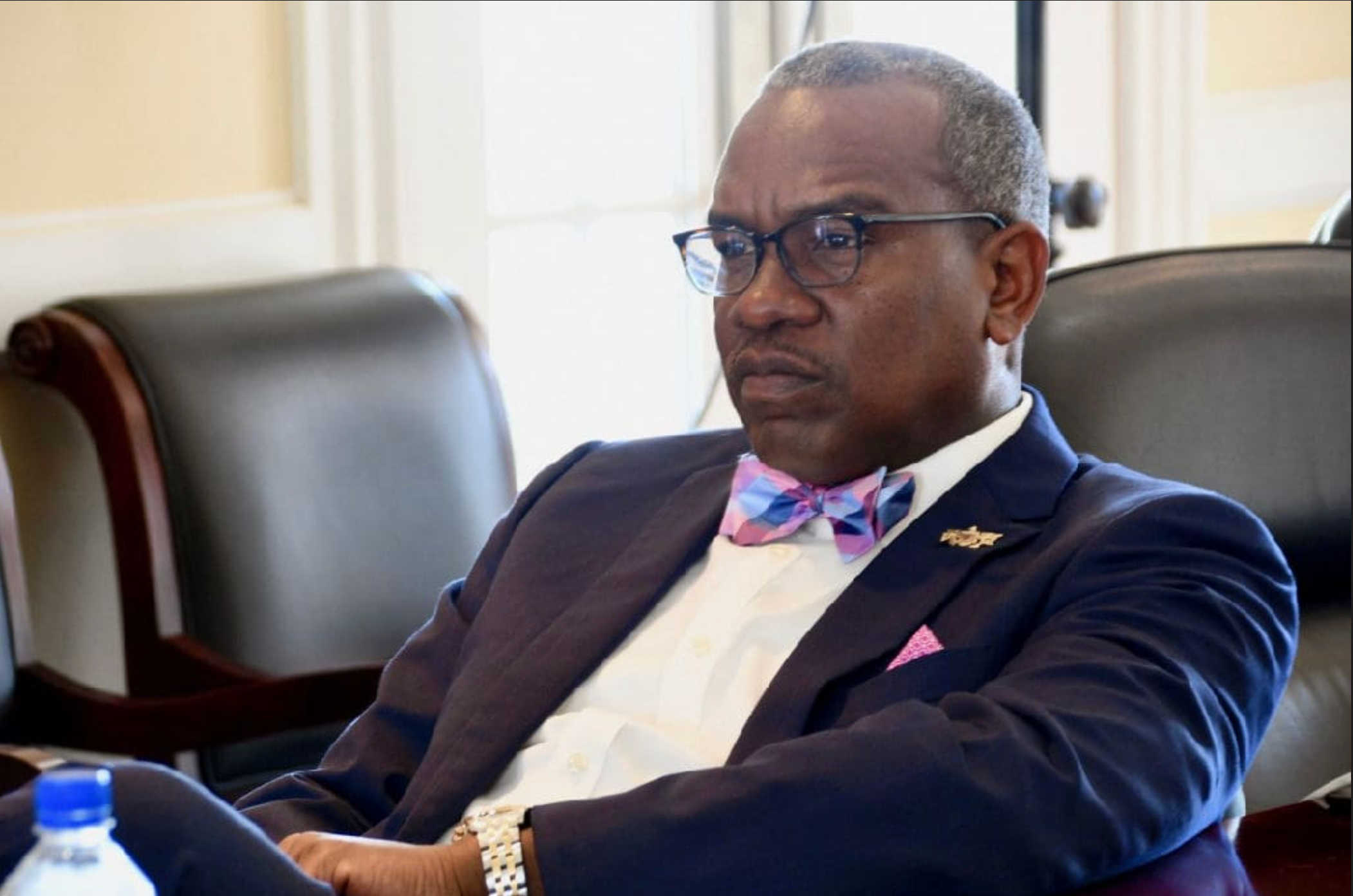
Governor Albert Bryan Jr. has confirmed he will not pursue legal action against the 36th Legislature’s efforts to roll back his salary increase. Speaking with the Consortium on Friday, Mr. Bryan publicly stated for the first time that he will not challenge the Senate's plan to override his veto of Bill No. 36-0085, signaling what may be the final chapter in a controversy that has dominated public discourse and overshadowed his other policy priorities.

Bill No. 36-0085, sponsored by Senator Alma Francis Heyliger, aims to rescind salary increases previously granted to Governor Bryan, Lieutenant Governor Tregenza Roach, and cabinet-level officials. Although Mr. Bryan has repeatedly argued that retroactively reversing approved compensation raises presents constitutional issues and undermines fundamental employment principles, he now says he intends to move on from the dispute.
Still, the governor maintains that the Legislature’s action is personal in nature. He is asking lawmakers to clarify key inconsistencies in their approach. “The interesting thing here is that it is personal,” said the governor. “If they override the bill and set my salary back to the code, doesn’t that mean that now all commissioners must be paid according to the code which is between $85k-$97k, and why aren’t the judges reverted back to their last salary in the code as well? If it’s not retaliation then why does the bill specifically speak to the governor and lt. governor and no one else? Why is one office being singled out and the other branch (judiciary) get to set their own salary?"
Despite his frustration, Mr. Bryan stressed his readiness to shift focus to more pressing matters. “I'm not going to court but they need to explain what the overriding of the bill means. I'm confused,” he said.

In May, Governor Bryan confirmed to the Consortium that all salary adjustments recommended by the V.I. Public Officials Compensation Commission (VIPOCC) for central government officials had been implemented. The VIPOCC study recommended raises for twelve public official positions. This implementation must now be reversed. Notices of Personnel Action (NOPAs) were also issued, although Division of Personnel Director Cindy Richardson came under scrutiny during a Thursday budget hearing for failing to provide documentation to the Senate as requested.
Senator Kenneth Gittens pressed Ms. Richardson on the issue, noting that his office had not received the requested documents. Ms. Richardson explained that her office had not received a formal written request, prompting a sharp rebuke from Gittens. “This is why we say that oftentimes we are met with disrespect. Whether or not it was sent to you in writing, it was a request publicly.”
The pay raises became a lightning rod for public outrage, especially given the territory’s ongoing struggles with high crime rates, inadequate healthcare, inflation, and aging infrastructure. The controversy intensified on Memorial Day—Monday, May 26—when the Consortium published video footage of a resident confronting Senator Novelle Francis and demanding that the raises be repealed. The video was viewed over 60,000 times and drew hundreds of comments condemning the pay increases.
Another widely shared video showed a resident lamenting the lack of medical services in the territory. That video surpassed 100,000 views and attracted more than 500 comments. The resident closed her remarks by urging Lieutenant Governor Roach and Senator Francis not to seek reelection to their respective offices.
The following day, Lt. Governor Roach publicly called on Governor Bryan to rescind the raises. He expressed frustration over not being informed of the appointment of Haldane Davies, chair of the VIPOCC, to lead the Bureau of Economic Research. In a letter to Governor Bryan, Mr. Roach wrote, “Had you and I consulted about this appointment, I would not have agreed to such a move, as it taints the work of the Commission and now makes the wage increases appear an instance of quid pro quo—wage increase for job appointment.”
Governor Bryan later revealed to the Consortium that the lieutenant governor had, in fact, been informed of Davies's appointment before it was made public. “He knew before we appointed [Davies] to the position,” Mr. Bryan said. “Of course he did, I told him.”
The governor also expressed disappointment with Mr. Roach’s approach to the issue. “Up to now the Lieutenant Governor hasn't spoken to me,” he said. “We didn't speak before then, either…I came to my desk, and he dropped off a letter, and I heard about it…people were calling me from the press at the same time. I didn't even get the decency of a conversation.”
Mr. Bryan suggested that the lieutenant governor’s position may be politically motivated. “I understand everybody in this situation here have to run for office. I don't,” he said. “He should have at least come and had a conversation with me and say ‘hey gov, I need to bail out this election.’ I would have been like, 'throw the blow, I good.’”
The Consortium reached out to Lieutenant Governor Roach to confirm whether he was informed in advance of Davies's appointment, but no response was received.

It is important to note that the salary increases in question were enacted by the V.I. Legislature through the V.I. Public Officials Compensation Commission (VIPOCC), which was established to review the salaries of local officials and make recommendations based on its findings. Once the review was completed, the commission was required to submit its report to Governor Bryan, Senate President Novelle Francis (at the time), and Rhys Hodge, Chief Justice of the V.I. Supreme Court. The VIPOCC submitted its report to the designated recipients in August 2024, triggering a 90-day window for Senate review, during which lawmakers could take action in response to the findings. However, it was not until January 2025—after the review window had lapsed—that Governor Bryan announced the raises had taken effect. Mr. Francis, who was responsible for sharing the report with fellow lawmakers, claimed he did not receive the email. However, the Consortium received confirmation that the report was in fact sent to him.