




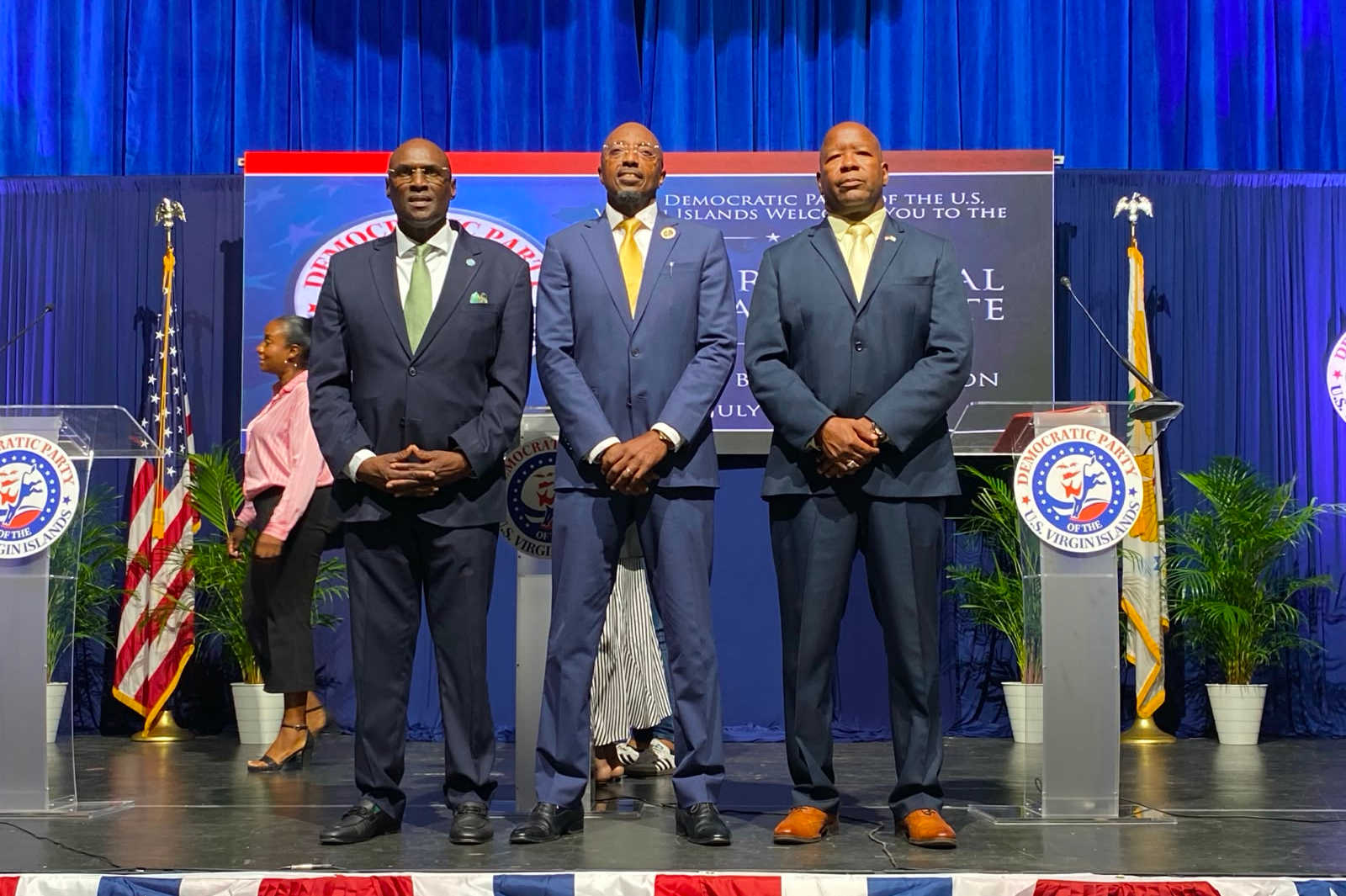
The three Democratic candidates for lieutenant governor offered sharply different assessments Friday night of what the office has accomplished and what must change, dividing over whether voters should choose continued modernization, more aggressive intervention in banking and insurance, or a management-focused overhaul built around staffing, digitization and faster service.

Senator Novelle Francis Jr., running with Lt. Gov. Tregenza Roach, presented himself as the candidate with the government, legislative and public-safety experience to continue work already underway. Senate President Milton Potter, Delegate Stacey Plaskett’s running mate, argued that the territory’s economic and government systems are not working for ordinary residents and called for more banking competition, employee development and accountability. Rodney Moorehead, running with former senator Donna Frett-Gregory, positioned himself as a nontraditional candidate focused on property appraisals, staffing, insurance access, workforce development and measurable results.
The debate, held at the St. Croix Educational Complex auditorium, was moderated by Sy Winans. Candidates received 90 seconds to answer questions and could use 30-second rebuttals, followed by a rapid-response round, audience questions and closing statements. The event was carried through the Government Access Channel and the Democratic Party of the Virgin Islands’ Facebook page, with Isle 95 participating as a media partner.
The audience included supporters wearing campaign shirts as well as undecided voters looking for detailed and achievable proposals.

Debate Begins With Disagreement Over the Lieutenant Governor’s Role
Asked how he would serve as the governor’s governing partner while carrying out the office’s independent responsibilities, Francis said he would draw on Roach’s experience as lieutenant governor and his own previous service as acting lieutenant governor.
Francis said he had helped advance legislation affecting the office and was familiar with its operations before entering the race. He pledged to continue expanding the Street Addressing Initiative and improving insurance products and other services.
Potter responded that the governor and lieutenant governor must be treated as partners who share responsibility for an administration’s successes and failures.
“The role of the lieutenant governor and the governor, they are partners. So you take the bitter with the sweet,” Potter said.
Moorehead said voters must also consider how long projects have taken, noting that some have continued for more than eight years. He said the objective should be to make maximum use of the limited time an administration has to deliver results.
Francis then criticized Potter’s attendance as Senate president, alleging that Potter had been off island 15 times and that the Legislature’s vice president had been required to act in his place during those absences.
Francis and Potter Revisit Government Compensation Dispute
The debate became more pointed when Potter was asked to describe a disagreement with a colleague or leader.
Potter cited the controversy surrounding recommendations from the V.I. Public Officials Compensation Commission. He accused Francis, who was then Senate president, of knowing that a commission letter had been received and understanding that the proposed compensation changes would take effect if the Legislature did not act.
Potter said he worked with colleagues to schedule hearings and stop implementation of the raises.
Francis responded that the Legislature was closed because of Hurricane Ernesto on August 12 and 13. He said he accepted responsibility for matters that occurred while he was Senate president and argued that he would not have benefited from the proposed increase, while Potter would have.
“As the Senate President, I take full responsibility for anything that happened under my watch,” Francis said.
Potter countered that Francis had said he did not receive the email and alleged that the matter changed only after local media obtained an image of a read receipt. Potter said leadership required honesty and responsibility even when circumstances were difficult.
Moorehead declined to become involved in the dispute, saying he did not want to be distracted from identifying solutions for residents.
Property Appraisals and Uncollected Taxes
Moorehead identified the property-appraisal division as requiring the most immediate improvement. He said the territory has more than 60,000 properties but only about 8,000 had been appraised.
He proposed developing an apprenticeship program beginning in the public schools, allowing students to work with experienced appraisers and build a pipeline of trained workers who could help reduce the backlog.
Francis said the Office of the Lieutenant Governor had generated almost $1 billion in property-tax collections under Roach. He agreed that more appraisal training was necessary and proposed automation and technology dashboards to improve performance.
Potter said large collections did not erase the amount still outstanding. He cited more than $140 million in uncollected property taxes and argued that the government should pursue money already owed before discussing new taxes or increases.
Moorehead said he agreed with the need to collect outstanding revenue.
Modernization and Customer Service
All three candidates supported greater use of technology but differed over whether the current pace was adequate.
Francis said residents should not have to leave home to access routine services. He called for technology, software and automation throughout the office and said work had already begun through the Street Addressing Initiative and changes within the tax assessor’s office.
He also said modernization must be supported by better customer service and leadership from the lieutenant governor down through every division.
Potter agreed that equipment and technical upgrades were important but said the employees performing the work must be treated and compensated properly. He called for training and professional development to extend beyond senior managers to rank-and-file workers.
Moorehead questioned why the improvements had not already been completed and said the office must be fully staffed to reduce delays.
Francis responded that modernization was underway. He pointed to changes he said he made within the Legislature, including annual salary increases of 3 percent and the opportunity for employees to receive merit increases of up to 6 percent if they exceeded performance standards.
Banking Competition and Small-Business Access
Potter proposed a banking summit and an intentional effort to recruit additional financial institutions to the Virgin Islands.
He said banks operating in the territory did not always provide the same products they offered in Puerto Rico and other jurisdictions. He suggested inviting banks from across the United States and internationally, including institutions from Africa, to consider entering the market.
Potter argued that new competition would pressure existing banks to improve lending opportunities and rates for small businesses.
Francis responded by pointing to the Catalyst Fund, which he said made $5 million available to small businesses. He emphasized that he owns a business and understands gross receipts taxes, excise taxes and the daily challenges facing business owners.
He also accused the Plaskett-Potter campaign of being beholden to large contributors, referring to donors he said had contributed hundreds of thousands of dollars. The allegation was not independently addressed during the debate.
Potter said Francis was presenting a picture in which government programs were successfully reaching the public when ordinary residents continued to struggle.
“All is not well with regular Virgin Islanders,” Potter said. “The programs that you're talking about is not reaching us. It's not reaching real people.”
Francis replied that he works at his gas station after spending eight to 12 hours at the Legislature and said he experiences the pressures facing business owners.
Moorhead said the central issue was the government’s responsibility to relieve that pressure. He proposed examining neobanks and other financial services, recruiting more institutions and expanding access to capital for businesses and homebuyers.
Land Records and Probate
Asked about property taxation, Geographic Information Systems and title management, Francis said technology should make land information easier for the public to access.
He connected unpaid property taxes to the territory’s probate backlog, saying families can remain caught in unresolved cases for decades. Francis said some probate matters take 20 to 30 years and referred to legislation and discussions about establishing a probate court to move cases more quickly.
Potter and Moorehead did not challenge that response.
Disaster Preparation and Document Protection
Potter said the lieutenant governor has a significant role before and after a disaster because the office regulates banking and insurance.
He proposed regular discussions with financial institutions, public education about underinsurance and advance planning for borrowers who may need payment relief after a storm.
Francis said the government must first secure an emergency declaration and questioned whether the Plaskett-Potter team could establish the necessary federal relationships. He also criticized disaster-recovery oversight in the Legislature, alleging that Potter did not hold a hearing on St. Croix while chairing the relevant committee.
Potter disputed Francis’s characterization and accused him of repeating statements without evidence.
Moorehead said the government must coordinate with agencies including the Federal Emergency Management Agency and the V.I. Department of Human Services before a storm to ensure that support services are ready afterward.
All three supported digitizing personal records so residents can recover deeds, photographs, insurance records and other important documents after a disaster.
Moorehead referred to documents lost during major hurricanes and said he was fully in favor of storing information digitally.
Francis encouraged residents to create inventories and use their cellphones to photograph possessions and documents for insurance companies or FEMA.
Potter agreed but also raised the planned relocation of the Recorder of Deeds to the former FirstBank building in downown Christiansted. He said the property was purchased around 2024 and that the move had still not been completed.
Insurance Costs and Limited Options
Francis said the territory must attract better insurance products and look beyond the local market, including online coverage. He also identified forced-placement insurance as a source of high costs.
He proposed exploring whether the Virgin Islands could pool its market with Puerto Rico, the British Virgin Islands or another jurisdiction to create a larger customer base and make the territory more attractive to insurers.
Potter said the government should consider incentive packages to recruit insurance companies and emphasized that competition was necessary in a market with few options.
Moorehead said insurers would first want reliable data on hurricanes, risk factors and health conditions. He proposed strengthening territorial data collection before attempting to recruit companies.
Francis disagreed that the central problem was missing data. He said the information already exists and that the larger challenge is the territory’s small market, exposure to hurricanes and limited volume.
Candidates Define Their Priorities in Lightning Round
Asked what government process they would eliminate or simplify, Francis identified the gross receipts tax, though he then said it could be modified. Potter selected the business-license process, while Moorehead said he would reduce long turnaround times for government services.
Francis said the South Shore Enterprise Zone would have the greatest economic impact. Potter chose investment in children and youth programs. Moorehead selected the industrial park, saying it should be used to attract businesses rather than house government offices.
The candidates identified character, integrity and humbleness as qualities public servants should possess.
Francis said the greatest challenge facing young Virgin Islanders is opportunity. Potter selected access to a strong education, while Moorehead identified workforce development and opportunities to succeed.
Potter said one misconception is that the lieutenant governor’s post is ceremonial, emphasizing its responsibilities for banking, insurance, property and other services. Moorehead said people underestimate how demanding the position is. Francis cited perceptions about the timeliness of the Recorder of Deeds.
Francis defined success as improving quality of life. Potter said success means fair systems that provide access regardless of a resident’s station in life. Moorehead said success would be a booming economy that generates the money needed to support children, senior citizens and the wider community.
Audience Questions Focus on Loans, Healthcare and Accountability
Responding to an audience question about limited banking options and difficulty obtaining home and business loans, Francis said he would search the market for better products and consider online lending opportunities.
Potter was asked about the territory’s exclusion from the Affordable Care Act and the lack of affordable medical insurance. He proposed an intensive and unified effort involving all three branches of the territorial government to negotiate with the federal government.
He also discussed pooling small businesses to spread risk and make them more attractive to insurance providers.
Moorehead was asked how he would slow the departure of young residents and attract professionals back home. He proposed creating career tracks in public schools and linking students directly to workforce training.
“We need to create careers, not jobs,” Moorehead said, adding that young professionals must be paid what they are worth and receive benefits that allow them to meet their expenses.
Francis was asked to identify three actions he would take during his first 100 days to increase transparency and accountability.
He proposed strengthening the offices of the inspector general and attorney general, creating an anti-corruption task force, ensuring that the Epstein matter is thoroughly investigated and holding responsible parties accountable.
Francis also proposed a transparency website allowing the public to view government financial information and disaster-recovery projects in real time. He said the governor and lieutenant governor would report periodically on the status and direction of the government.
Potter said he would support legislation establishing firm deadlines for spending and reporting appropriated funds, along with penalties for agency heads who fail to comply.
“Accountability is key in government,” he said, arguing that rules applied to lower-level employees should also apply to commissioners and department leaders.
Moorehead said he would use his mediation experience to negotiate with insurance companies and press them to offer better options to homeowners.
Candidates Close With Contrasting Appeals
Francis based his closing argument on his record in law enforcement and the Legislature. He highlighted his service as police commissioner and Senate president, the development of a new legislative building and the creation of the Capitol Police force.
He said his career had been built through work in the Virgin Islands rather than a recent decision to seek higher office. Francis characterized Potter’s presentation as a scripted Washington message and said his own experience had prepared him for the position.
Potter said the size of the audience confirmed his belief that residents are deeply concerned about government performance.
He pointed to struggling schools, healthcare institutions and WAPA and questioned why residents were still suffering if existing initiatives were working as described. Potter argued that electing another administration connected to the current government would amount to 12 years of the same direction.
He also referred to information he said three women showed him concerning planned eight-hour WAPA outages on July 13 and 14, saying residents without generators would bear the consequences.
Moorehead closed by emphasizing support for labor unions and saying too many contracts had expired. He pledged to help ensure that workers are paid what they are worth.
He again called for a modernized and digitized office, additional insurance companies and stronger support for small businesses.
Moorhead acknowledged that he was not a seasoned politician but said he had spent 30 years working with children and solving problems.

“Enough is enough. It's time for results,” he said.