



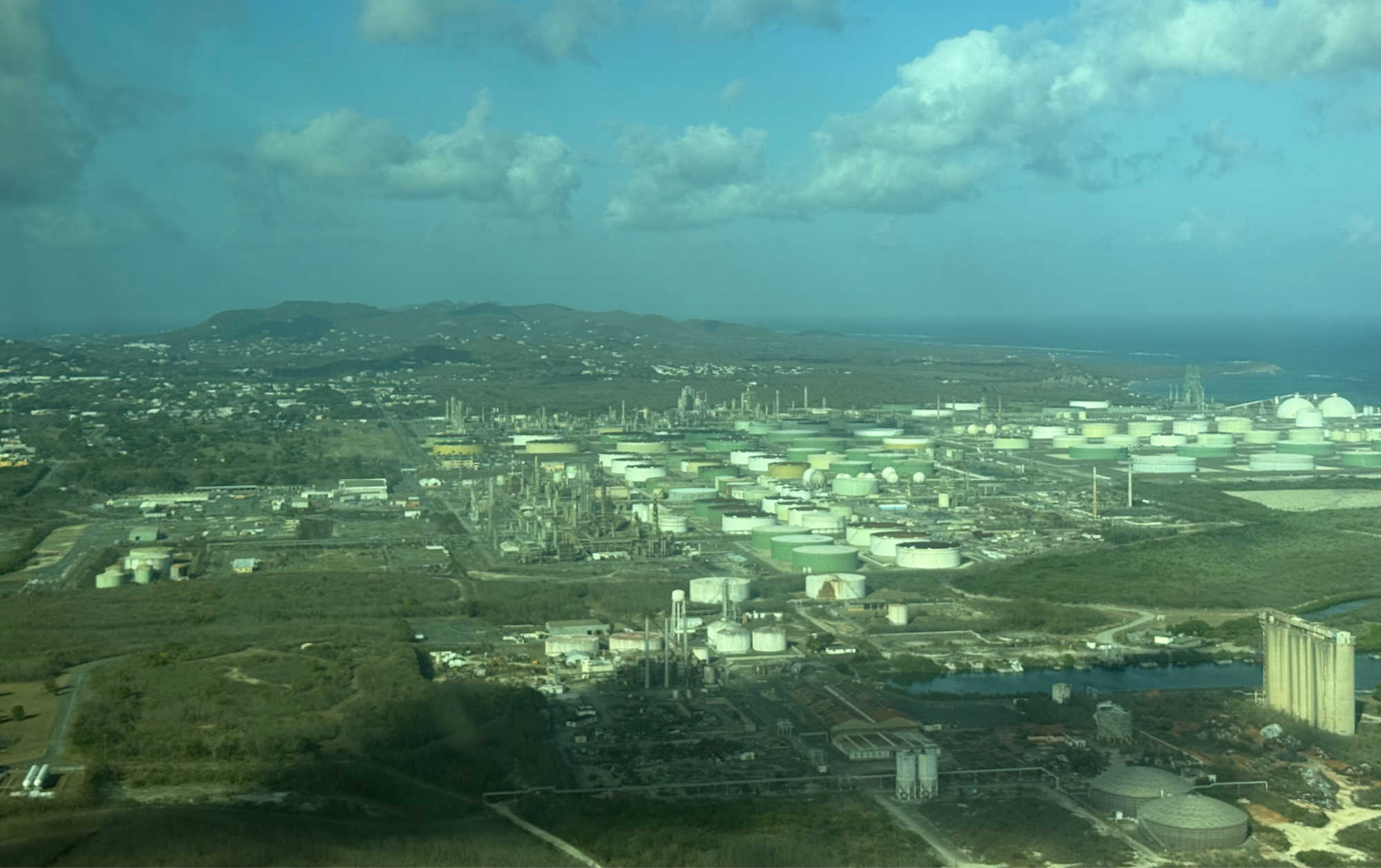
ST. CROIX — Port Hamilton Refining and Transportation is targeting 2027 for a phased restart of the long-idled St. Croix refinery, with plans to eventually exceed 200,000 barrels of production per day and an unnamed commercial partner committed to both supply crude oil and purchase the finished fuels produced at the facility.

The new details, disclosed by Port Hamilton Director David Johnson in an interview with Bloomberg, provide the clearest timeline yet for an effort that has been discussed for several years but has repeatedly faced questions over financing, regulatory compliance and the work required to safely return the massive south shore facility to operation.
Johnson said Port Hamilton hopes the process now underway will lead to a restart within approximately 12 months, but emphasized that the 2027 target remains dependent on completing financing and satisfying regulatory, engineering and other requirements necessary for startup.
Port Hamilton is evaluating several financing alternatives, according to Johnson, who said the project has attracted significant interest from U.S. government financing programs as well as private investors and lenders.

No final financing package or federal funding award has been publicly announced.
A potentially significant addition to the restart plan is an agreement with a commercial partner whose identity has not been disclosed. Bloomberg reported that the company has committed to supply crude to the St. Croix refinery and purchase its refined products.
The terms of that arrangement — including the volume of crude to be provided, the amount of finished fuel to be purchased, pricing and duration — have not been made public.
Port Hamilton intends to bring the refinery online in stages, with total production ultimately exceeding 200,000 barrels per day. That aligns closely with Johnson’s public comments on St. Croix in May, when he said the company envisioned restarting the facility at approximately 220,000 barrels per day, similar to the configuration used during the Limetree Bay restart.
The latest disclosure comes less than two weeks after Gov. Albert Bryan Jr. publicly urged the Trump administration to treat the St. Croix refinery as a national energy asset and establish a coordinated federal pathway for its reopening.
As The Consortium reported September 25, Bryan made the appeal in an op-ed published in the Washington Examiner, arguing that Washington should take advantage of an existing American refinery at a time when additional refining capacity is being sought nationally.
Bryan proposed bringing the territorial government, refinery owners and federal agencies responsible for energy, environmental regulation, territorial affairs and national defense together to identify what would be necessary for a safe restart and what federal tools might appropriately support the project.
The governor specifically said he was not seeking exemptions from environmental requirements or a federal guarantee of private investment.
“We are not asking Washington to waive environmental standards or guarantee a private investment,” Bryan wrote. Instead, he called for federal agencies to establish clear requirements, evaluate available support and make decisions about whether and how the refinery can return to operation.
The new information from Port Hamilton indicates that some of the issues central to Bryan’s appeal — federal interest, financing and regulatory coordination — are now active parts of the company’s restart discussions. There has been no announcement, however, that the federal government has approved financial support for the project.
Federal policy has increasingly favored expansion of U.S. refining capacity.
In April, President Donald Trump formally determined under Section 303 of the Defense Production Act that domestic petroleum production, refining and fuel-logistics capacity are essential to national defense. The directive authorized federal tools including purchases, purchase commitments and financial support intended to overcome financing constraints, permitting delays and infrastructure bottlenecks.
The White House has also been encouraging the restart of idled refining capacity as the administration seeks to increase domestic fuel production.
Those efforts have taken on added significance amid tightening global fuel markets.
Bloomberg reported that refinery margins have risen sharply as conflicts involving Iran and Ukraine have disrupted refining capacity and fuel supplies in the Middle East and Russia. Tight conditions are expected to persist into 2027, potentially increasing the value of additional refining capacity coming onto the market.
St. Croix also has a geographic advantage. Its location places the refinery near major Western Hemisphere crude-producing regions, including Venezuela and Guyana, while its deepwater infrastructure historically allowed large quantities of crude and refined petroleum products to move through the south shore complex.
Bryan highlighted that advantage in his September op-ed, noting that the refinery was originally designed in part to process heavy Venezuelan crude.
The facility was constructed by Hess Oil in 1966 and expanded dramatically over subsequent decades. At its peak during the 1970s, capacity exceeded 650,000 barrels per day, making it for a period the largest refinery in the world.
By the time HOVENSA ceased refining operations in 2012, the facility was processing approximately 360,000 barrels daily.
A multibillion-dollar effort later sought to revive portions of the refinery under Limetree Bay. More than $3.2 billion was invested ahead of the February 2021 restart, according to Johnson, with the revived operation configured at roughly 200,000 barrels per day.
That restart was short-lived.
A series of serious environmental and operational incidents followed, including emissions of hydrogen sulfide and sulfur dioxide, releases that affected surrounding communities and a major flare incident. In May 2021, the Environmental Protection Agency ordered refining operations paused after determining that continued operation presented an imminent and substantial danger to public health and the environment.
Limetree subsequently ceased refining operations and entered bankruptcy.
Port Hamilton acquired the refinery through the bankruptcy process later that year. Johnson told Bloomberg that rather than mothballing the industrial equipment, the company deliberately maintained key systems and continued staffing a control room so the refinery could remain in what he described as a safe idle condition.
Port Hamilton also won a major legal victory in 2023 when the U.S. Court of Appeals for the Third Circuit rejected EPA’s determination that the refinery had to obtain a new Prevention of Significant Deterioration permit simply because it had remained shut for an extended period.
That ruling did not eliminate the refinery’s other federal and territorial environmental obligations.
EPA has continued overseeing cleanup and chemical-removal work at the facility under consent orders. The agency’s current refinery information states that removal work involving ammonia, amines and liquefied petroleum gas has been completed.
Bloomberg reported that the refinery has now cleared most of the permitting-related hurdles facing the restart, although remaining regulatory matters will need to be addressed once an actual startup date is established.
EPA spokesperson Brigit Hirsch said the Trump administration remains willing to work with the parties to address outstanding requirements and establish a safe and lawful path forward.
That distinction is significant: 2027 is Port Hamilton’s target, not an approved or guaranteed startup date.
Johnson acknowledged the history surrounding the previous restart and said the company cannot sacrifice safety in an effort to get the facility operating quickly.
His family lives on St. Croix, he noted, and his children were born and attend school on the island. “Ensuring that this refinery operates safely and responsibly is personal for me,” Johnson said.
For Port Hamilton, the immediate task is now converting government and investor interest into completed financing while resolving remaining engineering and regulatory requirements.

If those pieces come together, the company’s latest plan would return large-scale refining to St. Croix more than five years after the failed Limetree restart, and place the territory back into the petroleum market at a time when global fuel supplies are under significant pressure.