

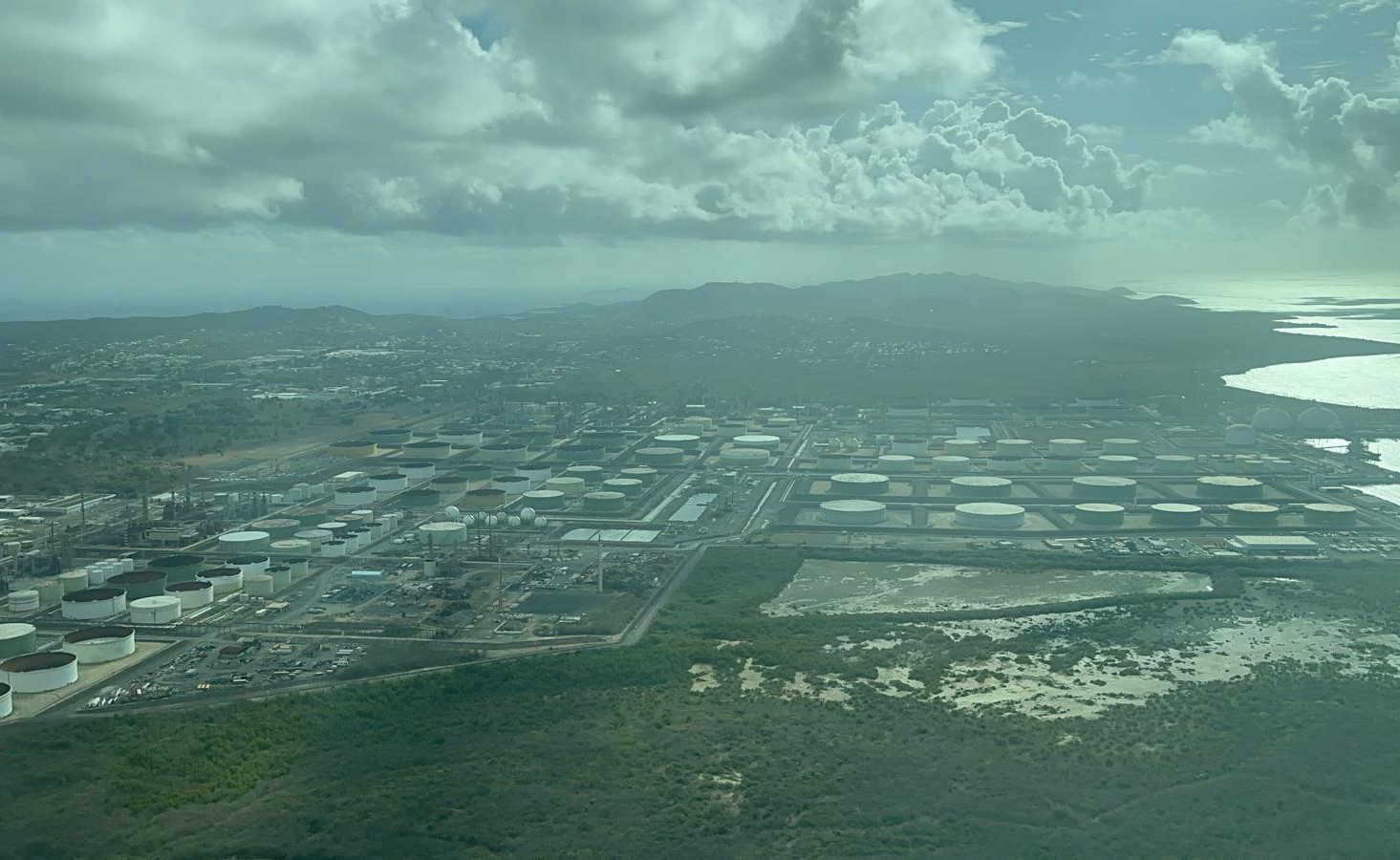
Gov. Albert Bryan Jr. is calling on the Trump administration to treat St. Croix’s long-idled oil refinery as a national energy asset and establish a coordinated federal pathway toward restarting it, arguing that the existing facility could help expand U.S. refining capacity as Washington seeks ways to turn newly accessible Venezuelan crude into gasoline, diesel and jet fuel.

Mr. Bryan made the case in an op-ed published Thursday by the Washington Examiner under the headline, “America needs oil now: Trump is sitting on a sleeping giant in the Virgin Islands.” His appeal comes as President Donald Trump presses U.S. refiners to increase domestic fuel production and following a new agreement that the White House says gives the United States majority control over more than 65 billion barrels of proven Venezuelan oil reserves.
The timing places St. Croix’s refinery in the middle of a broader national discussion over refining capacity. President Trump met with nearly a dozen refiners earlier this month to discuss increasing output, faster permitting and additional investment, while Reuters reported that the administration has been considering how the Defense Production Act could be used to expand U.S. refining capacity. In April, Mr. Trump formally determined that domestic petroleum production, refining and logistics capacity are essential to national defense and authorized the Department of Energy to use authorities under Section 303 of the Defense Production Act to support expansion.
Mr. Bryan argued that unlike a new refinery that would have to be designed and constructed from the ground up, much of the industrial infrastructure already exists on St. Croix. The former Hess refinery was built in 1966 and expanded until its peak capacity exceeded 650,000 barrels per day, making it for a period in the 1970s the world’s largest refinery. After portions of the facility were taken offline, official capacity fell substantially, and the 2021 Limetree Bay restart operated at roughly 200,000 barrels per day before operations stopped. “Today, the plant produces zero,” the governor wrote.

Federal data support the description of the facility as currently dormant. The U.S. Energy Information Administration lists no operable refinery capacity in the Virgin Islands as of January 1, 2026, compared with 180,000 barrels per stream day of operating capacity in 2021.
Mr. Bryan emphasized that much of the industrial infrastructure associated with the former refinery complex remains in place. The refinery retains its processing units and related infrastructure, while the neighboring storage tanks and marine docks are owned and operated by Ocean Point Terminals, a separate company. He contrasted that existing industrial footprint with the expense and time required to build a comparable refinery from scratch, arguing that the United States should make use of infrastructure already in place rather than wait years for a new facility to clear financing, construction and permitting hurdles.
His argument comes as the U.S. refining sector has contracted significantly in the number of facilities operating since the early 1980s. EIA records show 258 operable U.S. refineries in 1983 compared with 130 as of January 1, 2026 — exactly 128 fewer. EIA also says that while smaller refineries have been built more recently, the newest U.S. refinery with significant downstream processing capacity remains the Garyville, Louisiana facility that came online in 1977.
For Mr. Bryan, the recent developments in Venezuela strengthen the argument for St. Croix. He noted that increasing crude supplies alone does not produce additional gasoline, diesel or jet fuel without sufficient refinery capacity to process that oil. The governor pointed to St. Croix’s proximity to Venezuela and Guyana and noted that the refinery was built to process Venezuelan heavy crude. He argued that restarting the facility could allow more crude to be processed on U.S. soil while supplying American and Caribbean markets that currently rely in part on imported finished petroleum products.
The White House announced August 31 that Venezuelan interim authorities had granted North American Blue Energy Partners 100-year concessions covering 17 oil fields with approximately 65 billion barrels of proven reserves. The administration says the agreement gives the U.S. government governance rights, economic ownership and guaranteed low-cost offtake from the company.
Mr. Bryan also grounded his appeal in St. Croix’s economic history. The governor, who previously worked at the refinery, said a successful operation supports skilled employment, contractors and government revenue that can finance schools, infrastructure, retirement obligations and public services. But he acknowledged the other side of the refinery’s history as well. “When it is run badly, neighbors pay in public health and lost trust,” he wrote. A credible restart, he said, would require capital, modern environmental and safety practices, experienced operators, reliable crude supplies and offtake agreements, along with a commercial structure capable of surviving swings in commodity markets.
Those environmental concerns have a substantial history. In May 2021, the Environmental Protection Agency used emergency powers under the Clean Air Act to order Limetree Bay to pause refining operations after a series of incidents involving air pollution and oil releases. EPA said some nearby residents had become sick and concluded at the time that continued operation presented an imminent risk to public health.
The regulatory landscape has changed since then. After Port Hamilton Refining and Transportation purchased the refinery through bankruptcy proceedings, EPA determined in 2022 that the facility would need a new Prevention of Significant Deterioration permit before restarting. The U.S. Court of Appeals for the Third Circuit overturned that decision in 2023, ruling that EPA had exceeded its statutory authority because the Clean Air Act’s PSD provisions apply to newly constructed or modified facilities, not simply to the restart of an existing plant. EPA subsequently abandoned its broader “Reactivation Policy” in 2025. Other federal and territorial environmental, safety and operating requirements remain applicable.
EPA’s current refinery page also says the agency has completed the removal of ammonia, amines and liquefied petroleum gas from the Port Hamilton facility and discontinued related air monitoring after the removal work was completed. Port Hamilton, meanwhile, publicly reiterated its intention to restart the refinery in May, when director David Johnson said the company envisioned an initial configuration of approximately 220,000 barrels per day.
Mr. Bryan is now asking Washington to organize those separate interests into a single federal effort. He proposed that the White House designate a team bringing together the territorial government, refinery owners and operators, and federal agencies responsible for energy, environmental compliance, territorial affairs and national defense. The objective, he wrote, should be a coordinated process identifying what is required for a safe restart and determining which existing federal tools could appropriately support financing for a qualified project.
The governor stressed that he is not seeking a waiver of environmental standards or a federal guarantee of private investment. Instead, he called for agencies to establish clear requirements, evaluate available federal support and reach decisions about whether and how the refinery can move forward.
“We are not asking Washington to waive environmental standards or guarantee a private investment,” Mr. Bryan wrote. “We are asking it to use the authorities it already has: put the agencies at one table, set clear requirements, evaluate available support, and reach decisions.”

He closed his argument by placing the refinery squarely within the administration’s domestic-energy agenda: “The Virgin Islands are part of the U.S. This is an American refinery. Our workers are American workers. That option deserves a federal path — not another year of drift."