




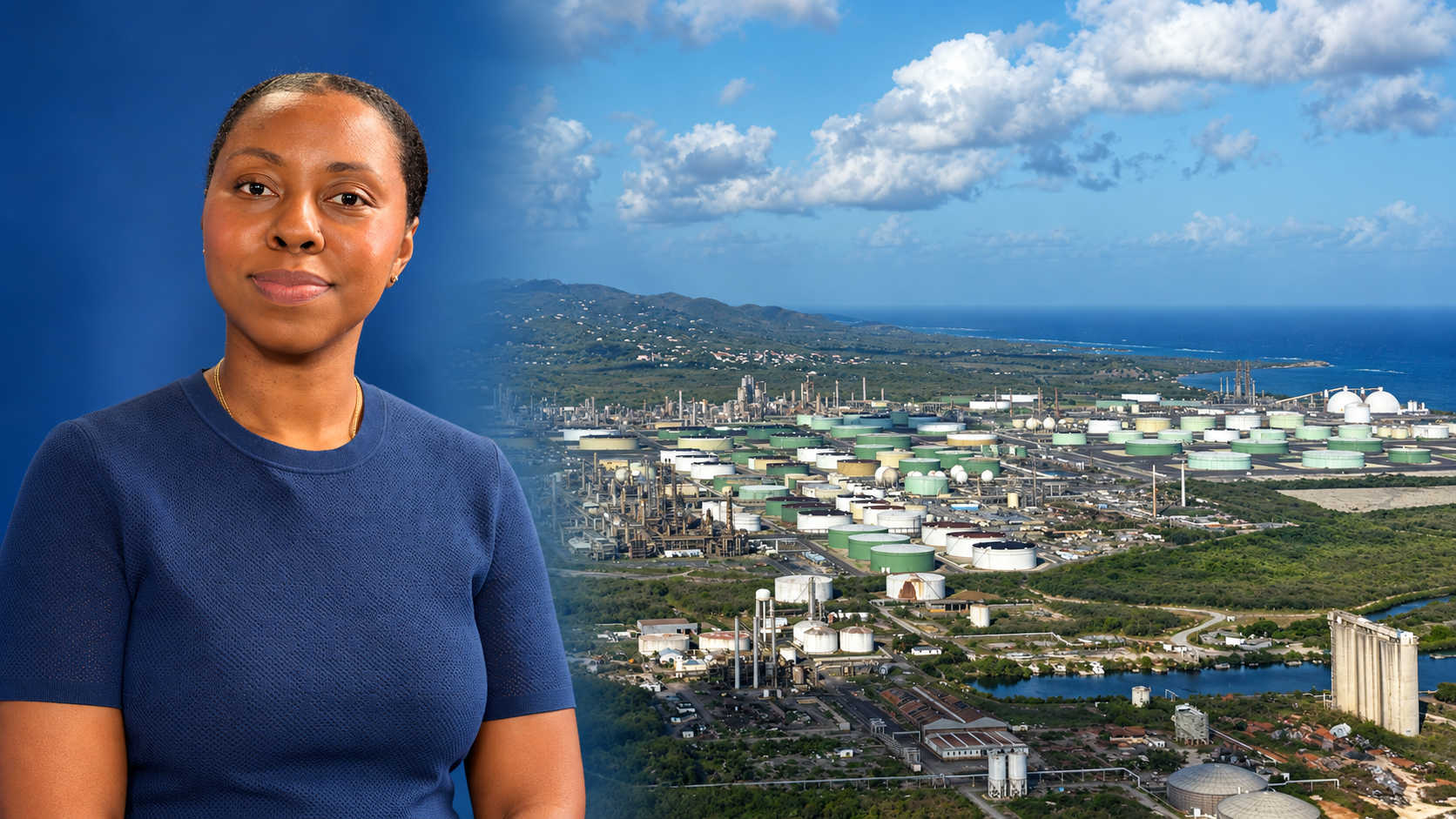
ST. CROIX — At-large Senate candidate Hadiya Sewer declared her opposition to reopening the St. Croix oil refinery during Thursday night's V.I. Consortium-WTJX debate, rejecting an industry that once supported thousands of jobs and generated substantial government revenue, and whose proposed revival Governor Albert Bryan has linked to more than 400 new positions and $45 million in annual revenue for the territory.

Asked directly whether she supported restarting the South Shore facility, which Port Hamilton Refining and Transportation is targeting for a phased reopening in 2027, Sewer gave a one-word answer: "No."
She argued that the health and environmental risks associated with refining, combined with the financial difficulties experienced by previous operators, outweighed the potential benefits of another restart.
Incumbent Senator at Large Angel Bolques Jr. took a different position, supporting the refinery's reopening provided environmental protections and safety requirements are maintained.

The exchange placed two approaches to St. Croix's economic future in direct competition: one seeking to restore a major source of industrial employment and government revenue, and the other seeking to replace that activity with environmental services, technology, light manufacturing and other industries.
Sewer Says Health and Financial Risks Outweigh Job Projections
During the debate, Sewer said the refinery's history demonstrated why another attempt should not be supported.
"I would argue that the environmental and the public health impact creates a significant financial and health burden for the people of the Virgin Islands," she said.
She cited approximately $1.3 billion in losses reported before HOVENSA closed in 2012 and referred to roughly $4 billion in losses associated with Limetree Bay's unsuccessful attempt to resume refining in 2021.
HOVENSA's reported $1.3 billion in losses over its final three years is documented in the company's January 2012 closure announcement. The roughly $4 billion figure associated with Limetree, however, requires a distinction: reporting at the time of its 2021 bankruptcy established that investors had spent more than $4 billion attempting to revive the operation, which is not necessarily equivalent to an audited net loss of the same amount.
Sewer maintained that the promise of jobs was insufficient evidence that a new operator could successfully restart and sustain the refinery.
She said the territory was being asked to accept the possible environmental and health consequences of another uncertain undertaking.
When questioned about what could replace refinery employment, Sewer proposed jobs in environmental services, climate-related industries, digital technology and light manufacturing. She said such opportunities could begin developing within 12 to 24 months.
She also advocated legislative changes to encourage remote work, attract software businesses and expand activity through the University of the Virgin Islands Research and Technology Park.
Gilbert pressed Sewer on whether those industries could deliver employment on the scale of the refinery, when the jobs would materialize and whether they would offer salaries comparable to industrial positions.
Sewer pointed to potential business incentives and opportunities for companies to establish operations in the territory. She did not identify a specific group of funded projects, committed employers or a detailed employment forecast demonstrating that the alternatives would produce equivalent jobs and wages within the proposed timeframe.
What the 2012 HOVENSA Closure Cost St. Croix
The history of the refinery's closure remains central to the economic debate.
The sprawling South Shore operation began under Hess Oil in the 1960s and later became HOVENSA, a joint venture involving Hess and Venezuela's state-owned petroleum company.
In January 2012, HOVENSA announced that it would permanently cease refining operations after accumulating approximately $1.3 billion in losses over the preceding three years. Refining ended in February, bringing to a close decades of large-scale industrial production at the site.
The consequences extended far beyond the refinery gates.
A historical assessment published through the federal Health Resources and Services Administration reported that approximately 2,150 employees and subcontractors were dismissed in 2012, resulting in an estimated annual payroll loss of $269 million to $301 million.
The report put the refinery's economic activity in 2011 at approximately $420 million, including $346 million in payments to individuals and vendors. Much of that spending flowed through the St. Croix economy, supporting housing, retail businesses, restaurants, transportation, educational institutions and service providers.
The same assessment reported that unemployment on St. Croix increased from approximately 9 percent when the closure was announced to 17 percent by December 2012.
Federal officials also documented the government's immediate financial exposure. In May 2012, the U.S. Department of the Interior told Congress that the HOVENSA shutdown was expected to reduce anticipated territorial government revenue by approximately $92 million, or 14 percent.
The closure also removed a major source of subsidized fuel for the Water and Power Authority, while depriving the economy of a large concentration of skilled workers and high-paying employment.
The U.S. Bureau of Economic Analysis subsequently reported that the Virgin Islands' real gross domestic product contracted by 15 percent in 2012, followed by another contraction in 2013. The territory was already experiencing broader economic difficulties, but the loss of refinery activity was a major part of the economic disruption.
School Closures, Business Losses and the Departure of Skilled Workers
The refinery's closure also changed the social and educational landscape of St. Croix.
Private schools were particularly exposed because refinery employees and their families formed part of their enrollment base. In testimony to Congress in 2012, the Interior Department specifically warned that HOVENSA-paid private school tuition benefits would end, putting financial pressure on both private institutions and public schools expected to absorb displaced students.
One direct casualty of the period was Kingshill School, which announced that it would close in the spring of 2012. The St. Croix Reformed Church, which had supported the school, connected the financial challenges facing local private education to the economic conditions created by HOVENSA's closing.
Good Hope School and St. Croix Country Day School also faced the changing enrollment and financial environment.
In 2013, the institutions merged to form Good Hope Country Day School, consolidating operations at the former Country Day campus. As the Consortium reported in September 2025, the refinery closure had significantly reduced enrollment at Good Hope, helping drive the merger. The former Good Hope campus later became the subject of a proposed community redevelopment project.
For businesses dependent on refinery workers and their households, the disappearance of wages also meant fewer customers, reduced demand for services and less commercial activity.
The St. Croix Foundation documented the broader impact in its 2012–2014 annual report, describing the refinery's shutdown as having produced widespread private-sector job losses, government layoffs and the departure of residents and skilled labor from the island.
The federal Health Resources and Services Administration's historical assessment estimated that approximately 30 percent of affected employees migrated off-island seeking employment.
That departure represented more than a reduction in the number of residents. St. Croix lost experienced workers, tradespeople, professionals and families whose spending had supported businesses and educational institutions.
Many sought opportunities in the continental United States. Texas was among the mainland locations with longstanding ties to the territory's refinery workforce, although the available historical assessments do not provide a verified count of how many displaced HOVENSA workers moved there.
The population decline continued during the following decade. Census figures show the territory's population fell from 106,405 in 2010 to 87,146 in 2020. That decline cannot be attributed entirely to HOVENSA, as it also encompassed the economic difficulties of the decade and the devastation of Hurricanes Irma and Maria in 2017.
Mapp's Refinery Agreement Brought Money Into Government Coffers
Former Governor Kenneth Mapp's administration pursued a return to oil refining as part of an effort to restore industrial employment and government revenue.
In July 2018, Mapp announced an agreement with ArcLight Capital Partners and the operators of Limetree Bay to invest approximately $1.4 billion in refurbishing the refinery.
At the time, the administration projected more than 1,200 construction jobs during the rebuilding period and as many as 700 permanent positions after refining resumed.
The financial agreement was also expected to provide direct benefits to the government.
The Consortium reported in July 2018 that the arrangement called for a $70 million closing payment, consisting of $30 million for the purchase of government-owned real estate and $40 million described at the time as a prepayment of taxes.
Government financial statements subsequently established that the money was received.
The Government of the Virgin Islands' financial statements for fiscal year 2022 record that, after Limetree secured approximately $1.3 billion in financing in December 2018, the government received $40 million in short-term financing and $30 million for housing units and other properties associated with the refinery.
Those payments were actual financial proceeds from the transaction, rather than revenue dependent on the refinery eventually operating. The $40 million was classified in the later financial statements as financing, not simply as recurring tax collections.
An earlier agreement had also generated a major government payment associated with the oil storage terminal. The same financial statements record that Limetree paid $220 million in December 2015 as a payment in lieu of taxes under the terminal operating arrangement. That transaction concerned the storage business, rather than an operating refinery.
The 2018 refinancing and refurbishment agreement was negotiated under Mapp, but refining did not restart during his administration. The facility eventually resumed production in February 2021, after Governor Bryan had taken office.
The economic impact of the refurbishment was nevertheless visible before production resumed.
In December 2019, the Consortium reported figures from a V.I. Public Finance Authority investor presentation showing that Limetree had invested approximately $1.6 billion at the facility and reported generating more than 4,000 construction jobs during the project. The proportion of those positions filled by local workers was not established in that presentation.
The U.S. Bureau of Economic Analysis also identified major capital improvements at the St. Croix refinery and oil terminal as contributing to increased private investment during 2019, a year in which the territory's economy expanded. Federal disaster assistance, insurance-funded reconstruction and other economic activity also contributed to that growth.
Refinery Jobs Paid an Average of $143,000, Economic Study Found
The wages associated with refinery employment provide additional context for Thursday's exchange.
An October 2021 economic-impact study prepared by the V.I. Bureau of Economic Research reported that the average annual wage of Limetree Bay refinery employees was approximately $143,000, based on company employment data from 2020.
For comparison, the report placed average earnings for full-year, full-time workers in the Virgin Islands at approximately $48,000.
The bureau's analysis estimated that the refinery directly supported approximately 600 employee and contractor positions, with additional jobs supported through supply-chain activity and household spending.
Including those wider effects, the study estimated that refinery operations supported approximately 800 jobs, $112 million in annual labor income and $633 million in economic value added to the territory.
It also calculated approximately $1.8 billion in related economic output and an estimated $25 million in annual tax collections associated with workers, suppliers and other linked economic activity.
Those figures were economic-impact estimates based on historical operating and employment data, not a guarantee that another restart would reproduce the same results. The report also expressly excluded the environmental and public health costs associated with refinery operations.
Separate from those modeled tax effects, the refinery's former operating arrangements included concession fees payable to the territorial government. In September 2021, the Consortium reported that the government stood to lose a refinery concession fee of approximately $14 million following Limetree's shutdown.
The loss of industrial activity was also evident when the refinery ceased operating. The Consortium reported in September 2021 on workers facing layoffs, businesses reporting reduced trade and families considering whether they could afford to remain on St. Croix.
The 2021 Restart and Environmental Shutdown
The economic benefits of refinery activity were accompanied by substantial environmental concerns, which formed the basis of Sewer's opposition during Thursday's debate.
Limetree Bay resumed refining in February 2021, almost nine years after HOVENSA ceased production.
The restart was followed by a series of incidents involving emissions, flaring and releases of petroleum-related substances.
On May 14, 2021, the U.S. Environmental Protection Agency used its emergency powers under the Clean Air Act to order the refinery to pause operations.
The agency cited repeated incidents that had endangered nearby communities, including releases of air pollutants and oil droplets. EPA officials said residents had experienced health effects, while contamination concerns affected homes and water collection systems.
The order followed a major May 12 incident involving sulfur dioxide emissions and came after several earlier problems at the facility.
Limetree subsequently announced an indefinite end to refining operations and entered bankruptcy proceedings. Hundreds of workers lost their jobs, and the refinery was later sold through the bankruptcy process.
The environmental consequences remain the subject of litigation.
On October 15, the Consortium reported that St. Croix residents affected by the 2021 incidents had until November 3 to submit claims under seven proposed class-action settlements totaling approximately $59.8 million.
The settlements have received preliminary court approval but not final approval. The companies entering the agreements deny wrongdoing and liability, and the proposed settlements do not amount to judicial findings that they caused the alleged injuries.
The refinery's 2021 history therefore remains part of both sides of the current debate: the loss of well-paying employment and public revenue, and the need to prevent a recurrence of the incidents that disrupted surrounding communities.
Bryan Backs a Restart; Port Hamilton Targets 2027
Governor Bryan has publicly supported bringing the refinery back into operation, presenting it as an opportunity to restore industrial employment and strengthen the territorial economy.
In his 2025 State of the Territory address, Bryan projected that the facility could generate more than $400 million annually in economic activity, produce approximately $45 million in direct government revenue and create 400 well-paying jobs.
He has also argued that renewed refining could strengthen the territory's energy security and potentially provide benefits to the Water and Power Authority.
Those figures are projections tied to a successful restart and sustained operations. The employment and revenue have not yet materialized.
Port Hamilton has continued pursuing the project.
As the Consortium reported October 7, Port Hamilton director David Johnson said the company was targeting a phased restart in 2027 and ultimately hoped to process more than 200,000 barrels of crude oil per day.
The company said it had secured an unnamed commercial partner willing to supply crude oil and purchase finished products. Johnson also described interest from potential government and private financing sources.
However, a completed financing package has not been publicly announced, and the proposed restart remains dependent on further engineering, regulatory and financial work.
A federal appeals court ruling in 2023 overturned a particular EPA permitting determination concerning the restart. The ruling did not exempt the facility from other applicable environmental laws, operating requirements or safety obligations.
Bolques Favors Reopening With Environmental Safeguards
During the debate, Bolques argued that the refinery could return to operation without abandoning environmental protections.
He acknowledged the continuing regulatory concerns and suggested that the territory could strengthen its own standards even if federal environmental requirements were weakened.
"But again, the refinery has to be opened safely with all environmental protections intact," he said.
His position also reflected his earlier comments about electricity costs. During the debate's discussion of WAPA, Bolques said an operating refinery could potentially support a local fuel supply arrangement, although no such arrangement was established in the discussion.
Sewer maintained that St. Croix should instead pursue economic development less dependent on petroleum processing and its associated risks.
Her proposal centered on creating businesses in environmental technology, climate solutions, digital services and light manufacturing, with legislation and business incentives intended to accelerate job creation.

The disagreement leaves voters with distinctly different positions ahead of the November 3 election: Bolques supports reopening the refinery with safeguards, while Sewer opposes a restart and proposes developing alternative industries to provide employment and economic growth.