




Oil prices climbed Monday after President Donald Trump rejected Iran’s response to a U.S. peace proposal, raising fears that the war will continue to restrict shipping through the Strait of Hormuz and keep global energy markets under pressure. For the U.S. Virgin Islands, where fuel, food, cargo, electricity generation and basic goods are heavily exposed to imported energy and freight costs, the latest setback threatens to deepen a cost-of-living squeeze already being felt across the territory.

Trump’s rejection came after Iran outlined a counterproposal that included demands for compensation for war damage, recognition of Iranian sovereignty over the Strait of Hormuz, an end to the U.S. naval blockade, guarantees against future attacks, lifting of U.S. sanctions and an end to the American ban on Iranian oil sales. The U.S. proposal had called for an end to fighting before negotiations on more contentious issues, including Iran’s nuclear program.
Within hours, Trump dismissed Tehran’s proposal.
“I don't like it — TOTALLY UNACCEPTABLE,” Trump wrote on Truth Social.

Iran, however, defended its position. Foreign Ministry spokesperson Esmaeil Baghaei said Tehran viewed its proposal as legitimate and responsible.
"Our demand is legitimate: demanding an end to the war, lifting the (U.S.) blockade and piracy, and releasing Iranian assets that have been unjustly frozen in banks due to U.S. pressure," Baghaei said. "Safe passage through the Strait of Hormuz and establishing security in the region and Lebanon were other demands of Iran, which are considered a generous and responsible offer for regional security."
The diplomatic breakdown immediately moved markets. Brent crude rose to $103.99 a barrel Monday morning, while U.S. West Texas Intermediate climbed to $97.66. Both benchmarks had risen even higher earlier in the session, with Brent reaching $105.99 and WTI touching $100.37.
The market reaction reflects the importance of the Strait of Hormuz, one of the world’s most critical energy chokepoints. Before the war began on February 28, the waterway carried roughly one-fifth of the world’s oil and liquefied natural gas flows. That traffic through the strait remains reduced to a trickle, with three crude tankers exiting last week while their trackers were switched off to avoid Iranian attack.
The U.S. Virgin Islands has already begun absorbing the early effects of the oil shock through shipping, fuel and utility pressure.
The Consortium reported in April that Tropical Shipping and Crowley had raised fuel-related cargo charges affecting USVI trade as the war constrained Hormuz and pushed oil above $100 a barrel. Tropical said its bunker surcharge for cargo moving between Puerto Rico and the U.S. Virgin Islands would rise effective April 12 because of “volatility in global fuel costs.” For a 20-foot dry container, the surcharge increased from $100 to $350. For a 40-foot dry container, it increased from $200 to $700.
Crowley also finalized higher vessel-fuel charges for the U.S./Puerto Rico–U.S. Virgin Islands route. The company said fuel prices remained “elevated and volatile,” and its schedule showed a 20-foot charge moving from $200 to $400, a 40-foot charge from $400 to $800, and vehicle charges from $90 to $170.
Those changes matter in a territory that depends heavily on imported food, household goods, vehicles, construction materials, refrigerated cargo, barrels, pallets and consumer shipments. Even when merchants absorb part of the increase, higher landed costs eventually pressure shelves, invoices, contracts and household budgets.
Fuel prices have also been moving upward. A territorial six-week fuel analysis covering February 3 through March 23 found that all fuel types experienced sharp upward movement beginning in early March. Diesel recorded the largest increase, rising 61.1 percent, while regular and premium fuel both rose by more than 45 percent over the period.
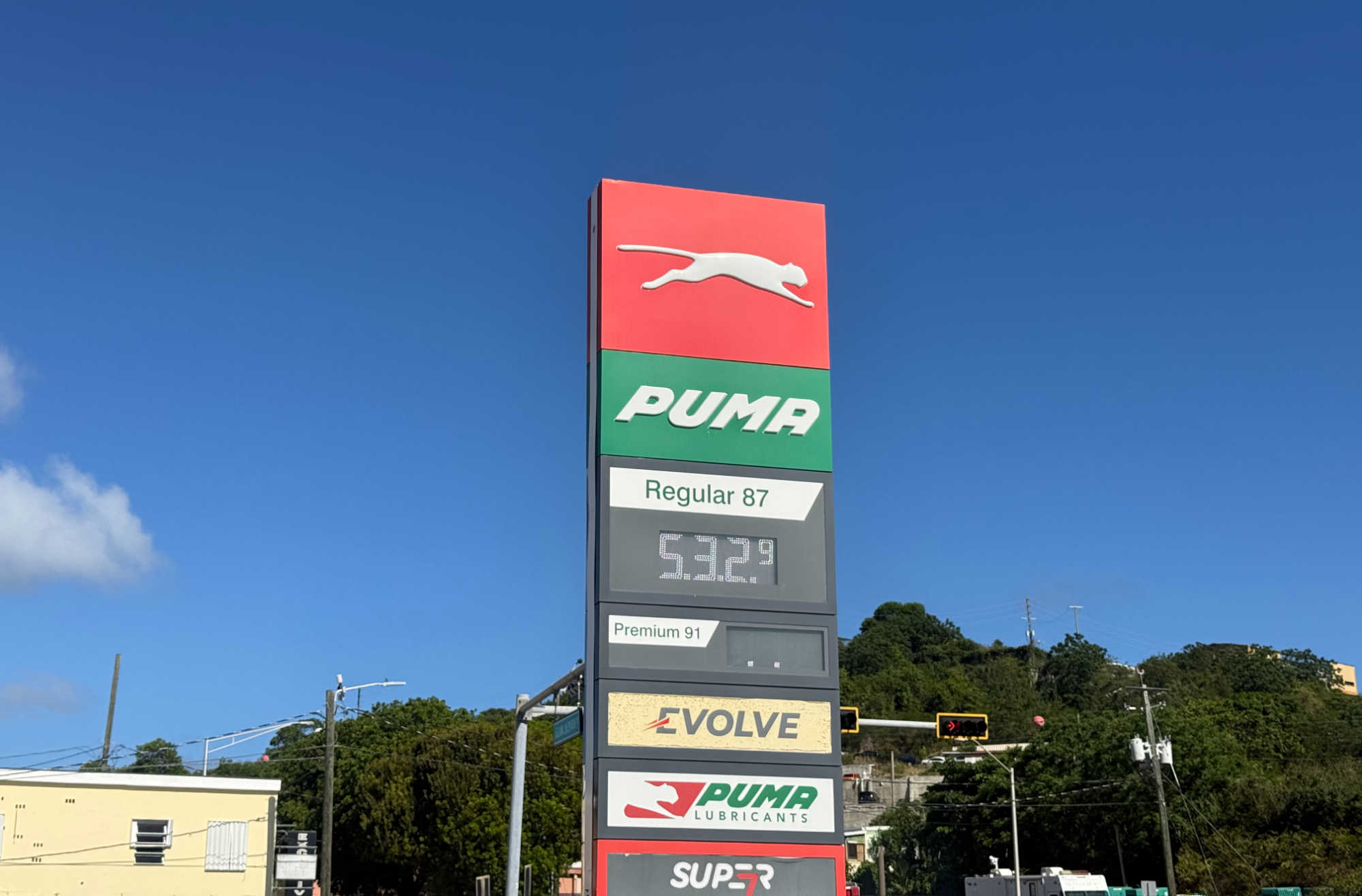
St. Thomas remained the territory’s highest-priced market in that analysis, with limited competition below $4.50 for regular fuel and most premium prices exceeding $5.19. However by May, gas had shot up to over $5 a gallon in St. Thomas for regular at some service stations, and over $5 in many locations on St. Croix for premium fuel.
The V.I. Department of Licensing and Consumer Affairs has also tightened oversight of local fuel price increases. In March, DLCA said retailers must provide proof of delivery and inventory data before price increases are considered, including delivery records, supplier invoices and tank reports.
The concern is that another prolonged oil spike could ripple beyond the gas pump. Higher fuel costs can raise the cost of moving cargo, delivering water, operating taxis, running construction equipment, keeping restaurants open, maintaining generators, and transporting goods between ports, warehouses and stores. The Consortium previously reported during the 2022 fuel spike that the high cost of fuel translated into more than pain at the pump, affecting groceries, restaurants and travel. That same pressure is now again at risk of intensifying as the Hormuz crisis drags on.
WAPA is also exposed. While the utility has reduced its dependence on oil in recent years, the territory still relies on imported fuels and remains vulnerable when global energy corridors are disrupted. The Consortium previously reported that oil above $100 had placed WAPA and the Public Services Commission on a collision course over rising costs, with shipping and fuel pressures creating a direct path from the war-driven oil shock to local consumers and businesses.
The PSC and WAPA are scheduled to meet tomorrow in what is expected to be an important indication of the utility’s financial position, and whether the Levelized Energy Adjustment Clause, known as the LEAC, will remain unchanged or whether WAPA will seek an increase.
Internationally, the next diplomatic test may come in China. Trump is expected to arrive in Beijing on Wednesday, where Iran is expected to be among the issues discussed with Chinese President Xi Jinping. Trump has been pressing China to use its influence to push Tehran toward an agreement. For now, however, the U.S. and Iran appear far from a deal.