




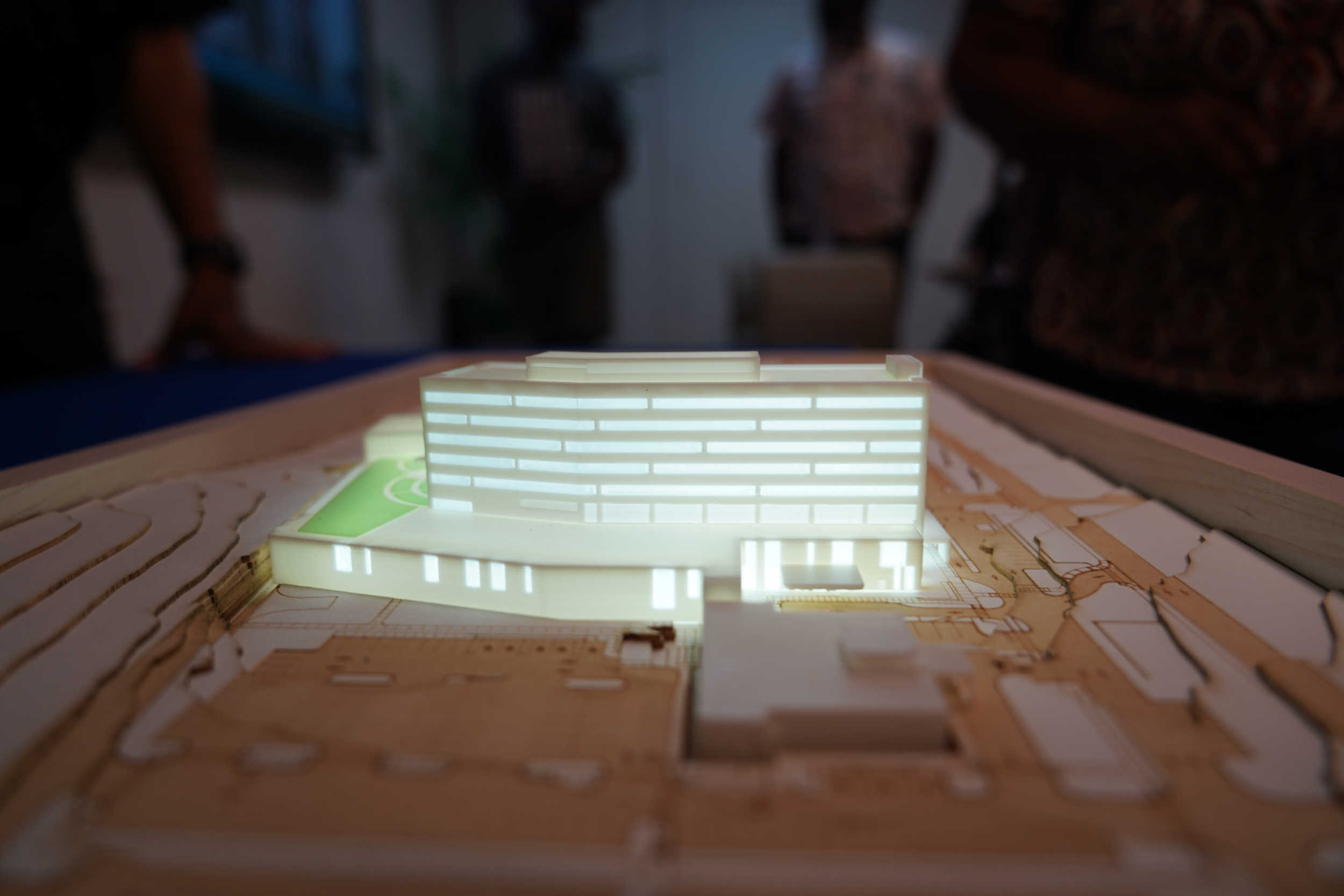
The long-awaited reconstruction of the Juan F. Luis Hospital is moving forward, with a contractor expected to be finalized by the end of this year and a projected four-to-five-year timeline for the completion of the new facility, according to Territorial Hospital Redevelopment Team Executive Director Darryl A. Smalls.

Speaking at the “Conversations on Care: Community Dialogue” town hall on Wednesday at JFL’s conference center, Mr. Smalls provided an extensive update on the project’s progress, emphasizing collaboration, sustainability, and long-term resilience for the territory’s healthcare infrastructure.
Mr. Smalls announced that the redevelopment team has selected a contractor, Clark-MCN USVI, and is currently in the negotiation phase, with plans to have the firm “on board before Christmas.” Once finalized, the project will move into full-scale demolition and reconstruction.
He clarified that while the design and planning phases are largely complete, the federal environmental review process has been the main cause of delay. “The environmental review for just the demolition and reconstruction of JFL is approximately almost two years,” he said. “You cannot put a shovel in the ground with federal dollars without getting that environmental approval. If you do it, you cannot use the federal funds.”

That process, he added, is “not unique to the Virgin Islands” but applies nationwide, as a single federal team reviews all such projects. The environmental approval is expected by the end of this year, aligning with the contract execution timeline.
Smalls explained that the demolition phase will begin immediately following approval but will not look like a traditional wrecking operation. Instead, the hospital will undergo a “surgical demolition” — an internal dismantling process where contractors will first remove interior materials such as carpeting, ceilings, and sheetrock before dismantling the main steel and concrete structure.
“When we say demolition has begun and you drive by and see the building still standing, demolition is occurring internally,” he said.
He also addressed questions about the duration of the project, stating that once the contract is signed and environmental clearance is received, construction is expected to take four to five years. This estimate includes the time needed for shipping materials to the territory and the use of modular construction methods to accelerate completion.
“Typically, a facility like this would take four to five years on the mainland. Because of shipping, we’re looking at strategies to match or come close to that,” Mr. Smalls said. “We’re exploring modular construction, where entire operating rooms, patient rooms, or bathrooms can be manufactured off-island and shipped here for installation.”
He stressed that modular construction should not be mistaken for temporary structures. “Don’t think of it as trailers,” he said. “This is a permanent installation, and when completed, you wouldn’t even know it was modular.”
While the new facility is being built, JFL will continue operating out of its modular hospital, which has faced maintenance challenges over the years. Mr. Smalls said maintaining and improving those facilities until the new hospital opens remains a top priority.
“My job is to make sure our facilities are sustained until we get into the new ones,” he said, noting that the hospital is conducting both minor and major repairs to extend the modular units’ usability.
JFL CEO Darlene Baptiste confirmed that internal work has already been completed by the hospital’s team and that larger repair projects have been turned over to outside partners for execution.
Smalls also detailed several enabling projects underway to support both the transition and the new build. These include an off-site dialysis facility at the rear of the hospital, a temporary construction storage building, and new parking infrastructure to serve JFL North during demolition.
The new facility will feature state-of-the-art technology, designed for resilience and self-sufficiency in the face of natural disasters. Each hospital will have a central energy plant capable of generating its own power on-site, along with multiple redundancies.
“We’re going to have at least what we call N+1 — at least three generators — with a 30-day fuel, water, and food supply,” Smalls said. “We’re constructing facilities that can sustain themselves in a disaster.”
He added that the design includes sustainability elements such as water reuse systems, natural light integration, and energy-efficient technologies already being tested in the hospital’s new cancer center, where daylight is used to illuminate interior spaces.
“These facilities will be something all Virgin Islanders can be proud of,” Smalls said. “They will be resilient, efficient, and designed to serve the community for generations.”
In response to public questions, Smalls confirmed that FEMA funds for the project are already secured and remain untouched by federal administrative changes. “The FEMA funds are allocated for this hospital. We have it. It’s sitting there, and that’s what we’re going to draw upon to construct this hospital,” he said.
He also clarified that the chosen contractor is part of a joint venture led by Clark Construction, a firm with extensive experience building hospitals across the United States. “These major companies have special divisions that handle healthcare and education projects,” he said.
Smalls noted that the reconstruction of JFL is one part of a broader effort to standardize and modernize healthcare facilities across the Virgin Islands, including Schneider Regional Medical Center on St. Thomas and a new clinic on St. John. All will be designed to complement one another as part of a unified healthcare system.
Mr. Smalls and Ms. Baptiste both underscored the importance of involving hospital staff in the design and decision-making process. “When we came up with the original design, we had over two months of meetings in this room — doctors, nurses, clinical staff, non-clinical staff — everyone had input,” Smalls said.
He assured attendees that CEO Baptiste and her executive team continue to have a seat at the table in ongoing meetings with the Office of Disaster Recovery, ensuring that operational needs directly inform design choices.
“If I can’t be there, the CNO will be,” Baptiste said. “Between the both of us, there’s always going to be representation at the table for all the meetings.”
Smalls agreed, emphasizing that decisions are collaborative. “We call it managing expectations. When there’s an issue, I contact the CEO right away, collaborate, and get more individuals involved before the decision is made,” he said.
Despite the delays, Smalls said he is confident that the project is on track to deliver a world-class hospital for St. Croix. “We can’t construct everything we want in this market, but we’re going to be proud of our facilities,” he said. “They’re going to be technologically advanced, efficient, and capable of providing better care for our patients.”

The new JFL is expected to mark a transformational milestone for healthcare in the Virgin Islands — a facility built not just for recovery, but for resilience, modernization, and excellence.