




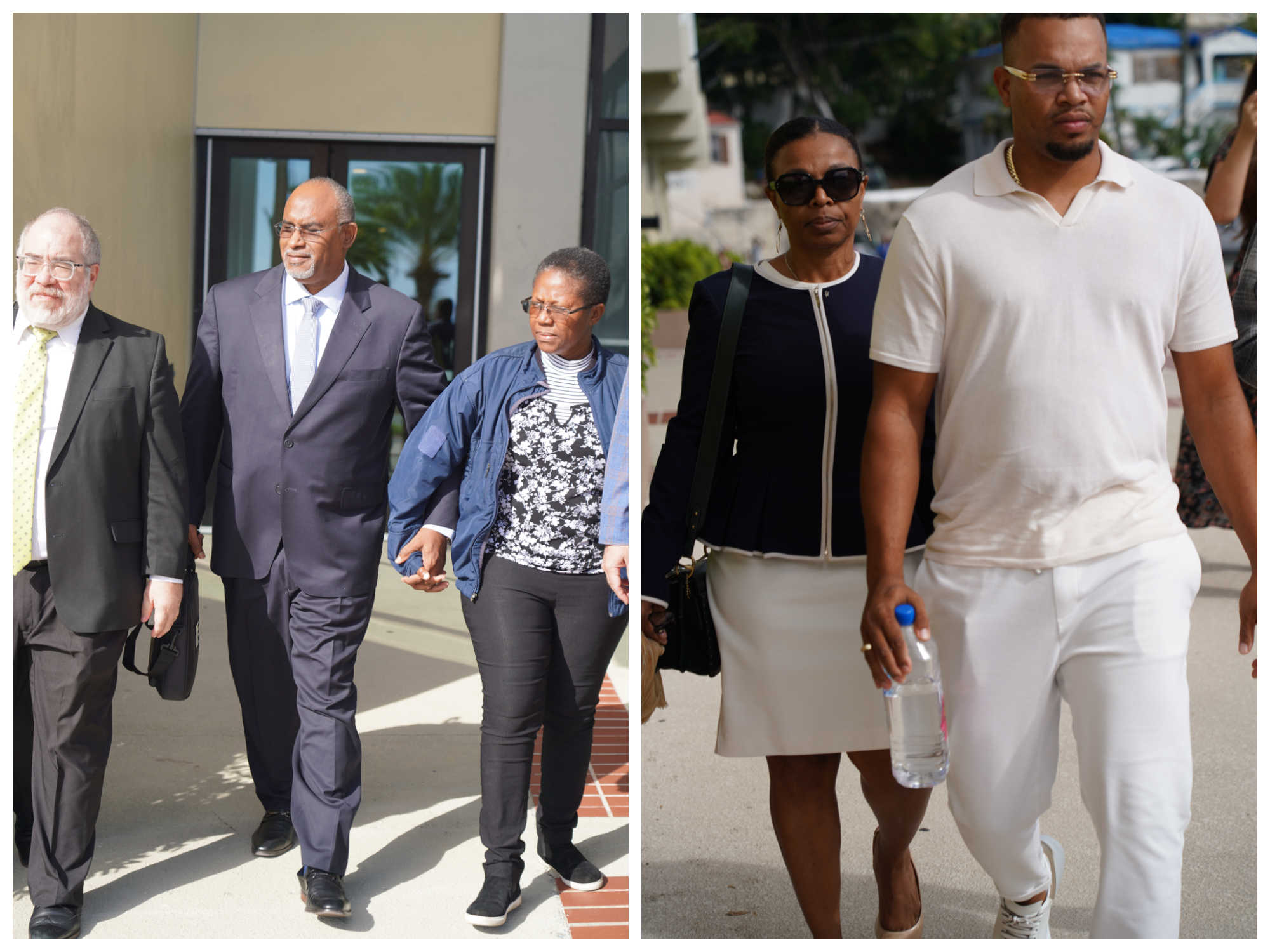
The federal corruption trial that has gripped the U.S. Virgin Islands reached a landmark conclusion Thursday afternoon, as a jury found former Police Commissioner Ray Martinez and former Office of Management and Budget Director Jenifer O’Neal guilty on all counts, convicting two of the territory’s most powerful former public officials of a sweeping scheme that prosecutors said “walked into corruption willfully.” The verdict came just hours after jurors began deliberating at 8:30 a.m., marking a decisive end to a case built on months of investigative work, thousands of recorded calls, financial tracing, and testimony from cooperating witness David Whitaker, whose dealings with both defendants formed the core of the government’s case.

The decision delivered the accountability prosecutors argued the law required when “public officials betray the people they serve,” and punctuated a trial that showcased starkly different portrayals of the same evidence — one depicting calculated abuse of office for personal gain, and the other insisting on legitimate business arrangements, bureaucratic delays, and the unreliability of a witness with a history of fraud.
Martinez, who faced ten counts in total, was convicted of every charge, including five counts of Honest Services Wire Fraud (Counts 1–5), Bribery Concerning Programs Receiving Federal Funds (Count 6), Money Laundering Conspiracy (Count 8), and two obstruction counts tied to efforts prosecutors said were meant to destroy evidence and fabricate a cover story (Counts 9 and 10).
O’Neal, who faced Honest Services Wire Fraud (Counts 4–5), Money Laundering Conspiracy (Count 8), and Bribery Concerning Programs Receiving Federal Funds (Count 7), was also convicted on all charges.

A Trial Built on Contrasting Narratives
The verdict caps a six-day evidentiary presentation followed by sharply divergent closing arguments on Wednesday, where prosecutors insisted Martinez and O’Neal exploited their positions for personal benefit, while defense counsel sought to dismantle the government’s narrative by attacking gaps in evidence, Whitaker’s credibility, and what they described as unsupported leaps in logic.
Assistant U.S. Attorney Cherrisse Amaro framed the conduct as deliberate corruption carried out by two officials “empowered to make decisions and entrusted with resources,” and who knowingly exchanged their influence for financial and personal gain. Whitaker, she said, provided Martinez nearly $100,000 in benefits — first-class Boston trips, luxury hotel suites, steak dinners, gambling funds, home rent payments, and children’s school tuition — while the police commissioner approved and advanced a $1.48 million contract for Whitaker’s company, Mon Ethos.
Jurors saw evidence of three Boston trips paid for by Whitaker, including a photo of Martinez in a high-rise suite prosecutors said was paid for with ARPA funds through Mon Ethos accounts. Amaro reminded the jury of Martinez’s own words — “Burn the phone then” — after federal raids in June 2024, and the promissory note prosecutors labeled “fake,” created after agents confronted him.
For O’Neal, Amaro pointed to the $216,000 invoice that prosecutors said was inflated by $70,000, using Whitaker’s texts and recordings to argue she was fully aware of its fraudulent nature. When Whitaker relayed that Martinez needed the extra funds for his restaurant, she responded “lol,” then instructed her subordinate, ARPA grants manager Jamie Gaston, to push the invoice forward.
Amaro told jurors O’Neal didn’t want anything that could be traced, highlighting concerns O’Neal expressed about how Whitaker would send the $17,730 lease payment for her Java Grande coffee shop at Yacht Haven Grande. The government showed the wire transfer — sent by Whitaker, not O’Neal — which prosecutors said came directly from the inflated $70,000. “Nothing about Jenifer O’Neal’s actions was accidental,” Amaro said.
Defense Attorneys Counter: ‘Where Is the Invoice?’ and ‘Lie, Steal, Repeat’
Martinez’s attorney, Miguel Oppenheimer, rejected the idea that the Boston trips or restaurant payments constituted bribery, arguing instead that they were part of a multi-tiered friendship and a legitimate business venture: the “Steak Out” agreement, a memorandum signed on April 1, 2023 outlining plans for a show filmed at Don Felito’s Cookshop. The memo, drafted with help from Whitaker’s longtime attorney, was real, he insisted — not a façade for kickbacks.
“This is not a case about stealing government money,” he told jurors. “It comes down to bribery.” And if bribery was the accusation, he asked repeatedly: “Where is the invoice?”
The government had not produced the invoice for $216,000, nor one showing a line item for the $70,000, nor the KLR Services purchases, he argued. Without them, he said, the jury could not rely on the prosecution’s inflation theory.
Oppenheimer also emphasized Martinez’s medical history, reminding jurors that Whitaker traveled with him during his brain surgery and attended follow-up appointments. The luxury suite photo, he said, was not a symbol of corruption but of “a man who had just survived brain surgery.”
O’Neal’s attorney, Dale Lionel Smith, launched a different attack: that Whitaker — a man he described as living by “Lie, steal, repeat” — could not be trusted. Smith said O’Neal never knowingly joined a conspiracy, comparing the government’s theory to giving a friend a ride from the bank and being wrongly implicated in a robbery. Smith repeatedly cast the FBI’s reliance on Whitaker as misguided.
He also revived a theme raised earlier in the trial: that investigators believed O’Neal might lead them to “big fish,” including the governor. “This is what this is about,” he said, arguing that the case was built on assumptions, not evidence. Near the end of his closing, he spoke quietly: “I am really afraid for Ms. O’Neal.”
Government Rebuttal: ‘The Criminals Pick Each Other’
DOJ Trial Attorney Alexandre Dempsey delivered the rebuttal, urging jurors not to be distracted by claims of political motives or missing invoices. Wire transfers are not public documents, he said — they were obtained through subpoena because they were never meant to be visible.
“The government does not pick the criminal co-conspirators,” Dempsey said, arguing that the criminals pick each other.”
He told jurors not to rely solely on Whitaker’s words but on the entire constellation of texts, recordings, wire transfers, and actions taken by both defendants. Hours later, the jury agreed.
A Sweeping Conviction
The guilty verdict on every count represents a decisive rejection of both defendants’ defenses and a validation of the government’s narrative: that Martinez and O’Neal used their public power for private benefit, knowingly, repeatedly, and in coordination with each other and with Whitaker.
Sentencing has been tentatively scheduled for the week of June 10, 2026. Both O’Neal and Martinez face the possibility of significant prison time under federal statutes, though their ultimate sentences will be determined under federal sentencing guidelines. The defendants were permitted to remain out of custody until then, with Martinez ordered to self-surrender on February 17. Before adjourning, Judge Mark Kearney commended all parties for their work, noting that each side had done a good job. He then shook hands with the attorneys, the defendants, and the prosecution team.
For the Virgin Islands — where the trial exposed the inner workings of government contracting, ARPA fund management, and the role of a cooperating witness with a complicated past — the verdict marks a defining moment: a rare corruption case that reached every level of government authority and ended with a jury declaring unanimously that the evidence proved guilt beyond a reasonable doubt.

The courtroom was quiet as the verdicts were read. By the time the jurors filed out, the future of two of the territory’s once-most influential officials had been sealed.