


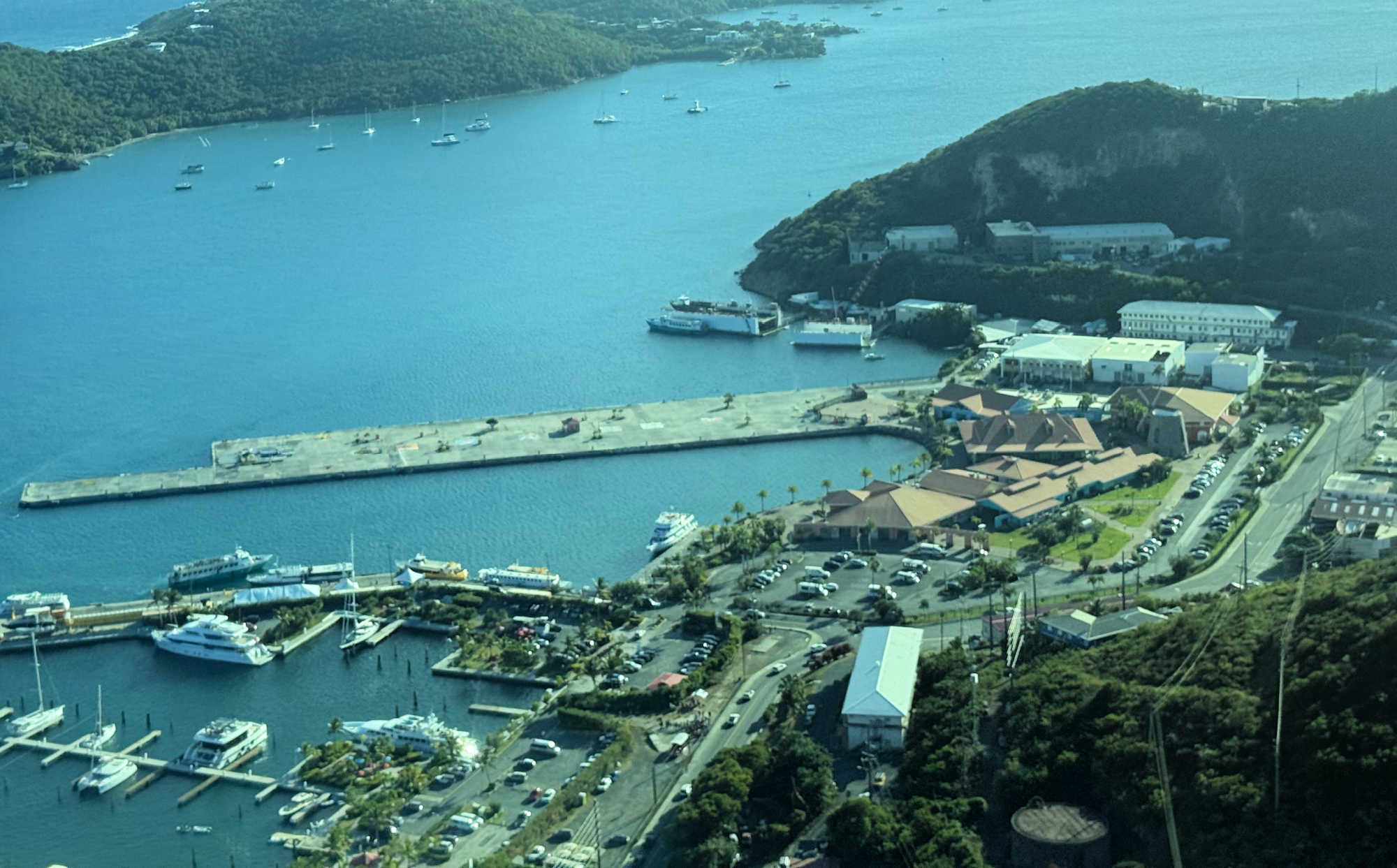
Leaders from the V.I. Port Authority, Cruise Terminals International, and Royal Caribbean Group formally marked the beginning of a major redevelopment of Crown Bay on Wednesday, framing the agreement as a long-term investment in the territory’s tourism economy that preserves public ownership while expanding capacity and opportunity.

The signing ceremony brought together territorial officials and industry partners to commemorate what VIPA Governing Board Chair Willard John described as a carefully considered step forward. The agreement, he said, “reflects responsible leadership, long-term planning, and sound stewardship of the Virgin Islands Port Authority assets.” Crown Bay has long served as a center of commercial activity, and the redevelopment is intended to build on that history while positioning the port for future growth.
Mr. John emphasized that the arrangement does not transfer ownership of the facility. “This development represents a strategic decision by the board to strengthen the foundation of our tourism economy while safeguarding public ownership and ensuring long-term value for the people of the territory,” he said, adding unequivocally that Crown Bay “will always be owned by the people of the Virgin Islands.”
Instead, the agreement is designed to expand the port’s capacity and offerings. Planned improvements include a new cruise ship berth, additional venues, and new attractions aimed at serving both visitors and residents. Drawing parallels to the public-private partnerships used at the territory’s airports, Mr. John said the model allows VIPA to leverage private investment while minimizing financial risk and protecting taxpayers, ensuring the ports remain “engines of opportunity.”

Tourism Commissioner designee Jennifer Matarangas-King, who also serves on VIPA’s governing board, echoed that broader vision, stressing that the redevelopment is not limited to St. Thomas alone. “This is not just about St. Thomas. It truly is about the Virgin Islands,” she said, noting that the relationship with Royal Caribbean is expected to produce territory-wide benefits. Both she and Mr. John underscored that St. Croix remains part of the overall strategy to advance the cruise industry across the Virgin Islands. “I'm very excited about the future,” Ms. Matarangas-King said.
Mastermind of all these VIPA transformative efforts, Executive Director Carlton Dowe, detailed the extensive groundwork behind the agreement, describing it as the product of roughly two years of discussions among numerous stakeholders. Acknowledging that “major change is never simple nor easy in any community,” Mr. Dowe highlighted the scale of coordination required to reach this point.
He also underscored the central role tourism plays in the Virgin Islands economy, noting that “over 75% of what we spend in this territory is a result, directly or indirectly, of the tourism product.” As an example, he pointed to shipping operations near the port, explaining that imported goods, including food, ultimately support cruise ship operations and the wider tourism ecosystem.
Addressing practical implications of the redevelopment, Mr. Dowe spoke about the need to relocate some current occupants of Port Authority property slated for use in the project. While many of those occupants operate on month-to-month leases or informal arrangements, he said they will not be displaced abruptly. Instead, he explained that “Royal Caribbean passengers pay an additional $5 per passenger so that they can help the Port Authority in relocation and redevelopment,” providing resources to manage the transition.
Royal Caribbean Group Senior Director of Destination Development Melissa Morales hailed the project as a major step in a process that required extensive groundwork. “There's been a lot of work that's been put into this, but now the hard work begins,” she said. Ms. Morales said Royal Caribbean’s participation is connected to a shared development vision with VIPA and CTI that includes cultural and community elements. “For this very reason, RCG has partnered with CTI and the Virgin Island Port Authority in a shared vision and a shared mission, positioning St. Thomas as a global leader in tourism through a revitalized cruise facility that honors the territory's rich culture and authenticity.” She said the facility is intended to support community use as well as cruise operations. “For this reason, the facility will include event space for community gatherings, cultural program, music events, carnival and any other thing that just comes as part of that,” she said, adding that the partners want to ensure “that the development serves the U.S. Virgin Island residents who welcome our guests every year.”
Senate President Milton Potter characterized the agreement as “a vote of confidence in the future of Crown Bay and in the people of these Virgin Islands.” He praised the strength of public-private partnerships, saying, “Together, we can reshape a district, reimagine an economy, and renew a sense of possibility for the entire U.S. Virgin Islands.” Mr. Potter also highlighted Mr. Dowe’s persistence in advancing the project, joking that “it may actually be easier to redesign a whole cruise ship terminal than to tell Dowe no and expect him not to come back tomorrow with an even better proposal.”
Governor Albert Bryan Jr. placed the Crown Bay project within a wider context of ongoing tourism investment throughout the territory. He pointed to the revitalization of the Frenchman’s Reef complex and an upcoming arrangement that will eventually return ownership of those properties to the government, as well as a $40 million Hampton hotel investment supported through the hotel redevelopment tax. Other initiatives, including dredging of the Charlotte Amalie Harbor, refurbishment of Veterans Drive and Main Street, and improvements to the Fort Christian parking lot, were cited as part of the same push.
The governor also referenced downtown enhancements such as new public restroom facilities, a vendors’ plaza, and rehabilitation work at Education Park and the 99 Steps, among other projects. “There's so many amazing things that happen, I think we get kind of tone deaf to the magnitude of some of the things that we're dealing with here,” he said.
Like other speakers, Governor Bryan directly addressed concerns that the redevelopment could result in a loss of public control over Crown Bay. “We have not sold the dock to the cruise ship them,” he said. “I keep saying it because misinformation is the code of the day.” Using a familiar analogy, he explained the partnership by saying, “Carlton understood that peanut butter and jelly sandwiches was selling. He had peanut butter and jelly, but Royal Caribbean had the bread.”

“These are the kind of partnerships that make the Virgin Islands work,” the governor concluded, framing the Crown Bay redevelopment as part of a broader strategy to strengthen the territory’s tourism infrastructure while keeping critical assets in public hands.