



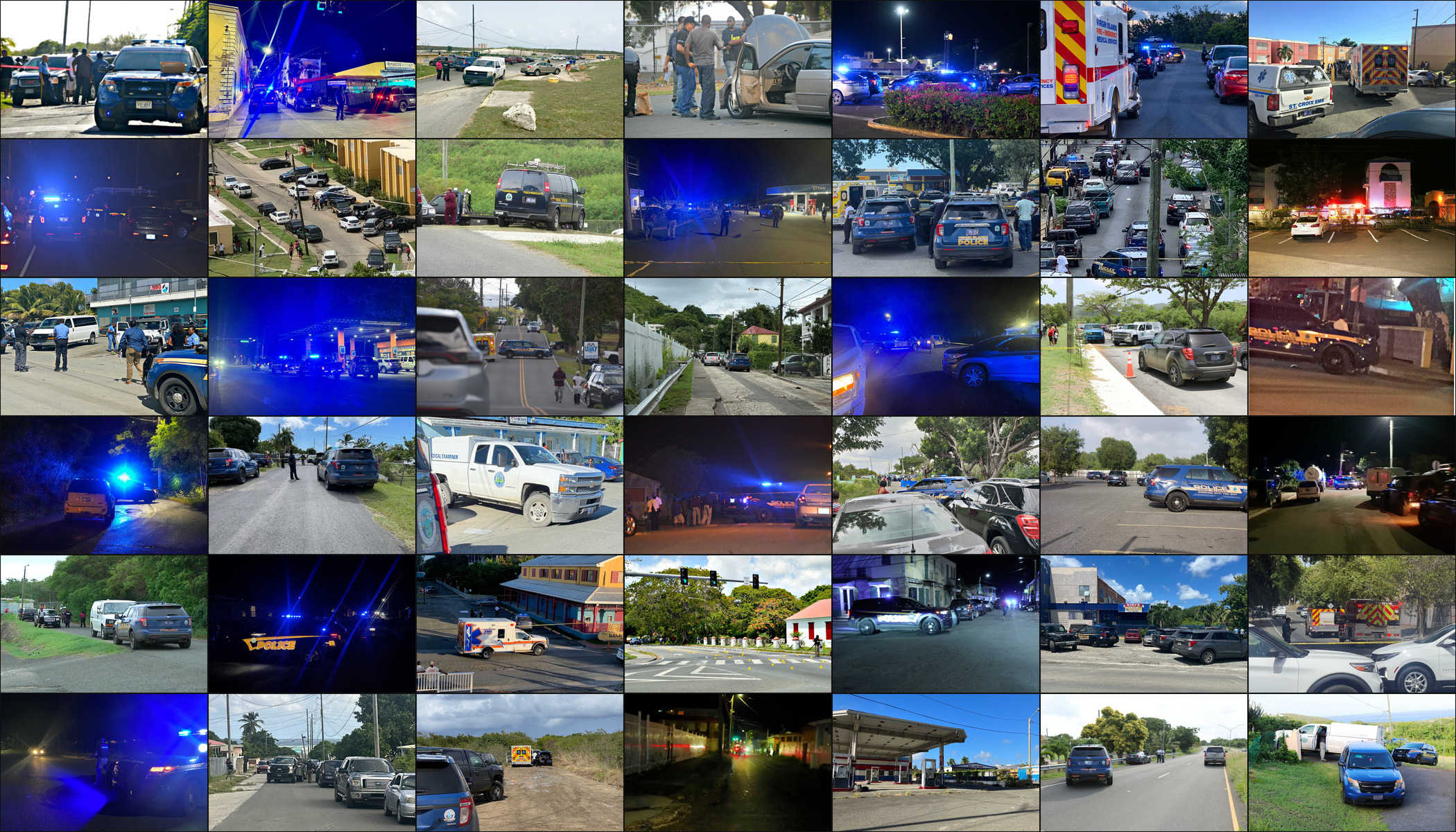
ST. THOMAS — A fatal shooting near Cancryn Bridge on Wednesday brought the U.S. Virgin Islands’ homicide count to 50 for 2026, according to Consortium tracking, reaching a grim threshold with more than six weeks remaining in the year.

The killing adds to a toll that a Consortium review of historical police figures, federal records and published annual counts places at roughly 1,200 since 1996. The territory has surpassed 50 in several previous years, while its shrinking population has increased the significance of each death in per-capita comparisons.
Wednesday’s victim was discovered in an upper parking garage after police responded to reports of gunfire near the FrostCo Building, according to information VIPD Director of Communications Glen Dratte provided to the Consortium upon inquiry.
Mr. Dratte said the department was notified of the shooting at approximately 8:24 a.m. Several police units responded, and the department’s gunshot detection system also registered multiple rounds being discharged in the area. A concerned citizen directed responding officers to the unresponsive man.

Emergency Medical Services personnel confirmed that he was dead. Police are withholding his identity pending notification of his next of kin. The Criminal Investigation Bureau is investigating; the information provided did not identify a suspect or motive or announce an arrest.
The death raises St. Thomas’s homicide count to 20, alongside 29 on St. Croix and one on St. John. It comes three days after 23-year-old Elijah E. V. Penn was killed near Beehive nightclub in Subbase, bringing the territorial count to 49.
This year’s total is already 15 deaths, or approximately 43 percent, above the 35 homicides police reported for all of 2025. That annual police tally comprised 19 in the St. Thomas–St. John district and 16 on St. Croix.
Historical records establish at least four earlier years with 50 or more homicides: 2009, 2010, 2012 and 2017.
A historical series presented by then-Police Commissioner Trevor Velinor in 2020 recorded 54 homicides in 2009 and 59 in 2010. The FBI’s published district figures for 2010 total 60 murders and nonnegligent manslaughters — 29 on St. Croix and 31 in the St. Thomas reporting district — illustrating a discrepancy between historical sources without changing the conclusion that the territory exceeded 50.
The FBI’s 2012 figures total 52. For 2017, the VIPD budget presentation underlying the Consortium’s reporting recorded 52 victims in 48 cases and explicitly excluded vehicular homicides. The distinction between victims and cases matters: a single incident can claim more than one life.
Other historical totals require care. A preliminary 2016 police presentation counted 55 homicides, including 10 vehicular homicides. That figure cannot be treated as 55 intentional killings or as a directly comparable final annual total.
The longer record shows how sustained the losses have been. The University of the Virgin Islands’ statistical digest lists district figures totaling 111 homicide offenses from 1996 through 1999. Velinor’s historical series counted another 436 deaths from 2000 through 2010.
His later aggregate figures imply 384 for 2011 through 2019, while the territory finished 2020 with 49 homicides. Published counts for the next five years were 46 in 2021, 37 in 2022 and 39 in 2023, 44 in 2024 and 35 in 2025 — approximately 200 more deaths before this year’s 50.
Together, those records support an estimated toll of roughly 1,200 since 1996. They do not constitute a single audited victim register: some sources count offenses, others count victims, and classifications and reported totals differ. The estimate is rounded to reflect those limitations.
Population size makes the current toll especially consequential. Fifty homicides divided by the United Nations’ projected 2026 USVI population of 83,400 produces a rate of approximately 60 deaths per 100,000 people. That measures the deaths already recorded this year against the projected population; it is not a forecast of the year-end total.
The population denominator must be identified because it materially affects the result. Using the territory’s older 2020 census count of 87,146 would produce 57.4 per 100,000. The census documented an 18.1 percent population decline from 106,405 in 2010. A comparable number of killings therefore falls on a smaller population than it did a decade and a half ago.
For international comparisons, the Consortium used 2024, allowing the territory to be measured against other jurisdictions for the same completed year.
The USVI’s 44 reported homicides in 2024, cited by Governor Albert Bryan Jr. in his 2025 State of the Territory Address, divided by the UN population projection of 84,905 for that year, yield approximately 51.8 per 100,000. That is about 10 times the global rate of 5.1 reported by the United Nations and the U.S. national rate of 5.1 reported by the Bureau of Justice Statistics for 2024.
The July 2026 release of the UN Office on Drugs and Crime’s homicide dataset provides 2024 rates for 95 countries and territories. Adding the separately calculated USVI rate would place the territory fourth among the 96 jurisdictions in that comparison, behind Turks and Caicos, Haiti, and St. Kitts and Nevis.
| Country or territory | 2024 homicides per 100,000 people |
|---|---|
| Turks and Caicos Islands | 103.1 |
| Haiti | 64.3 |
| St. Kitts and Nevis | 59.8 |
| U.S. Virgin Islands | 51.8 |
| St. Vincent and the Grenadines | 50.7 |
| Trinidad and Tobago | 41.5 |
| St. Lucia | 40.6 |
| Jamaica | 40.4 |
| South Africa | 39.7 |
| Ecuador | 38.9 |
Selected highest rates in the available 2024 comparison. Source: UNODC’s July 2026 dataset; USVI calculated separately from its reported count and UN population projection.
This is a comparison within available data, not an official or complete world ranking. UNODC’s own published USVI series ends in 2012, requiring the territory’s recent rate to be calculated separately. Differences in reporting and classification also remain relevant.
The comparison nevertheless places the USVI’s reported homicide burden among the highest internationally. It measures homicide rather than every form of violent crime, and the territory’s current 2026 rate cannot be assigned a 2026 world ranking using other jurisdictions’ 2024 figures.

Police are asking anyone with information about Wednesday’s shooting to call 911, the Criminal Investigation Bureau or Office of the Police Chief at 340-774-2211, or Crime Stoppers VI at 1-800-222-TIPS (8477).