

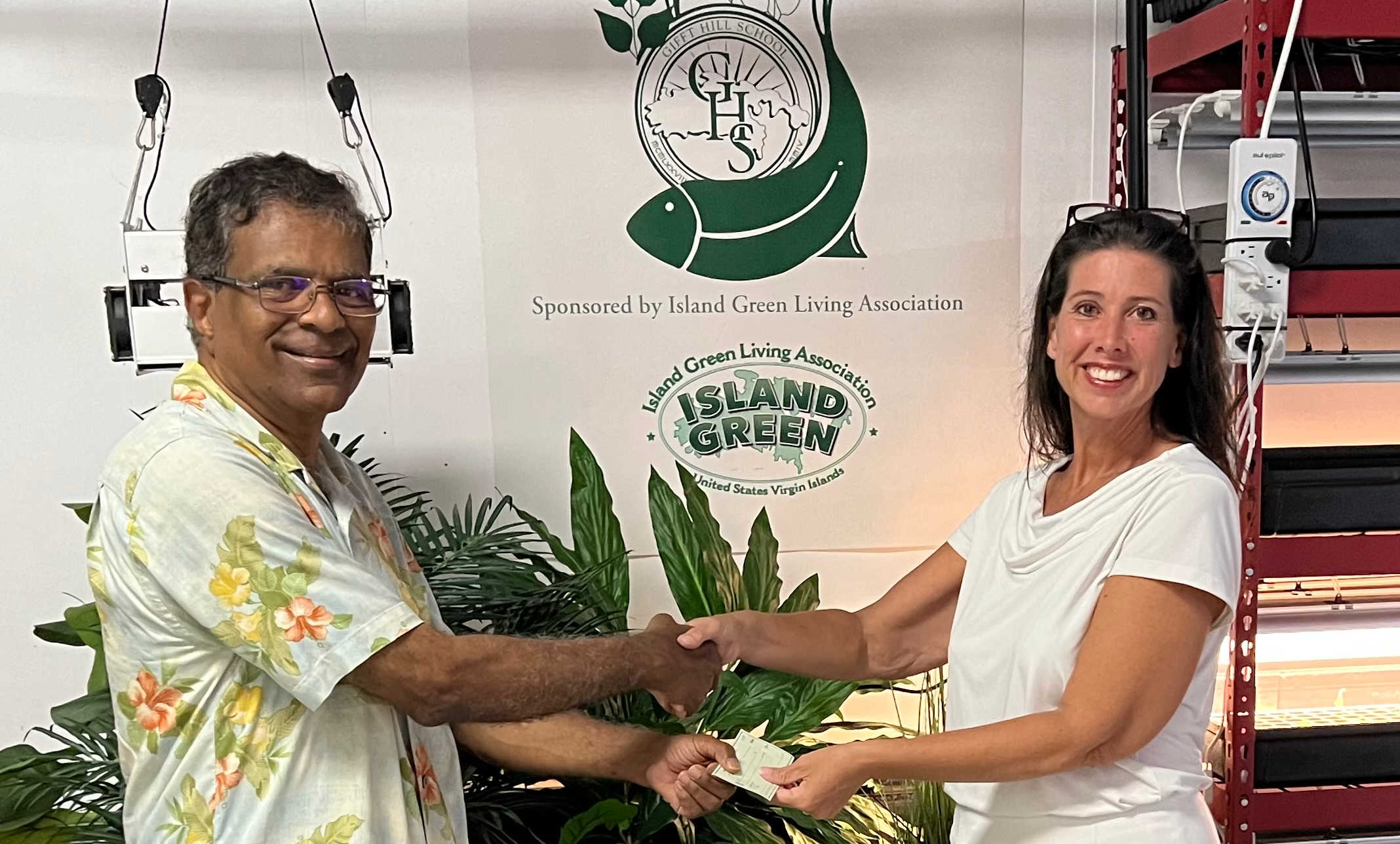
ST. JOHN — In a major boost for its aquaponics and hydroponics program, Gifft Hill School announced on Wednesday that it has received a $25,000 donation from Island Green Living, an extension of support for the initiative.
Island Green initially donated the aquaponics system to the school in December 2020 and made the first $25,000 donation in 2022.
“The continuation of the aquaponics program, and Gifft Hill’s EARTH program, is essential to address the island’s food security issues,” said the president of Island Green’s Board of Directors Harith Wickrema, emphasizing the broader impact of this initiative as he handed over the donation. Mr. Wickrema said that the GHS system can serve as a model for similar programs across the territory. The idea, he says, is in discussion with the Department of Education.
According to GHS, the aquaponics system is an integral part of the school’s curriculum for grades 6-12, developing skills in STEAM (Science, Technology, Engineering, Arts, and Mathematics) -related areas. Students are involved in maintaining the system - caring for tilapia, whose waste is the source for nutrients for the herbs and greens grown in the soilless system.

Monitoring water quality and harvesting the plants and tilapia are also part of the student’s responsibilities, GHS says. The fish and produce generated have served as ingredients for various dishes in culinary classes, adding a new dimension to the students’ understanding of sustainability.
“The aquaponics system offers rich opportunities for students to apply rigorous academic concepts from a variety of disciplines,” said GHS Head of School Liz Kinsella. “We have seen students’ knowledge and critical thinking skills benefit tremendously from the integrated lessons involving the aquaponics and EARTH programs.”
Future plans, the school announced, include “enhancing previous micro-business models that allowed students to sell produce grown in the aquaponics system to local restaurants.”

Ms. Kinsella said that GHS would share its food security curriculum framework to schools in the territory interested in developing a similar experiential learning program. “We’re excited to provide leadership in the area of environmental stewardship and green education,” she said.