
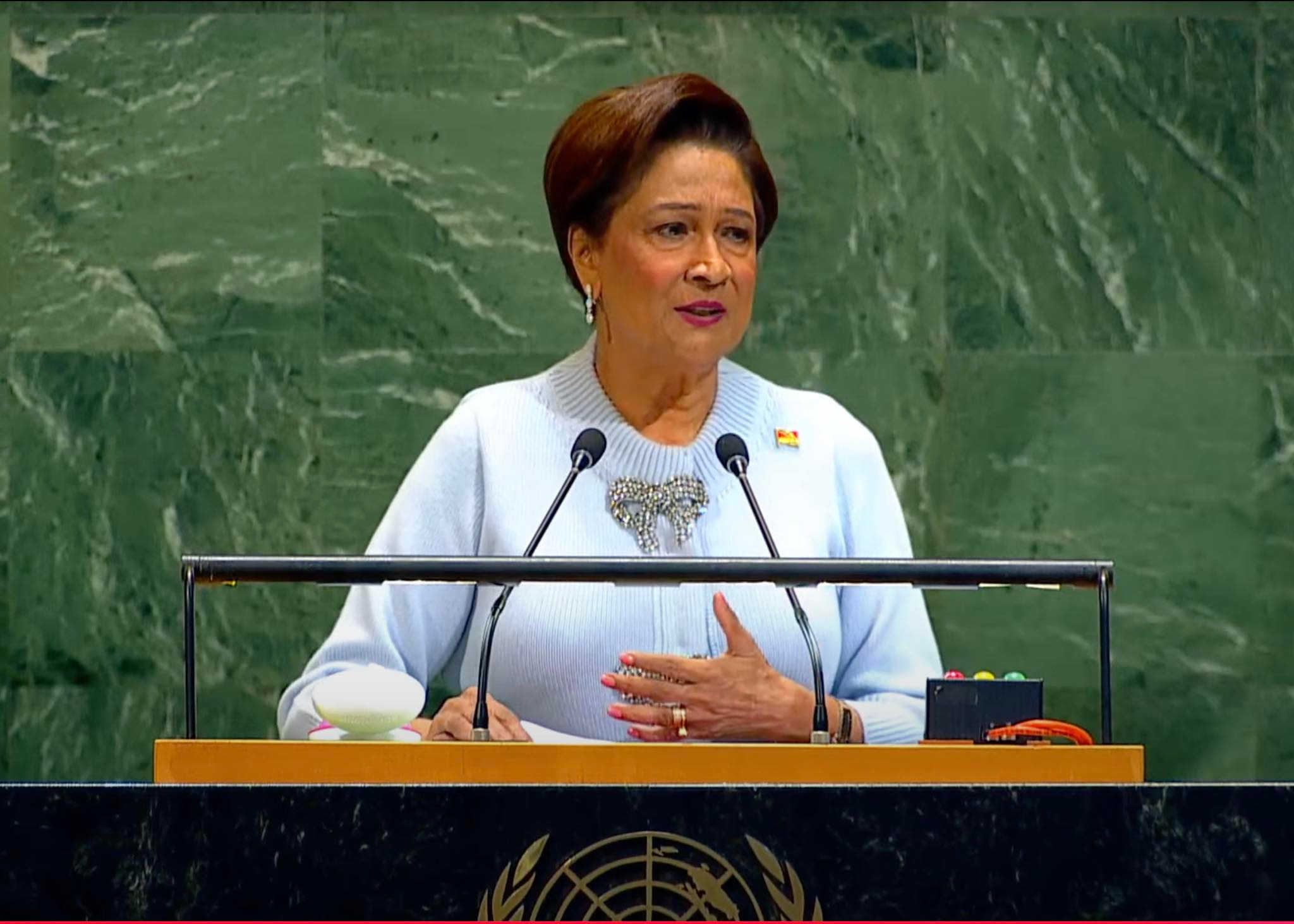
The tensions between Kamla Persad-Bissessar, Prime Minister of Trinidad & Tobago, and the rest of the independent Caribbean nations that make up the Caribbean Community (CARICOM) have reached new heights, with a statement denouncing the regional political grouping sparking a war of words between state leaders.

Ms. Persad-Bissessar's initial comments were in response to a CARICOM statement following the United States’ decision to restrict entry into the U.S. for nationals from several countries, including the Commonwealth of Dominica and Antigua & Barbuda.
After stating that Trinidad & Tobago did not endorse the CARICOM statement, which expressed concern about the lack of consultation prior to the U.S. announcement, the Trinidadian Prime Minister went on to attack not only the stance of CARICOM on this particular issue, but the foundational principles of the regional grouping itself.
“CARICOM is not a reliable partner at this time. The fact is that beneath the thin mask of unity, there are many widening fissures that if left unaddressed will lead to its implosion,” said Ms. Persad-Bissessar, naming “poor management, lax accountability, factional divisions, destabilizing policies, [and] private conflicts between regional leaders and political parties” as some of those fissures. She also pointed to “the inappropriate meddling in the domestic politics of member states” – something she has been accused of herself in past months – as another potential contributor to CARICOM’s demise.
Ms. Persad-Bissessar framed CARICOM's insistence that the Caribbean remains a zone of peace as lending support to Venezuelan President Nicolas Maduro, who she reminded is “a dictator who has imprisoned and killed thousands of civilians and opposition members as well as threatened two CARICOM members.”
She closed her statement with a vow to “always make decisions that put Trinidad & Tobago first.”
Antiguan Prime Minister Gaston Browne issued a statement of his own in response to Ms. Persad-Bissessar's comments, noting that the CARICOM bloc is Trinidad & Tobago's second largest trading partner, behind the United States. “Assertions that CARICOM is an unreliable partner to Trinidad and Tobago are difficult to reconcile with the economic record,” Mr. Browne argued. He also rejected the Trinidad prime minister's assertion that CARICOM leaders had “bad-mouthed” the United States. “No evidence has been offered because none exists,” he pointed out. “Respectful dialogue with international partners is not subservience; nor is regional consultation disloyalty.”
Mr. Browne advised that the “balanced approach” adopted by CARICOM “has served our region well for decades. It should not now be diminished by rhetoric that divides where facts demonstrate the value of interdependence.”
Undeterred by his comments, Ms. Persad-Bissessar fired back on social media, insisting that “CARICOM has aligned itself with the Maduro narco government headed by a dictator who has imprisoned or killed thousands of Venezuelans who oppose him. Trinidad and Tobago wants no part of that alignment…we don't support CARICOM in their zone of peace fakery.”
With those remarks, the Trinidad and Tobago prime minister appeared to solidify her country’s alignment with the United States, while continuing to emphasize that Washington’s focus in the southern Caribbean is drug interdiction rather than regime change in Venezuela. That framing, however, sits uneasily with current developments, as U.S. President Donald Trump and other administration officials have openly called for regime change, amid reports that Trump has offered safe passage for President Nicolás Maduro and his family to leave the country.