
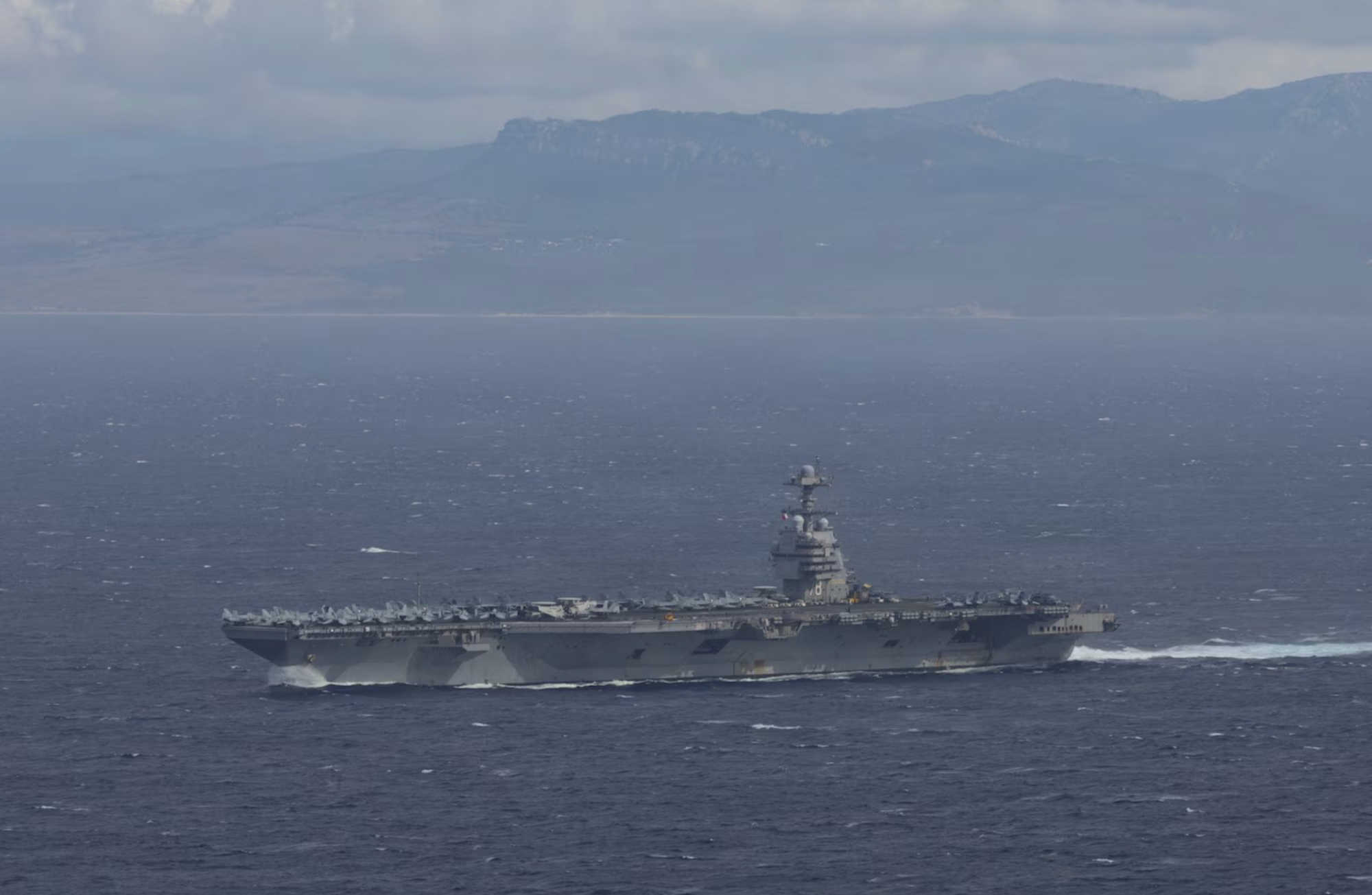
On Tuesday, the U.S. Naval Forces Southern Command (SOUTHCOM) announced the arrival of the USS Gerald R. Ford Carrier Strike Group in the region.

The group of warships is led by the USS Gerald R. Ford, which carries over four thousand sailors aboard. The world's largest aircraft carrier is expected to serve as a platform to “launch and recover fixed-wing aircraft on its flight deck…in support of tasked operations,” the announcement noted.
“Through our unwavering commitment and the precise use of our forces, we stand ready to combat the transnational threats that seek to destabilize our region,” said Admiral Alvin Holsey, outgoing SOUTHCOM Commander. “The USS Gerald R. Ford Carrier Strike Group's deployment represents a critical step in reinforcing our resolve to protect the security of the Western Hemisphere and the safety of the American homeland.”
Despite the administration's insistence that its campaign of airstrikes against vessels in the Caribbean Sea and Eastern Pacific is a legally valid component of the United States’ fight against narco-terrorism, growing global skepticism has led to tensions with a key ally.
The United Kingdom has reportedly suspended the sharing of intelligence with the U.S. on the activities of suspected drug-running boats in the region. The move is said to have come amid concerns that this information could be used to kill drug traffickers instead of allowing the Coast Guard to apprehend the vessels as was previously the case. CNN, which first broke the news on Tuesday, reported that the intelligence-sharing arrangement between the United Kingdom and a Florida-based joint interagency task force had been paused soon after the bombing campaign began in September. UK government officials, as per policy, declined to comment on intelligence matters.
The United States maintains robust, long-established intelligence capabilities sufficient to independently interdict and halt drug-trafficking vessels in the Caribbean, even amid the UK's recent suspension of related information sharing. Secretary of State Marco Rubio emphasized this self-sufficiency in a recent statement, noting that "the United States has long—for many, many years—established intelligence that allow us to interdict and stop drug boats, and we did that." While the pause in UK cooperation represents a notable shift in allied dynamics, U.S. officials have indicated no disruption to ongoing operations, relying on domestic assets like naval sensors, patrol aircraft, and historical interdiction expertise honed over decades.
On Sunday, Secretary of the Department of Defense Pete Hegseth announced on social media that two more airstrikes had been conducted in the Eastern Pacific. “These vessels were known by our intelligence to be associated with illicit narcotics smuggling, were carrying narcotics, and were transiting along a known narco-trafficking transit route in the Eastern Pacific,” Mr. Hegseth said. Three men were on each vessel, noted the Defense Secretary. All six were killed.
“Under President Trump, we are protecting the homeland and killing these cartel terrorists who wish to harm our country and its people,” Mr. Hegseth wrote.