
U.S. Attorney General Pam Bondi announced Saturday that deposed Venezuelan President Nicolás Maduro and his wife, Cilia Flores, have been indicted in the Southern District of New York on a series of federal charges, including narco-terrorism conspiracy, conspiracy to import cocaine into the United States, possession of machine guns and destructive devices, and conspiracy to possess machine guns and destructive devices.

In a statement, Bondi said the couple would “soon face the full wrath of American justice” on U.S. soil. She praised President Donald Trump for demanding accountability and commended the U.S. military for what she described as a “highly successful mission” to capture the pair. The indictments revive and expand upon criminal charges first brought against Maduro in 2020, underscoring the Justice Department’s longstanding focus on his alleged ties to international drug trafficking networks.
Bondi’s announcement followed Trump’s early-morning statement on Truth Social, in which he said U.S. forces had carried out a “large-scale strike” inside Venezuela that resulted in Maduro’s capture and removal from the country. White House officials later confirmed to reporters that Maduro and Flores were en route to the United States for processing, marking what the administration characterized as the culmination of months of military and diplomatic pressure on the Venezuelan government.
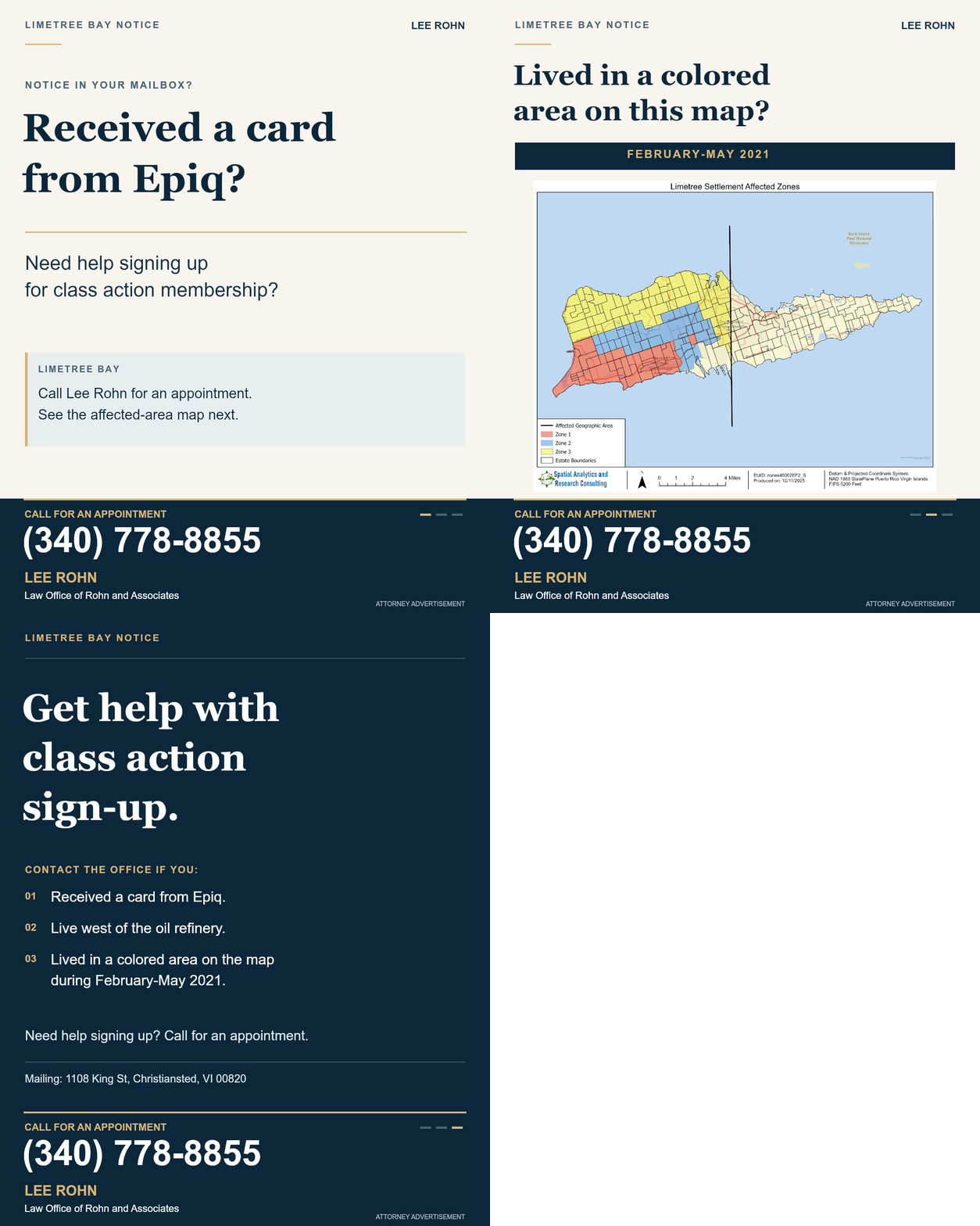
According to reporting, the operation involved U.S. special forces deployed under Operation Southern Spear. The announcement came after reports of explosions and gunfire in Caracas overnight, followed by Venezuelan state media initially downplaying the events before ceasing coverage.
The capture caps a sustained escalation in U.S. action against Maduro that dates back several years. The United States rejected Maduro’s 2018 reelection as fraudulent and, in 2019, recognized opposition leader Juan Guaidó as Venezuela’s interim president. Tensions intensified through economic sanctions, the designation of Venezuelan entities such as the Cartel de los Soles as terrorist organizations, and the deployment of U.S. military assets in the Caribbean beginning in August 2025.
More recent actions included interdictions of suspected drug trafficking vessels, a blockade of sanctioned Venezuelan oil tankers, and a public ultimatum from Trump offering Maduro safe passage if he stepped down. U.S. officials have repeatedly accused Maduro of harboring narco-terrorists and facilitating drug trafficking into the United States.
Venezuelan officials did not immediately respond to the developments. Opposition figures expressed cautious optimism and called for a peaceful transition, while international allies of Maduro, including Russia and China, condemned the operation as a violation of Venezuelan sovereignty. The United Nations Security Council is convening an emergency session to address the situation, as reactions across Latin America ranged from expressions of support by some governments to calls for restraint from others, including Brazil and Mexico.
In Washington, congressional leaders from both parties requested briefings on the operation, raising questions about its legality and broader implications for U.S. foreign policy. Legal experts noted that the capture bypassed traditional extradition processes, which U.S. officials have suggested may be justified under claims of self-defense against narco-terrorism threats, though the move raises unresolved questions about compliance with international law in the absence of United Nations authorization.

With the indictments now unsealed, the Justice Department is positioned to pursue Maduro’s prosecution, a process that could involve asset forfeitures and additional sanctions. However, officials have not disclosed where Maduro is being held, when a trial might take place, or what steps the administration plans to take regarding governance in Caracas.