

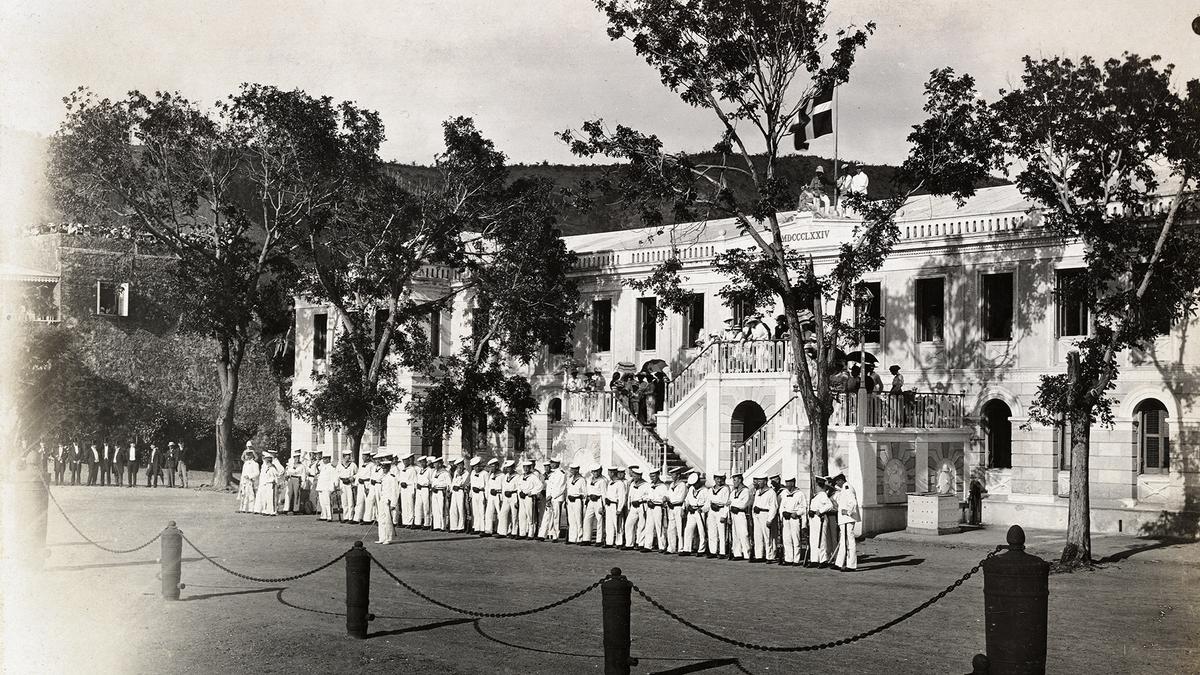
The African-Caribbean Reparations and Resettlement Alliance (ACRRA) has filed a landmark petition with the European Court of Human Rights (ECHR) against the Kingdom of Denmark, alleging continuing human rights violations tied to Denmark’s 1917 transfer of the Virgin Islands to the United States.

The case argues that Denmark remains legally responsible for alleged ongoing racial discrimination, disenfranchisement, and the absence of remedies for Virgin Islanders — a legacy ACRRA says has persisted for more than a century, most recently compounded by the March 28, 2025 repudiation of The Lansing Declaration by the U.S. government.
The Lansing Declaration, issued on August 4, 1916, by U.S. Secretary of State Robert Lansing, was a diplomatic assurance given to Denmark during the negotiations for the sale of the Virgin Islands. In it, the United States formally recognized Denmark’s sovereignty over Greenland, a condition that helped secure Denmark’s ratification of the 1916 Treaty of the Danish West Indies. ACRRA argues that the U.S. government’s March 28, 2025 repudiation of that declaration undermined the legal foundation of the original treaty and reactivated Denmark’s obligations to the people of the Virgin Islands.
In an exclusive interview with the V.I. Consortium’s Ernice Gilbert on Tuesday, ACRRA President Shelley Moorhead outlined the group’s ultimate goals, framing the case not as a demand for Denmark or the United States to dictate the Virgin Islands’ political status, but as a fight for reparative justice and resources enabling Virgin Islanders to decide their own future.

“Ultimately, the treaty must be revisited, and the political and civil rights guaranteed under Article Six need to be addressed,” Moorhead said. He explained that ACRRA is not asking either Denmark or the United States to determine the territory’s future, but rather to acknowledge and fulfill their responsibility for reparative justice.
Moorhead said the organization envisions a reparative justice fund, jointly managed by Danes and Virgin Islanders, to finance a long-overdue plebiscite — the referendum he said Denmark promised but never delivered when it sold the islands to the United States. Moorhead said the demand is straightforward: Denmark must provide the reparative funding owed so Virgin Islanders can finally hold the referendum that determines their political future.
While Moorhead referenced a promised referendum, historical records indicate that Denmark did propose a plebiscite during the 1916 treaty negotiations, but the idea was ultimately rejected by the United States, after which Denmark abandoned the request and proceeded with the transfer.
He confirmed that the claim seeks monetary reparations, anchored by a baseline valuation of $681 billion, a figure developed by the Brattle Group in conjunction with the CARICOM Reparations Commission. Those calculations, Moorhead explained, were “outlined specifically for the U.S. Virgin Islands.”
The ACRRA president noted that the group is not asking the European Court to impose independence, free association, or statehood but to enable self-determination through reparative funding. Moorhead said that three options should ultimately be available to the people of the Virgin Islands — independence, free association, or full U.S. citizenship rights. “We are not in a lawsuit asking Denmark to grant any of those,” he explained. “That would not be self-determination.”
The petition, filed on behalf of Virgin Islanders, alleges Denmark violated Articles 1, 3, 6, 8, 13, and 14 of the European Convention on Human Rights. ACRRA argues that Denmark knowingly transferred a predominantly Black population into a "racially exclusionary" U.S. legal system under the 1916 Treaty of the Danish West Indies, then failed to protect that population or advocate for it when those rights were later eroded.
According to the filing, Denmark’s legal responsibilities did not end in 1917. ACRRA claims Denmark “continues to violate multiple articles of the European Convention on Human Rights because of its conduct in negotiating and executing the treaty, and through its failure to protect or advocate for the transferred population in the face of a material breach of the treaty framework in 2025 by the United States.”
The group maintains that the repudiation of The Lansing Declaration, a diplomatic assurance forming part of the treaty’s ratification, reactivated Denmark’s obligations. The petition describes Denmark’s “silence following the U.S. government’s formal repudiation” as an “ongoing breach of its human rights obligations under the Convention.”
On August 4, 1916, Denmark and the United States signed the Treaty of the Danish West Indies, transferring sovereignty over St. Thomas, St. John and St. Croix for $25 million in gold, though the islands were formally transferred to the U.S. on March 31, 1917. While a referendum was held in Denmark, the inhabitants of the islands themselves were not given the opportunity to vote on the transfer.
Also on August 4, 1916, U.S. Secretary of State Robert Lansing issued The Lansing Declaration, affirming U.S. recognition of Denmark’s geopolitical interests in Greenland—a concession Denmark viewed as integral to the treaty.
ACRRA’s legal memorandum cites historical correspondence between Danish and U.S. diplomats revealing that Denmark understood Virgin Islanders would not receive equal rights under American rule. Foreign Relations of the United States (FRUS) archives show Danish officials acknowledged systemic racial discrimination yet still proceeded with the sale, waiving prior demands for citizenship guarantees.
When the U.S. government, under President Donald J. Trump and Vice President J.D. Vance, repudiated The Lansing Declaration in 2025, ACRRA says Denmark again failed to act—taking “no diplomatic, legal, or reparative steps to intervene, address the status of the transferred population, or seek remedy.”
ACRRA’s filing outlines ongoing breaches of human rights law. It argues Denmark failed to secure the rights of those it governed under Article 1 of the Convention, subjected a Black population to inhuman treatment under Article 3, denied Virgin Islanders a fair legal forum under Article 6, and fractured family and cultural continuity in violation of Article 8.
The group also claims Denmark denied the right to remedy under Article 13 and engaged in racial discrimination under Article 14 by abandoning guarantees of citizenship equality.
According to ACRRA, Denmark’s sustained inaction following the U.S. treaty breach in 2025 constitutes a “continuing, legally actionable failure” under international law.
Evidence from Diplomatic Archives
ACRRA supports its case with evidence from FRUS documents (1915–1917). Among them:
FRUS 771 (July 17, 1915): Danish Governor Christian Helweg-Larsen warned that under American rule, a Black leader like David Hamilton Jackson might have the vote “but would be looked on only as a ‘nigger’ and receive no social consideration.”
FRUS 795 (April 27, 1916): Denmark sought U.S. assurances that islanders would receive full citizenship—requests later withdrawn.
FRUS 873 (January 5, 1917): A petition from Virgin Islanders to King Christian X begged for intervention to stop the transfer. Denmark acknowledged the petition but took no action.
These records, ACRRA contends, prove Denmark knowingly enabled racial and political disenfranchisement, creating a “permanent jurisdictional void” for Virgin Islanders under international law.
The memorandum notes that the 1916 treaty transferred the islands as “property,” leaving their inhabitants without legal status or representation in any international forum. This design, ACRRA argues, prevents Virgin Islanders from seeking recourse before the Permanent Court of Arbitration or International Court of Justice, both of which restrict standing to sovereign states.
ACRRA says Denmark’s deliberate omission locked Virgin Islanders out of international legal systems—a condition that persists today.
Although the treaty predates the European Convention on Human Rights, ACRRA contends the case falls under the ECHR’s continuing violation doctrine, which allows review when a historical act continues to produce effects today.
The petition cites precedents including Cyprus v. Turkey (2001), Varnava v. Turkey (2009), and D.H. v. Czech Republic (2007), which found that prolonged human rights breaches remain actionable even decades later.
On April 24, 2025, Moorhead sent a final diplomatic appeal to Danish Prime Minister Mette Frederiksen, urging Denmark to acknowledge its obligations. “Continued silence in the face of this breach can no longer be interpreted as passive; it is complicit,” he wrote.
He reminded Denmark that while it documented corporate, property, and institutional rights, it omitted protections for the people it transferred. “This disparity speaks volumes,” Moorhead said.
The letter also noted that Virgin Islanders remain disenfranchised—without voting rights in federal elections, representation in Congress (the V.I. Delegate to Congress does not have voting power), or access to European Union frameworks such as the European Development Fund and the Overseas Countries and Territories Association.
Moorhead concluded that, absent Danish action, the matter would “proceed for international adjudication before the European Court of Human Rights.”
ACRRA’s petition asks the ECHR to declare Denmark in violation of the European Convention, affirm that the violations are ongoing, and recognize ACRRA’s standing to act on behalf of Virgin Islanders.
It also calls for the creation of a reparative justice fund, acknowledgment of wrongdoing, and direct engagement with Virgin Islanders to address historic and continuing harm.
“This is not a case about empire, but about what came after,” the filing concludes. “The people of the Virgin Islands were transferred without rights and left without remedy. Denmark has denied them acknowledgment. It has denied them justice. This Court has the power to ensure they are denied no longer.”
During the interview with the Consortium, Moorhead reiterated that ACRRA is not seeking Denmark’s guidance on self-determination, but rather reparative justice and funding to empower Virgin Islanders to decide their own path.
He explained that the absence of a referendum — the right of Virgin Islanders to vote on their political status — is part of the injustice itself. “There has never been a plebiscite or a legally recognized referendum in the Virgin Islands since that time,” he said. “So it is not incumbent upon the people or the populace to derive that data.”
When asked about possible outcomes, Moorhead said the case could produce “seismic political changes,” but emphasized that the decision would rest with the people.
He added that ACRRA’s lawsuit is demanding the funding necessary to make such a referendum possible: “Pay us our money so that we can go about and conduct the plebiscite, and we will go from there, but you owe.”

On reparations, Moorhead said, “There are two different baselines. We have one for $681 billion USD. That figure was derived by the Brattle Group… in conjunction with the CARICOM Reparations Commission.”