




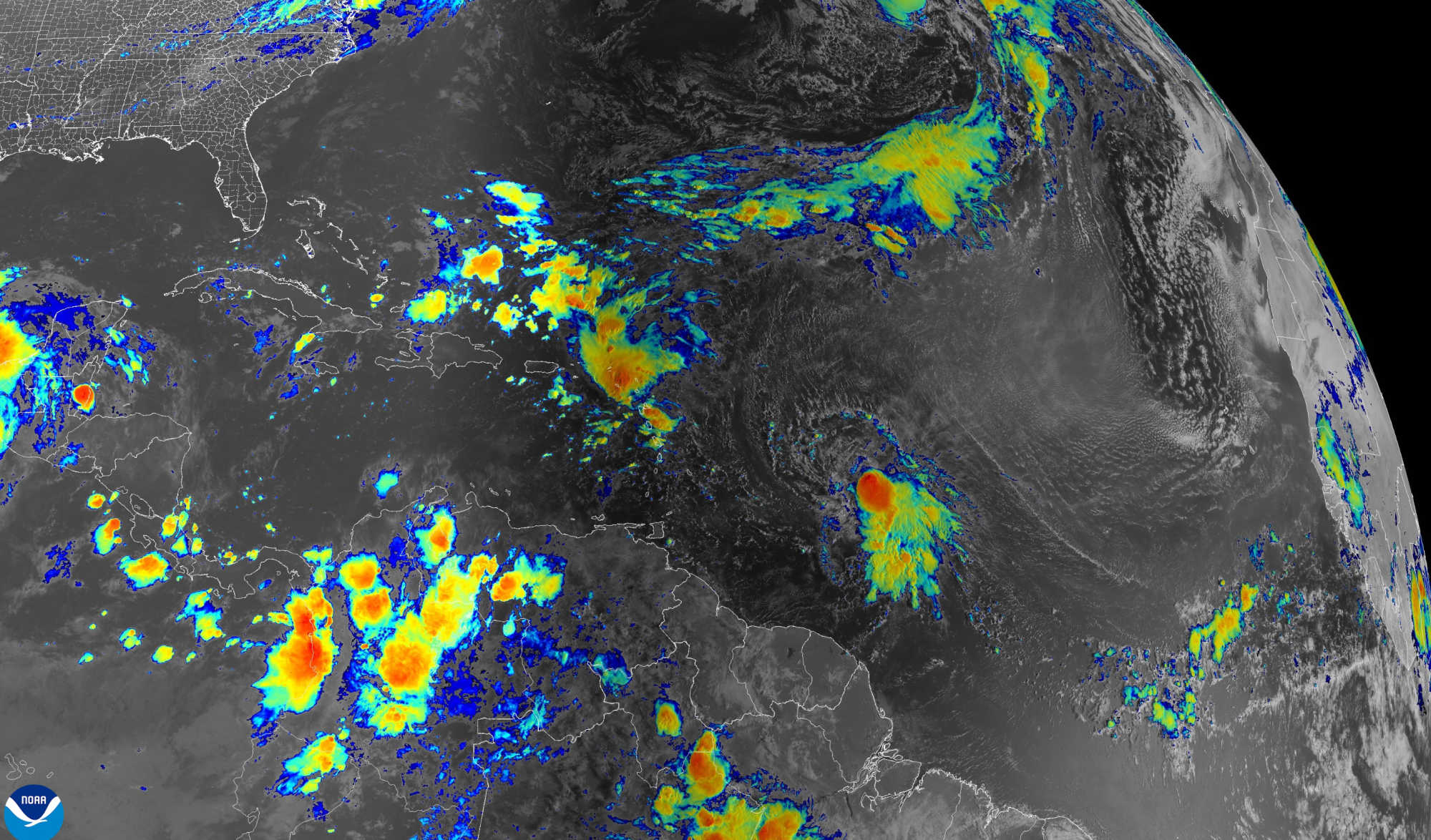
Tropical Storm Jerry is gaining strength in the central Atlantic as it races west-northwest toward the northern Leeward Islands, where tropical storm watches are now in effect. The system could bring rain, gusty winds, and dangerous surf to parts of the Caribbean, including the U.S. Virgin Islands and Puerto Rico, later this week.

According to the National Hurricane Center’s (NHC) 5 a.m. AST update, Jerry’s low-level center remains poorly organized and elongated, with most thunderstorm activity located south and east of the center. Despite this structure, maximum sustained winds have risen to 45 knots (50 mph) with a minimum pressure of 1003 mb. The storm is currently located near latitude 13.3° N, longitude 50.7° W, moving west-northwest at 20 knots (23 mph) under the influence of a strong subtropical ridge.
Path and Intensification Forecast
The NHC projects that Jerry will slow down over the next 24 hours as it moves toward the northern Leeward Islands late Thursday into Friday, before gradually turning northward and accelerating northeastward this weekend. Forecasters expect Jerry to strengthen over warm waters and improved atmospheric conditions, likely becoming a hurricane on Thursday and reaching maximum sustained winds near 80 knots (90 mph) by Saturday.

Watches, Rainfall, and Marine Hazards
Tropical-storm watches are now in effect for Antigua, Barbuda, Anguilla, St. Kitts and Nevis, Montserrat, St. Barthélemy, St. Martin/Sint Maarten, Saba, St. Eustatius, and Guadeloupe.
Jerry could bring tropical storm–force winds to these islands late Thursday into Friday, with rainfall totals between 2 and 4 inches and locally higher amounts possible, especially over elevated terrain. The NHC warns that heavy rain could trigger flash flooding, particularly in mountainous areas.
Large swells generated by Jerry will reach the Lesser Antilles on Thursday and spread westward to the Virgin Islands and Puerto Rico by Friday, creating life-threatening surf and rip-current conditions along east-facing beaches.
Weather Conditions in the USVI and Puerto Rico
For Wednesday, the National Weather Service (NWS) San Juan forecasts another active day of showers and thunderstorms across Puerto Rico and the U.S. Virgin Islands, with limited to elevated flooding risk in northwestern Puerto Rico and minor flooding possible in the USVI. Frequent lightning and gusty winds could accompany storms.
A Heat Advisory remains in effect for coastal and urban areas of Puerto Rico from 10 a.m. to 4 p.m. AST. The NWS also reports precipitable-water values above 2 inches, fueling widespread convective activity. Strong showers are likely over windward areas and interior Puerto Rico, where gusty winds and localized flash floods may occur.
Outlook for Thursday and Friday
As Tropical Storm Jerry approaches, moisture and instability will stay elevated. Early Wednesday, Jerry was located about 975 miles southeast of St. Croix and is expected to make its closest approach approximately 196 miles northeast of St. John by Friday morning, according to NWS projections. While forecasters stress ongoing uncertainty in Jerry’s exact path and strength, they urge residents to closely follow updates from the NHC and NWS.
By Thursday, southeasterly winds will continue to channel moisture into the region, leading to scattered showers over the U.S. Virgin Islands and afternoon thunderstorms across interior and western Puerto Rico. On Friday, as Jerry draws nearer, winds are expected to turn southwesterly, enhancing convection and rainfall.
High moisture levels of 2.25 to 2.50 inches are expected through the weekend as Jerry’s trailing moisture lingers, bringing additional showers, small-stream flooding, quick river rises, and potential landslides in saturated areas. Conditions should gradually improve by Tuesday, when drier air and high pressure build over the region.
Guidance From Forecast Models
Global and regional models, including ECMWF, HWRF, and HCCA, align with the NHC forecast that Jerry will strengthen into a hurricane north of the Leeward Islands later this week. Most models keep its core north of the islands, but slight southward deviations could bring tropical-storm conditions closer to the region. The eventual northward turn depends on the timing of an approaching upper trough, keeping Puerto Rico, the U.S. Virgin Islands, and the northern Leeward Islands within the monitoring zone.
Safety Recommendations
Authorities urge residents to stay vigilant as conditions evolve:
-
Flood Preparedness: Clear drainage systems, avoid low-lying areas, and never attempt to drive through flooded roads.
-
Monitor Updates: Follow official information from the NHC and local NWS offices as watches and warnings may change.
-
Heat Safety: Limit outdoor activity, remain hydrated, and check on vulnerable individuals such as the elderly and young children.
Tropical Storm Jerry continues to strengthen over the central Atlantic and is forecast to become a hurricane by Thursday. The system is expected to pass near or north of the northern Leeward Islands late Thursday into Friday, producing rain, gusty winds, and dangerous surf across portions of the northeastern Caribbean. Even if Jerry’s center remains north of the islands, its outer rainbands could affect Puerto Rico and the U.S. Virgin Islands, where heat, thunderstorms, and localized flooding are already a concern.

Residents are urged to remain alert and monitor official forecasts as Tropical Storm Jerry tracks closer to the region.