

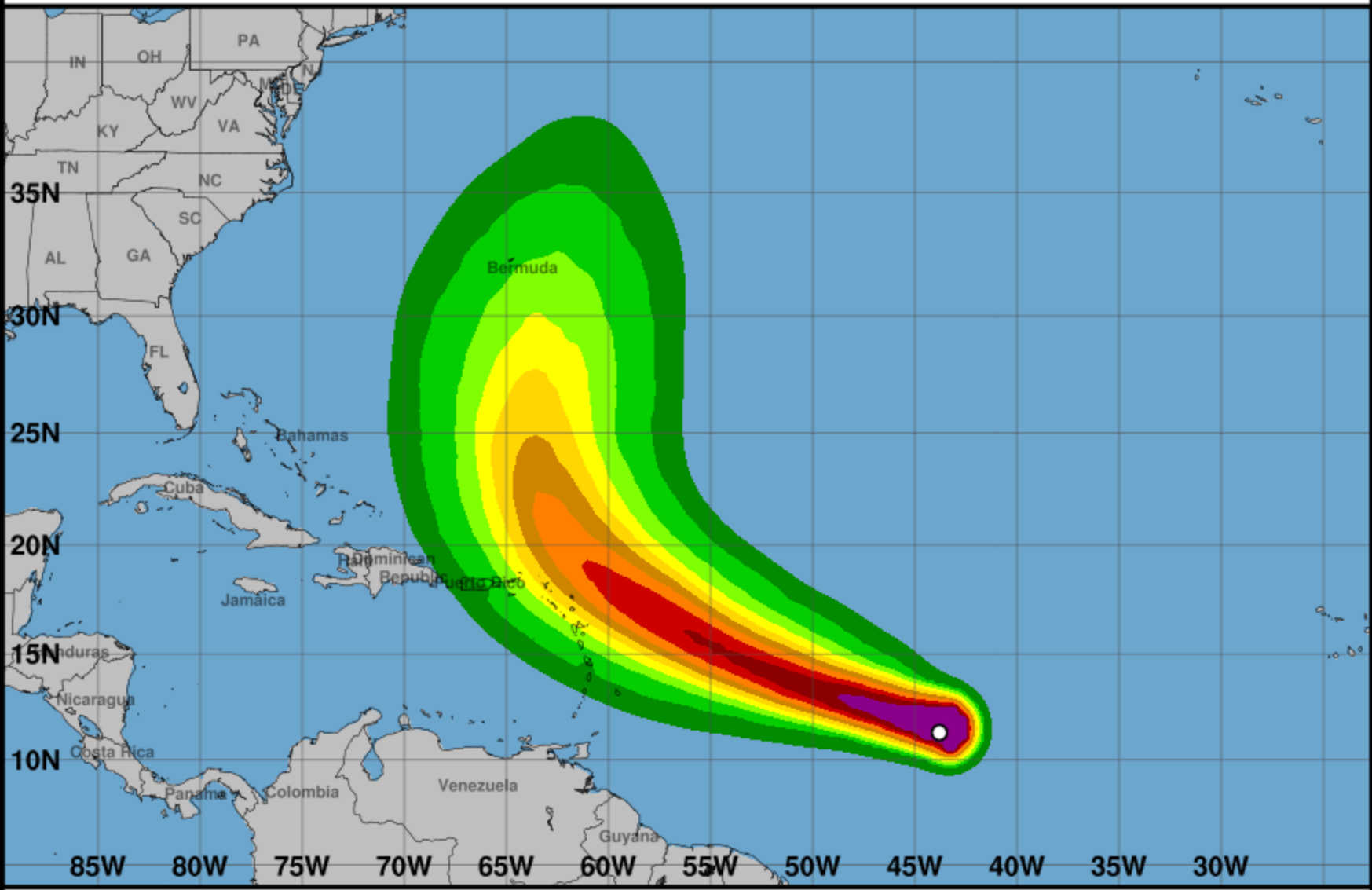
Tropical Storm Jerry has formed in the central Atlantic, becoming the tenth named storm of the season as it moves steadily westward toward the northern Leeward Islands.

According to the National Hurricane Center’s (NHC) 11:00 a.m. advisory, Jerry’s center was located near latitude 11.5°N and longitude 44.6°W, about 1,315 miles east-southeast of the northern Leeward Islands. The system is packing maximum sustained winds of 45 mph with higher gusts, and a minimum central pressure of 1,006 mb. The storm is currently moving west at 24 mph, though forecasters expect its forward speed to slow and its track to shift slightly west-northwest in the coming days.
No watches or warnings have yet been issued, but the NHC warns that tropical storm watches could be posted later today or tonight for the northern Leeward Islands. Swells generated by Jerry are forecast to reach the region by Thursday, producing life-threatening surf and rip current conditions.
Meteorologists say Jerry is situated on the southern edge of a strong subtropical ridge, which is guiding the system westward. As the storm approaches the southwestern edge of the ridge, a turn toward the west-northwest is expected. Later in the week, a deep-layer trough in the western Atlantic is expected to erode the ridge, allowing Jerry to curve northward over the west-central Atlantic.

The NHC forecast projects Jerry to strengthen to a 50 mph tropical storm by Wednesday morning and reach hurricane strength by Wednesday night or early Thursday. By Friday morning, Jerry could have sustained winds near 90 mph, positioning it near 19.8°N, 61.9°W.
The forecast discussion noted that two statistical-dynamical consensus models—HCCA and Google Deep Mind’s ensemble mean—have performed well this season, and the official track is slightly faster than the model consensus through 72 hours.
Both global models (GFS and ECMWF) show Jerry passing near or just north of the northern Leeward Islands late Thursday into Friday, though there remains uncertainty about how close the storm’s core will come to land. Some models show an earlier northward turn, while others maintain a more west-northwest trajectory—differences that could determine whether the islands experience only peripheral effects or a more direct brush.
Forecasters expect steady strengthening, with Jerry likely reaching hurricane intensity within 24 to 48 hours.
Local Impacts for Puerto Rico and the U.S. Virgin Islands
Although Jerry remains far out in the Atlantic, the National Weather Service (NWS) San Juan Forecast Office cautioned that a tropical wave and an upper-level low are already bringing showers and thunderstorms across Puerto Rico and the U.S. Virgin Islands.
The latest Area Forecast Discussion, issued at 8:49 a.m., warns of a limited to elevated flood risk across central, northwestern, and northeastern Puerto Rico, including the San Juan metropolitan area. Forecasters said frequent lightning, gusty winds, and localized flooding are possible in urban and small-stream areas.
For the U.S. Virgin Islands, similar conditions are possible, with occasional thunderstorms and minor flooding. However, the primary concern is the prolonged heat, which is expected to intensify midweek and persist through the weekend. The NWS advised residents to limit outdoor activity and stay hydrated as heat indices rise.
Even before Jerry’s arrival, the region’s unstable weather and elevated heat underscore the need for residents to stay alert and prepared for changing conditions.
Marine Conditions
The NWS marine forecast calls for east winds between 10 and 15 knots, diminishing to 5–10 knots later today, with seas of 5 to 6 feet north of Puerto Rico and the U.S. Virgin Islands. Mariners should anticipate numerous showers and isolated thunderstorms, along with the likelihood of worsening conditions as Jerry’s swells approach by late week.
By Thursday, swells from Jerry are expected to reach local waters, increasing the risk of rough seas and rip currents.
Preparedness and Safety Tips
Officials urge residents and visitors across Puerto Rico, the U.S. Virgin Islands, and the northern Leeward Islands to remain vigilant and take the following precautions:
Avoid hazardous waters: Swells from Jerry will create dangerous surf and rip current conditions by Thursday.
Stay alert to rainfall and flooding: Even before Jerry arrives, thunderstorms associated with a tropical wave may cause localized flooding.

Take heat precautions: Continue to stay hydrated, check on vulnerable individuals, and minimize outdoor activities during peak heat hours.